
[Paper Review] LLM-Adapters: An Adapter Family for Parameter-Efficient Fine-Tuning of Large Language Models
The paper introduces LLM-Adapters, a framework integrating PEFT adapters into open-source LLMs, and provides an empirical study of adapter types, placements, and hyperparameters on math and commonsense reasoning tasks, showing smaller models with adapters can match or exceed large models in specific settings.
The success of large language models (LLMs), like GPT-4 and ChatGPT, has led to the development of numerous cost-effective and accessible alternatives that are created by finetuning open-access LLMs with task-specific data (e.g., ChatDoctor) or instruction data (e.g., Alpaca). Among the various fine-tuning methods, adapter-based parameter-efficient fine-tuning (PEFT) is undoubtedly one of the most attractive topics, as it only requires fine-tuning a few external parameters instead of the entire LLMs while achieving comparable or even better performance. To enable further research on PEFT methods of LLMs, this paper presents LLM-Adapters, an easy-to-use framework that integrates various adapters into LLMs and can execute these adapter-based PEFT methods of LLMs for different tasks. The framework includes state-of-the-art open-access LLMs such as LLaMA, BLOOM, and GPT-J, as well as widely used adapters such as Series adapters, Parallel adapter, Prompt-based learning and Reparametrization-based methods. Moreover, we conduct extensive empirical studies on the impact of adapter types, placement locations, and hyper-parameters to the best design for each adapter-based methods. We evaluate the effectiveness of the adapters on fourteen datasets from two different reasoning tasks, Arithmetic Reasoning and Commonsense Reasoning. The results demonstrate that using adapter-based PEFT in smaller-scale LLMs (7B) with few extra trainable parameters yields comparable, and in some cases superior, performance to powerful LLMs (175B) in zero-shot inference on both reasoning tasks.
Motivation & Objective
- Motivate and enable PEFT in LLMs by integrating diverse adapters into a unified framework.
- Investigate optimal adapter placements and configurations across tasks and models.
- Evaluate adapter-based PEFT on math reasoning and commonsense reasoning datasets using open-source LLMs.
Proposed method
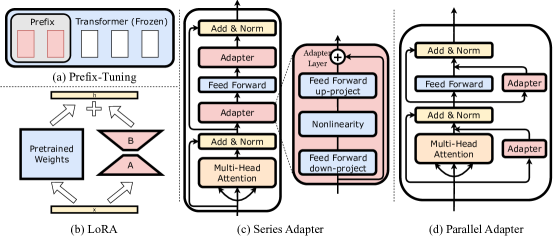
- Develop the LLM-Adapter framework to integrate Prefix-Tuning, Series Adapter, LoRA, and Parallel Adapter into LLMs.
- Conduct placement experiments to identify best locations for Series, Parallel, and LoRA adapters.
- Tune hyperparameters (vt for Prefix-Tuning; bn for Series/Parallel adapters; r for LoRA) to find optimal settings.
- Create Math10K and Commonsense170K fine-tuning datasets using teacher-generated rationales and task templates.
- Fine-tune 7B/13B open LLMs (LLaMA, BLOOMz, GPT-J) with selected PEFT methods and evaluate on 14 datasets spanning Arithmetic and Commonsense reasoning.
- Compare PEFT results to baselines including GPT-3.5 (175B) and ChatGPT.
Experimental results
Research questions
- RQ1What is the optimal placement and configuration of different PEFT methods?
- RQ2How do different adapters perform across downstream tasks?
- RQ3What are the differences in performance between in-distribution and out-of-distribution scenarios for PEFT methods?
Key findings
- Optimal placements: Series Adapter after MLP layers; Parallel Adapter within MLP layers; LoRA after both Attention and MLP layers.
- Smaller LLMs with PEFT can outperform larger models on simpler math tasks (e.g., LLaMA-13B with LoRA vs GPT-3.5 on MultiArith, AddSub, SingleEq).
- LLaMA-13B with LoRA achieves 65.4% average on six math datasets, approaching GPT-3.5 performance (≈92.8% of GPT-3.5) on those tasks.
- In commonsense reasoning, LLaMA-13B with Series/Parallel/LoRA adapters outperform baselines, with Parallel achieving an average of 81.5%, surpassing ChatGPT by about 4.5 percentage points.
- All three adapters on LLaMA-13B yield strong results on Commonsense170K, with Parallel Adapter achieving the highest average (81.5%) among the three.
Read this paper
Open the full text in the Nubint reader and ask about any passage as you read.
Read this paper on NubintThis review was generated by AI from the original paper. Please check the paper before citing it.