
[Paper Review] LLM-Based Human-Robot Collaboration Framework for Manipulation Tasks
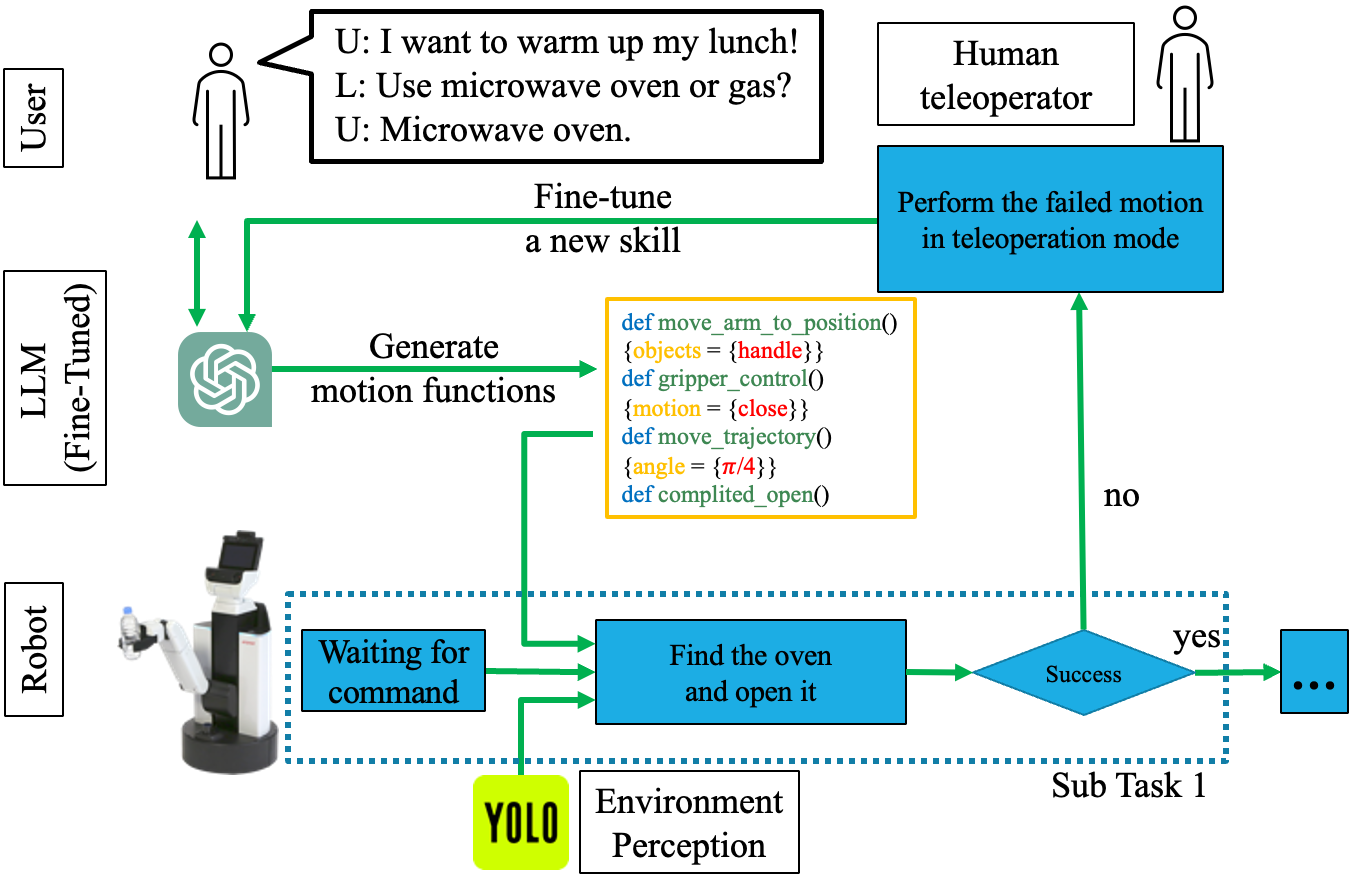
This paper proposes an LLM-based human-robot collaboration framework that translates high-level natural language commands into executable motion sequences using hierarchical task decomposition. By integrating YOLO-based perception, DMP-based teleoperation for error correction, and LLM-driven planning, the system achieves improved task feasibility and generalizability, with success rates exceeding 80% for short-horizon tasks and DMP correction enabling completion of previously infeasible actions like catching a bowl.
This paper presents a novel approach to enhance autonomous robotic manipulation using the Large Language Model (LLM) for logical inference, converting high-level language commands into sequences of executable motion functions. The proposed system combines the advantage of LLM with YOLO-based environmental perception to enable robots to autonomously make reasonable decisions and task planning based on the given commands. Additionally, to address the potential inaccuracies or illogical actions arising from LLM, a combination of teleoperation and Dynamic Movement Primitives (DMP) is employed for action correction. This integration aims to improve the practicality and generalizability of the LLM-based human-robot collaboration system.
Motivation & Objective
- To enhance robotic task planning for household manipulation by enabling interpretation of high-level natural language commands.
- To address inaccuracies in LLM-generated motion sequences through human-in-the-loop teleoperation and DMP-based trajectory learning.
- To improve system generalizability and feasibility by combining LLM reasoning with real-time environmental perception and motion correction.
- To develop a hierarchical task decomposition strategy that separates long-horizon tasks into manageable short-horizon subtasks.
- To enable seamless human-robot collaboration by dynamically switching between autonomous LLM planning and human-guided correction.
Proposed method
- The system uses GPT-2 fine-tuned on a task-specific corpus to map natural language commands to executable motion functions.
- A hierarchical task structure decomposes long-horizon tasks (over 10 functions) into short-horizon subtasks (under 10 functions), which are then mapped to individual motion functions.
- YOLO-based object detection provides real-time, accurate object position tracking, which is integrated into the LLM’s planning process.
- When LLM-generated actions are infeasible, the system switches to teleoperation via a VR interface to capture human demonstrations.
- Dynamic Movement Primitives (DMPs) are used to model and reproduce the teleoperated trajectories, enabling robust and generalizable motion execution.
- The framework integrates LLM planning, perception, teleoperation, and DMP correction into a unified interactive loop for human-robot collaboration.
Experimental results
Research questions
- RQ1Can LLMs effectively decompose high-level language commands into executable motion sequences for robotic manipulation?
- RQ2How can LLM-generated motion plans be corrected when they are infeasible or inaccurate?
- RQ3To what extent does integrating real-time YOLO-based perception improve task execution accuracy?
- RQ4Can DMP-based teleoperation improve the feasibility and generalizability of LLM-driven robotic actions?
- RQ5What is the impact of hierarchical task decomposition on the success rate of long-horizon manipulation tasks?
Key findings
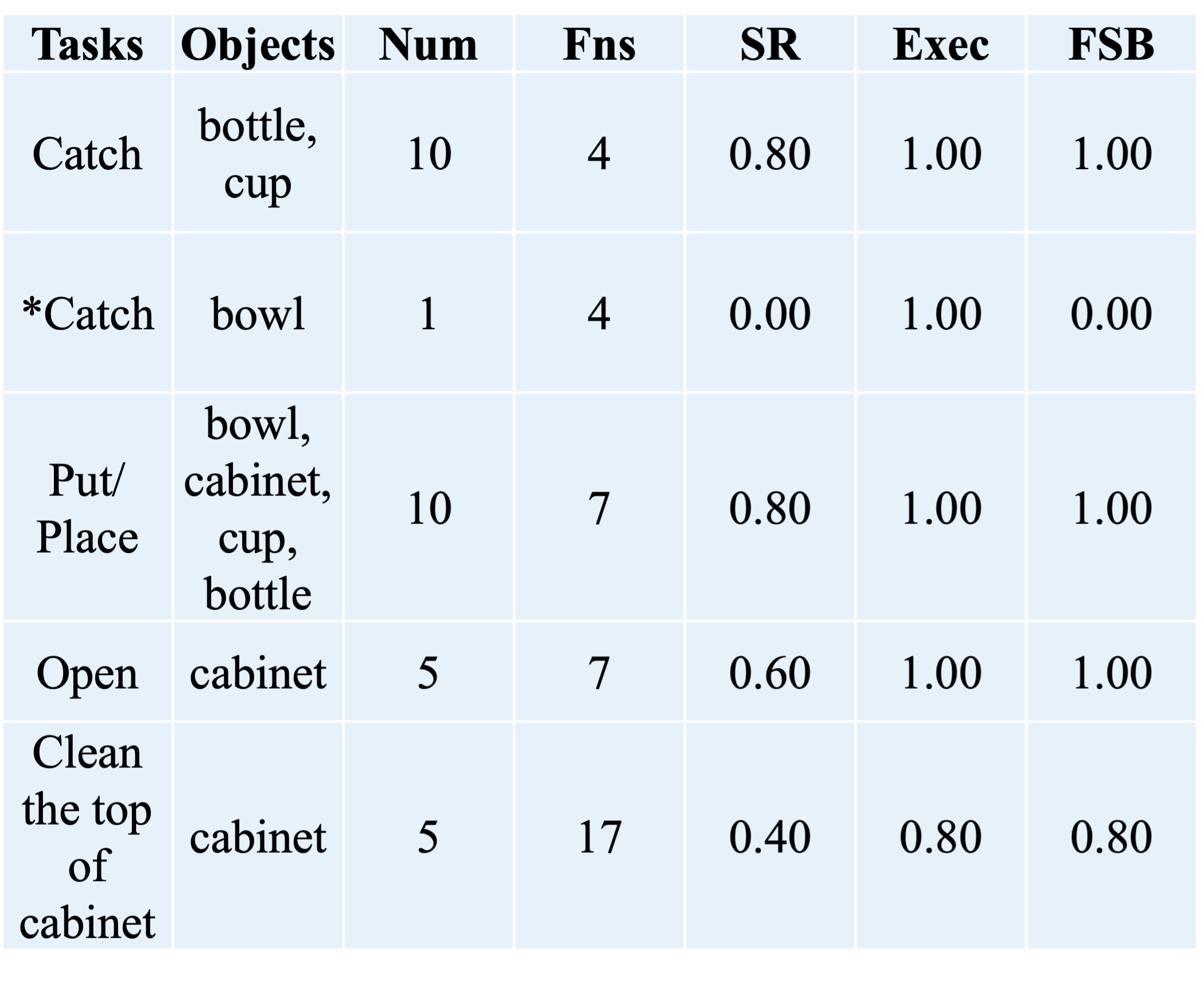
- The system achieved a success rate of 0.80 for the long-horizon task 'clean the top of the cabinet,' indicating reasonable performance for complex sequences.
- The 'catch the bowl' task had a feasibility score (FSB) of 0.00 when relying solely on LLM-generated functions, demonstrating the limitations of default motion primitives.
- DMP-based teleoperation correction successfully enabled the completion of the 'catch the bowl' task, demonstrating the effectiveness of human-in-the-loop correction.
- The system's executability (Exec) was 0.80 for 'clean the top of the cabinet,' with the remaining 20% failure attributed to LLM randomness in function generation.
- Short-horizon tasks like 'catch', 'put', and 'open' showed high success rates, confirming the framework's effectiveness for simpler actions.
- Error accumulation in long-horizon tasks remains a challenge, indicating a need for improved correction mechanisms and fine-tuning of teleoperation inputs.
Read this paper
Open the full text in the Nubint reader and ask about any passage as you read.
Read this paper on NubintThis review was generated by AI from the original paper. Please check the paper before citing it.