
[Paper Review] LLM-Blender: Ensembling Large Language Models with Pairwise Ranking and Generative Fusion
LLM-Blender ensembles open-source LLMs by pairing a pairwise ranking module (PairRanker) with a generative fusion module (GenFuser) and introduces MixInstruct as a benchmark for this task. It achieves superior performance over individual models and baseline ensembling methods.
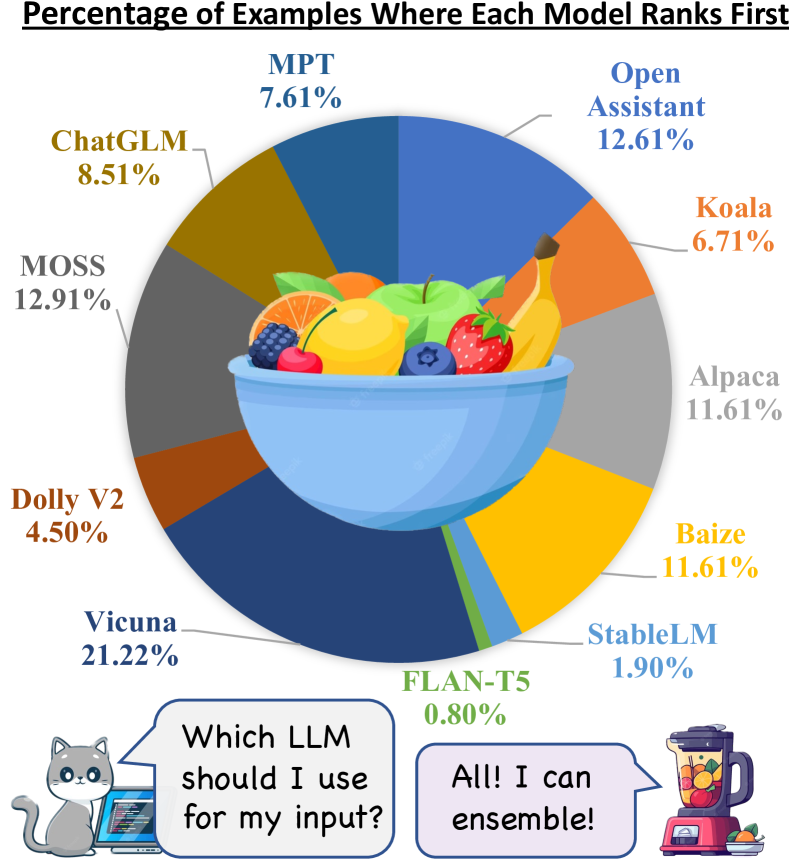
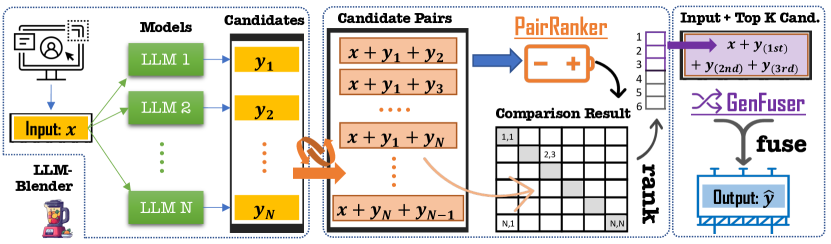
We present LLM-Blender, an ensembling framework designed to attain consistently superior performance by leveraging the diverse strengths of multiple open-source large language models (LLMs). Our framework consists of two modules: PairRanker and GenFuser, addressing the observation that optimal LLMs for different examples can significantly vary. PairRanker employs a specialized pairwise comparison method to distinguish subtle differences between candidate outputs. It jointly encodes the input text and a pair of candidates, using cross-attention encoders to determine the superior one. Our results demonstrate that PairRanker exhibits the highest correlation with ChatGPT-based ranking. Then, GenFuser aims to merge the top-ranked candidates, generating an improved output by capitalizing on their strengths and mitigating their weaknesses. To facilitate large-scale evaluation, we introduce a benchmark dataset, MixInstruct, which is a mixture of multiple instruction datasets featuring oracle pairwise comparisons. Our LLM-Blender significantly outperform individual LLMs and baseline methods across various metrics, establishing a substantial performance gap.
Motivation & Objective
- Motivate dynamic ensembling of diverse open-source LLMs to outperform any single model.
- Develop a pairwise ranking module that captures subtle differences between candidate outputs.
- Create a generative fusion module to synthesize top candidates into a superior final output.
- Provide MixInstruct as a benchmark for evaluating LLM ensembling with oracle pairwise comparisons.
- Demonstrate that ensembling yields robustness and alignment improvements across instruction-following tasks.
Proposed method
- PairRanker jointly encodes input and a pair of candidate outputs with cross-attention to learn pairwise superiority.
- Construct a pairwise comparison matrix across all candidate pairs and derive a ranking from it.
- Use MaxLogits (default) aggregation to select the top candidate efficiently in O(N) time.
- GenFuser takes the input and the top-K ranked candidates and generates a final output via a seq2seq model (Flan-T5-XL used in experiments).
- MixInstruct provides training data with oracle-style pairwise comparisons to supervise PairRanker and evaluate ensembling performance.
Experimental results
Research questions
- RQ1Can pairwise candidate comparisons better identify the highest-quality output among many LLM candidates than traditional pointwise scoring?
- RQ2Does fusion of the top-K ranked candidates yield outputs superior to any single candidate or simple re-ranking?
- RQ3How does the LLM- Blender framework perform on instruction-following tasks compared to individual LLMs and existing baselines?
- RQ4Is MixInstruct an effective benchmark for evaluating LLM ensembling methods across diverse instruction tasks?
- RQ5What is the correlation between automated metrics (BERTScore, BLEURT, BARTScore) and GPT-based ranking (GPT-Rank) in this setting?
Key findings
- PairRanker achieves the highest correlation with GPT-Rank among ranking methods, outperforming SummaReranker and SimCLS.
- LLM- Blender with top-3 PairRanker selections plus GenFuser yields superior GPT-Rank and NLG metrics compared to the best single LLMs.
- On MixInstruct, LLM- Blender with PR(K=3) + GF attains GPT-Rank 3.01, BERTScore 79.09, BARTScore -3.02, BLEURT -0.17, Top-3 percentage 68.59, and higher shares of outputs beating OA and Vicuna.
- PairRanker alone improves over the best individual model, achieving GPT-Rank 3.20 and Top-3 65.12%, indicating effective per-example model selection.
- BARTScore shows strong correlation with GPT-Rank among evaluation metrics, supporting its use for supervision in PairRanker training.
Read this paper
Open the full text in the Nubint reader and ask about any passage as you read.
Read this paper on NubintThis review was generated by AI from the original paper. Please check the paper before citing it.