
[Paper Review] LLM Comparative Assessment: Zero-shot NLG Evaluation through Pairwise Comparisons using Large Language Models
This paper proposes a zero-shot, pairwise comparative assessment method using large language models (LLMs) for automatic natural language generation (NLG) evaluation. By prompting LLMs to compare two NLG outputs at a time rather than assigning absolute scores, the approach achieves superior performance—especially with moderate-sized open-source models like FlanT5 and Llama2—while also identifying and mitigating strong positional biases through a debiasing technique.
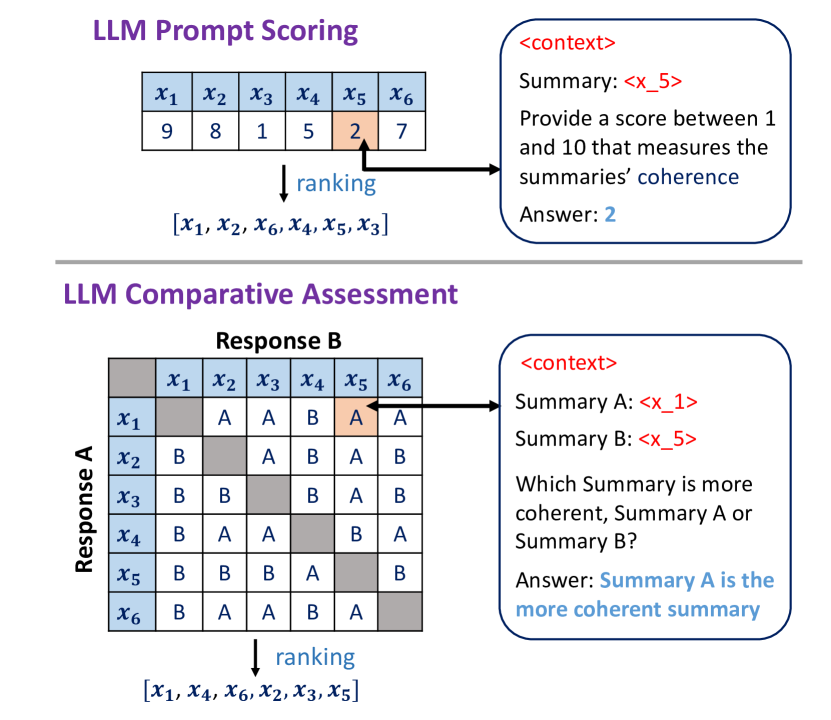
Current developments in large language models (LLMs) have enabled impressive zero-shot capabilities across various natural language tasks. An interesting application of these systems is in the automated assessment of natural language generation (NLG), a highly challenging area with great practical benefit. In this paper, we explore two options for exploiting the emergent abilities of LLMs for zero-shot NLG assessment: absolute score prediction, and comparative assessment which uses relative comparisons between pairs of candidates. Though comparative assessment has not been extensively studied in NLG assessment, we note that humans often find it more intuitive to compare two options rather than scoring each one independently. This work examines comparative assessment from multiple perspectives: performance compared to absolute grading; positional biases in the prompt; and efficient ranking in terms of the number of comparisons. We illustrate that LLM comparative assessment is a simple, general and effective approach for NLG assessment. For moderate-sized open-source LLMs, such as FlanT5 and Llama2-chat, comparative assessment is superior to prompt scoring, and in many cases can achieve performance competitive with state-of-the-art methods. Additionally, we demonstrate that LLMs often exhibit strong positional biases when making pairwise comparisons, and we propose debiasing methods that can further improve performance.
Motivation & Objective
- To investigate whether pairwise comparison between NLG outputs is more effective than absolute scoring for zero-shot NLG evaluation using LLMs.
- To evaluate the performance of comparative assessment across diverse NLG tasks and attributes using moderate-sized open-source LLMs.
- To identify and address positional bias in LLM-based pairwise comparisons, which can distort ranking outcomes.
- To assess the efficiency of subset comparison selection strategies for scalable and accurate ranking with minimal comparisons.
- To demonstrate that comparative assessment can achieve state-of-the-art or near-state-of-the-art performance without human-annotated references.
Proposed method
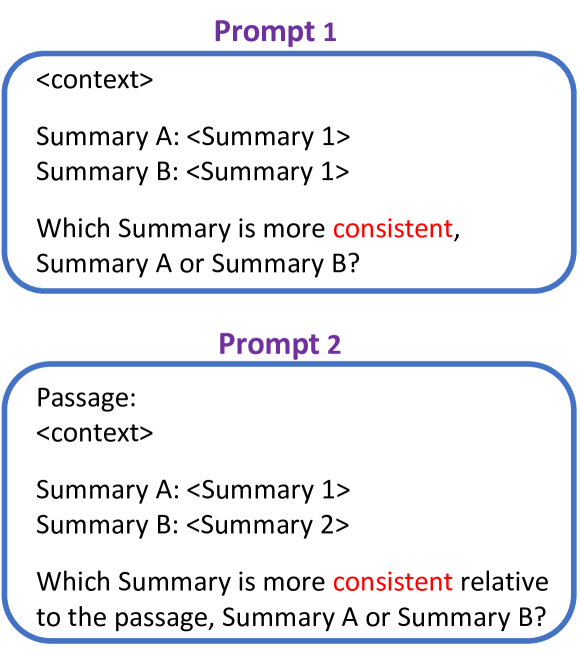
- Use a zero-shot prompting strategy where an LLM is asked to compare two NLG outputs and select the better one based on a specific attribute (e.g., coherence, fluency).
- Convert pairwise comparison results into a ranking via transitive inference or sorting algorithms, enabling full system comparison across multiple candidates.
- Implement a debiasing method that reverses the order of candidate pairs and averages predictions to reduce positional bias.
- Evaluate comparison selection strategies: random, no-repeat, and symmetric (bidirectional comparisons) to minimize computational cost while preserving ranking accuracy.
- Use Spearman correlation and pairwise accuracy metrics to evaluate ranking quality against gold-standard human scores.
- Apply the framework across multiple NLG benchmarks, including SummEval, for diverse attributes like coherence, fluency, and relevance.
Experimental results
Research questions
- RQ1Does pairwise comparative assessment outperform absolute score prediction in zero-shot NLG evaluation for moderate-sized LLMs?
- RQ2To what extent do positional biases in LLM comparisons affect ranking performance, and can they be effectively mitigated?
- RQ3How efficient is the ranking process when only a subset of pairwise comparisons are used, and which selection strategy yields the best trade-off between cost and accuracy?
- RQ4Can comparative assessment achieve performance competitive with state-of-the-art automatic evaluation methods across diverse NLG attributes and tasks?
- RQ5How consistent are LLM-based pairwise comparisons across different subsets of candidates, and does self-consistency improve with more comparisons?
Key findings
- Comparative assessment significantly outperforms prompt-scoring for moderate-sized LLMs such as FlanT5-xl and Llama2-chat, achieving state-of-the-art or near-state-of-the-art performance on multiple NLG attributes.
- Pairwise comparison accuracy ranged from 60% to 80% across tasks, with debiasing improving accuracy substantially, especially in high-bias scenarios.
- Self-consistency analysis showed that rankings based on just 8 out of 16 summaries achieved 95.5% accuracy relative to full rankings, indicating strong stability with few comparisons.
- The symmetric comparison selection scheme achieved nearly identical performance to no-repeat selection but used only half the number of comparisons, making it more efficient.
- Debiasing methods led to notable performance gains, particularly when only a small number of comparisons were available, highlighting the impact of positional bias.
- Even with limited comparisons (e.g., R < 100), the method maintained high Spearman correlation (e.g., >0.93 for COH on SummEval), demonstrating scalability and robustness.
Read this paper
Open the full text in the Nubint reader and ask about any passage as you read.
Read this paper on NubintThis review was generated by AI from the original paper. Please check the paper before citing it.