
[Paper Review] LLM-GAN: Construct Generative Adversarial Network Through Large Language Models For Explainable Fake News Detection
LLM-GAN proposes a novel framework that leverages large language models (LLMs) as both generator and detector in a generative adversarial network to enable explainable fake news detection. By employing inter-adversary prompting to simulate realistic fake news and self-reflection prompting to iteratively correct detection errors, LLM-GAN achieves state-of-the-art performance in both detection accuracy and explanation quality, outperforming existing methods on real-world datasets.
Explainable fake news detection predicts the authenticity of news items with annotated explanations. Today, Large Language Models (LLMs) are known for their powerful natural language understanding and explanation generation abilities. However, presenting LLMs for explainable fake news detection remains two main challenges. Firstly, fake news appears reasonable and could easily mislead LLMs, leaving them unable to understand the complex news-faking process. Secondly, utilizing LLMs for this task would generate both correct and incorrect explanations, which necessitates abundant labor in the loop. In this paper, we propose LLM-GAN, a novel framework that utilizes prompting mechanisms to enable an LLM to become Generator and Detector and for realistic fake news generation and detection. Our results demonstrate LLM-GAN's effectiveness in both prediction performance and explanation quality. We further showcase the integration of LLM-GAN to a cloud-native AI platform to provide better fake news detection service in the cloud.
Motivation & Objective
- To address the challenge of explainable fake news detection using large language models (LLMs), which often misclassify deceptive yet coherent fake news due to confirmatory bias.
- To overcome the high human annotation cost in generating reliable explanations by automating error correction through self-reflection prompting.
- To enhance LLM-based detection by simulating the complex, stochastic news-faking process via adversarial generation of fake content.
- To integrate the LLM-GAN framework into a cloud-native AI platform for scalable, real-world deployment with human-readable explanations.
Proposed method
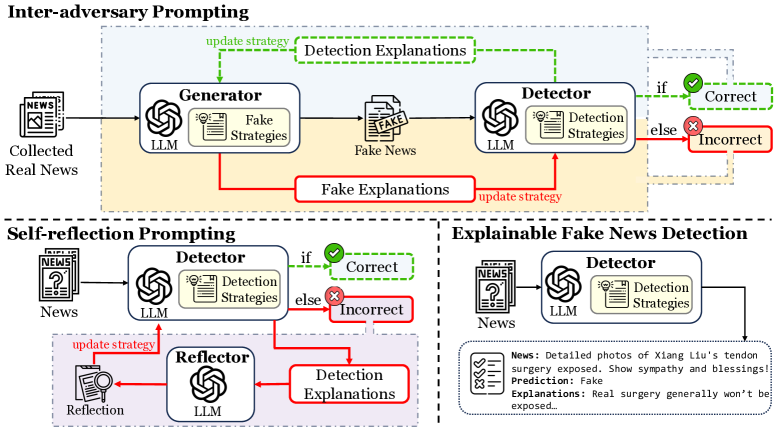
- Inter-adversary prompting: Uses an LLM as a generator to produce highly deceptive fake news based on real news inputs, forcing the LLM detector to learn from adversarial examples.
- Self-reflection prompting: Enables the detector to analyze its own past predictions and errors using verbalized, evidence-based reflections, allowing autonomous self-improvement without human intervention.
- The framework integrates two LLMs—one as generator (to create fake news) and one as detector (to classify authenticity and generate explanations)—in a dual-loop adversarial training mechanism.
- The system uses few-shot and chain-of-thought (CoT) prompting techniques to enhance the detector’s reasoning and generalization, with ablation studies validating their effectiveness.
- Ablation studies confirm that removing self-reflection prompting significantly degrades performance, proving its necessity for error correction and robustness.
- The model is deployed on a cloud-native AI platform (Alibaba Cloud) to support scalable, on-demand inference with WebUI access for journalists and experts.
Experimental results
Research questions
- RQ1Can LLMs be effectively prompted to serve as both generator and detector in a GAN-like framework for fake news detection?
- RQ2How does inter-adversary prompting—using LLMs to generate deceptive fake news—improve the detector’s ability to recognize subtle fake news patterns?
- RQ3To what extent can self-reflection prompting enable LLM detectors to autonomously correct their own mistakes without human labeling?
- RQ4Does the integration of explainable reasoning improve user trust and usability in real-world fake news detection systems?
- RQ5How does LLM-GAN compare to existing deep learning and LLM-based fake detection methods in terms of accuracy, fairness, and explanation quality?
Key findings
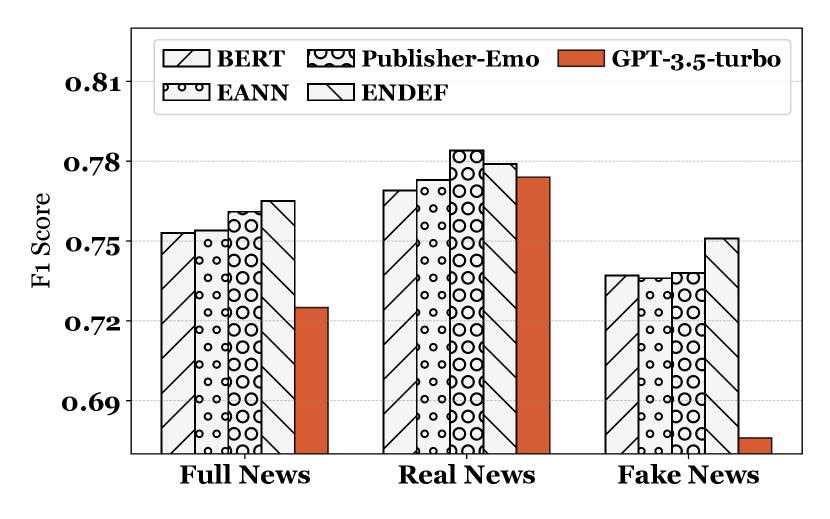
- LLM-GAN achieves a macro-F1 score of 0.804 on the GossipCop dataset and 0.806 on Weibo21 using few-shot CoT prompting, significantly outperforming baseline methods.
- The self-reflection prompting component reduces performance degradation when removed, with a drop in macro-F1 from 0.804 to 0.760 on Weibo21, proving its critical role in error correction.
- Inter-adversary prompting improves F1-fake scores substantially, demonstrating that exposure to adversarial fake news enhances detection of deceptive content.
- LLM-GAN achieves higher scores than GPT-3.5-turbo across all evaluation metrics, including relevance (5.7 vs. 4.1), accuracy (6.1 vs. 4.7), and contextual understanding (6.0 vs. 5.8).
- The ablation study confirms that few-shot prompting with CoT yields the best performance, especially on GossipCop, though CoT can occasionally reduce performance, indicating sensitivity to prompt design.
- Integration into a cloud-native AI platform enables dynamic scaling and real-time inference, with users receiving both predictions and human-readable explanations, enhancing trust and usability.
Read this paper
Open the full text in the Nubint reader and ask about any passage as you read.
Read this paper on NubintThis review was generated by AI from the original paper. Please check the paper before citing it.