
[Paper Review] LLM+P: Empowering Large Language Models with Optimal Planning Proficiency
LLM+P couples large language models with classical planners to translate natural language planning problems into PDDL, solve them optimally with a planner, and translate the plan back to natural language, achieving superior planning performance over plain LLMs.
Large language models (LLMs) have demonstrated remarkable zero-shot generalization abilities: state-of-the-art chatbots can provide plausible answers to many common questions that arise in daily life. However, so far, LLMs cannot reliably solve long-horizon planning problems. By contrast, classical planners, once a problem is given in a formatted way, can use efficient search algorithms to quickly identify correct, or even optimal, plans. In an effort to get the best of both worlds, this paper introduces LLM+P, the first framework that incorporates the strengths of classical planners into LLMs. LLM+P takes in a natural language description of a planning problem, then returns a correct (or optimal) plan for solving that problem in natural language. LLM+P does so by first converting the language description into a file written in the planning domain definition language (PDDL), then leveraging classical planners to quickly find a solution, and then translating the found solution back into natural language. Along with LLM+P, we define a diverse set of different benchmark problems taken from common planning scenarios. Via a comprehensive set of experiments on these benchmark problems, we find that LLM+P is able to provide optimal solutions for most problems, while LLMs fail to provide even feasible plans for most problems.\footnote{The code and results are publicly available at https://github.com/Cranial-XIX/llm-pddl.git.
Motivation & Objective
- Motivate the need for reliable long-horizon planning in robotics and demonstrate how classical planners can provide optimal solutions.
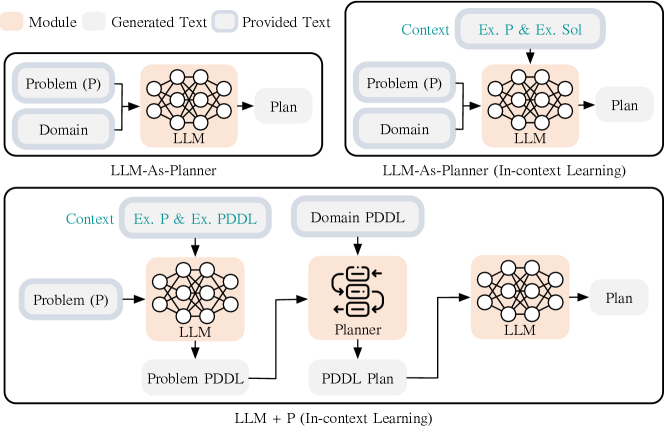
- Propose a pipeline (LLM+P) that converts natural language planning problems into PDDL, leverages a classical planner, and translates back to natural language.
- Show that LLM+P outperforms LLM-only planning and LLM-based search methods across diverse robot planning domains.
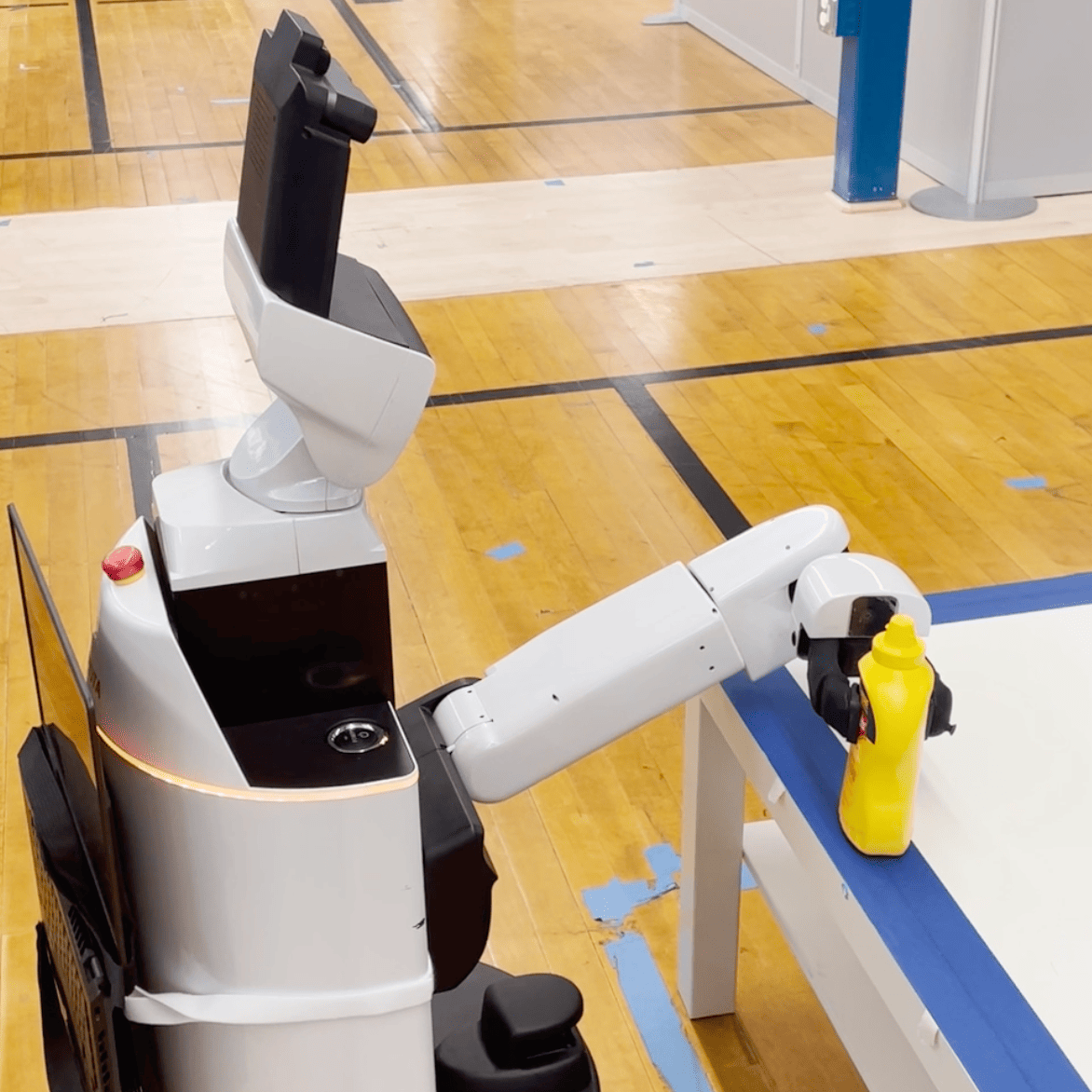
- Provide a realistic robot demonstration to validate practical applicability in home robotics.
Proposed method
- Use an LLM to translate a natural language planning problem into a PDDL problem file (domain and problem).
- Use a supplied domain PDDL (from a human expert) and feed the generated problem PDDL to a classical planner to obtain a plan, optimally when possible.
- Translate the generated PDDL plan back into natural language for user understanding or action execution.
- Comparison with baselines: LLM-as-P and Tree of Thoughts to assess planning feasibility and optimality.
- Evaluate with seven IPC-inspired domains and 20 tasks per domain, plus a real-robot tidying task demonstration.
Experimental results
Research questions
- RQ1Can state-of-the-art LLMs directly solve long-horizon planning problems (planning feasibility and optimality)?
- RQ2Does integrating a classical planner via LLM+P improve planning success and optimality across multiple domains?
- RQ3How crucial is context (example problem and problem PDDL) for LLM+P performance?
- RQ4Can LLM+P enable a home robot to perform realistic manipulation tasks efficiently from natural language prompts?
Key findings
- LLM-as-P often produces plans in natural language that are not feasible due to lack of precondition reasoning.
- LLM+P yields optimal plans for the majority of problems; most failures are due to mis-specified problem files rather than planner limitations.
- Context (problem-example pair) is crucial for LLM+P to generate correct PDDL problem files.
- LLM+P demonstrates practical effectiveness in a real home-robot tidying task, achieving lower cost than an LLM-only approach.
Better researchstarts right now
From reading papers to final review, dramatically reduce your research time.
No credit card · Free plan available
This review was created by AI and reviewed by human editors.