
[Paper Review] LLM-Planner: Few-Shot Grounded Planning for Embodied Agents with Large Language Models
LLM-Planner proposes a few-shot, grounded planning framework for embodied agents using large language models (LLMs) to generate and dynamically re-plan high-level plans based on real-time environmental observations. By integrating physical grounding through dynamic in-context example retrieval and logit biases, it achieves competitive performance—matching full-data baselines—using less than 0.5% of training data on the ALFRED benchmark.
This study focuses on using large language models (LLMs) as a planner for embodied agents that can follow natural language instructions to complete complex tasks in a visually-perceived environment. The high data cost and poor sample efficiency of existing methods hinders the development of versatile agents that are capable of many tasks and can learn new tasks quickly. In this work, we propose a novel method, LLM-Planner, that harnesses the power of large language models to do few-shot planning for embodied agents. We further propose a simple but effective way to enhance LLMs with physical grounding to generate and update plans that are grounded in the current environment. Experiments on the ALFRED dataset show that our method can achieve very competitive few-shot performance: Despite using less than 0.5% of paired training data, LLM-Planner achieves competitive performance with recent baselines that are trained using the full training data. Existing methods can barely complete any task successfully under the same few-shot setting. Our work opens the door for developing versatile and sample-efficient embodied agents that can quickly learn many tasks. Website: https://dki-lab.github.io/LLM-Planner
Motivation & Objective
- Address the high data cost and poor sample efficiency of existing embodied AI agents that require large amounts of labeled instruction-trajectory pairs.
- Enable versatile, sample-efficient agents capable of learning new tasks quickly with few demonstrations.
- Overcome limitations of static LLM-generated plans by introducing dynamic re-planning based on real-time environmental perception.
- Improve plan grounding by integrating environmental observations and object detection into LLM prompting via retrieval and logit bias mechanisms.
- Develop a planner that functions effectively in diverse, partially-observable environments without prior knowledge of all possible objects or actions.
Proposed method
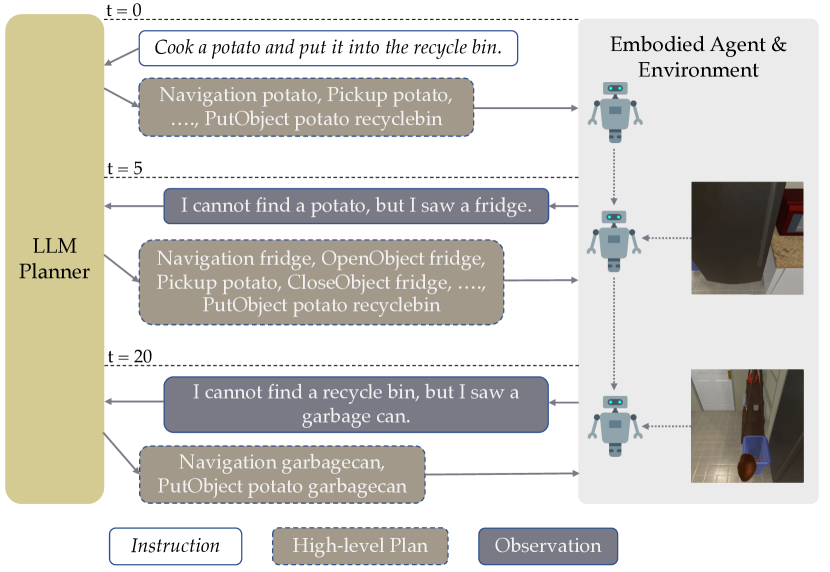
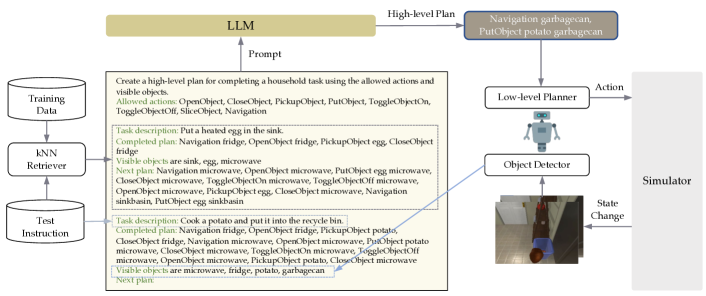
- Use a hierarchical planning architecture with a high-level planner (LLM) and a low-level planner (simulator-trained) to decouple high-level goal planning from primitive action execution.
- Employ in-context learning with few-shot exemplars (instruction, high-level plan pairs) to prompt the LLM without fine-tuning or parameter updates.
- Introduce a kNN-based dynamic in-context example retrieval mechanism to select relevant demonstrations based on instruction and observation similarity.
- Apply logit bias techniques to favor objects detected in the current environment, improving plan grounding and disambiguation of object references.
- Implement dynamic re-planning: when the agent fails, the LLM re-generates the plan using current observations, enabling adaptive, environment-grounded planning.
- Leverage commonsense knowledge from the LLM to infer plausible subgoals (e.g., 'food is often in the fridge') and improve plan robustness.
Experimental results
Research questions
- RQ1Can LLM-based planning achieve competitive performance in embodied instruction following with less than 0.5% of the full training data?
- RQ2How effective is dynamic re-planning based on environmental perception in improving plan grounding and task success?
- RQ3To what extent do dynamic in-context example retrieval and logit bias techniques enhance LLM-planner performance in few-shot settings?
- RQ4Can LLM-Planner generalize across diverse, partially-observable environments without prior knowledge of object types or actions?
- RQ5How does grounded re-planning compare to static planning in terms of success rate and robustness under few-shot and unseen conditions?
Key findings
- LLM-Planner achieves competitive success rates on the ALFRED benchmark using less than 0.5% of the full training data, outperforming existing methods under the same few-shot setting.
- Dynamic re-planning improves success rate by 1.83% on the unseen test split in the goal-instruction-only setting, demonstrating the value of environment-grounded adaptation.
- The kNN retrieval module significantly boosts performance, with a drop in high-level plan accuracy when replaced with random retrieval, confirming its necessity.
- Logit bias techniques improve grounding by favoring environment-observed objects, enabling correct disambiguation (e.g., 'lamp' to 'desklamp' or 'TableLamp').
- Performance improves with more in-context examples, but gains plateau around 250 examples, with 9 examples being a strong baseline for cost-performance trade-off.
- Case studies confirm LLM-Planner's ability to infer plausible object locations (e.g., cup in cabinet) and correctly ground ambiguous terms using environmental context.
Read this paper
Open the full text in the Nubint reader and ask about any passage as you read.
Read this paper on NubintThis review was generated by AI from the original paper. Please check the paper before citing it.