
[Paper Review] LLM-powered Data Augmentation for Enhanced Cross-lingual Performance
This paper proposes using large language models (LLMs) like GPT-4 and ChatGPT to generate synthetic data for low-resource multilingual commonsense reasoning tasks, improving performance of fine-tuned mBERT and XLM-R models. It demonstrates that LLM-generated data—especially from GPT-4—boosts zero-shot cross-lingual transfer, with a 13.4-point accuracy gain in the best case, and human evaluation confirms high naturalness and logical coherence in most languages, though challenges remain in low-resource languages like Tamil.
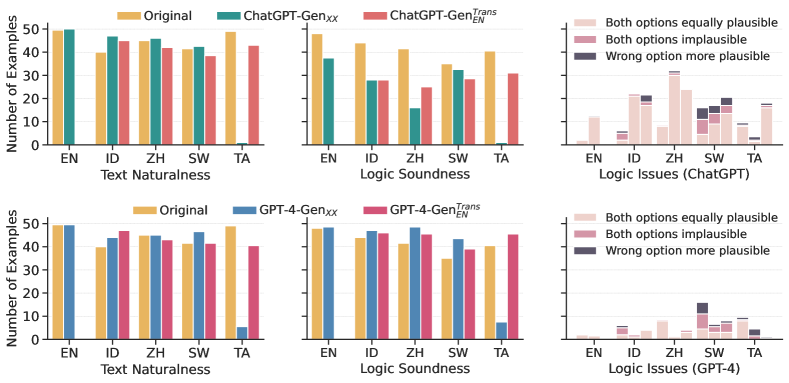
This paper explores the potential of leveraging Large Language Models (LLMs) for data augmentation in multilingual commonsense reasoning datasets where the available training data is extremely limited. To achieve this, we utilise several LLMs, namely Dolly-v2, StableVicuna, ChatGPT, and GPT-4, to augment three datasets: XCOPA, XWinograd, and XStoryCloze. Subsequently, we evaluate the effectiveness of fine-tuning smaller multilingual models, mBERT and XLMR, using the synthesised data. We compare the performance of training with data generated in English and target languages, as well as translated English-generated data, revealing the overall advantages of incorporating data generated by LLMs, e.g. a notable 13.4 accuracy score improvement for the best case. Furthermore, we conduct a human evaluation by asking native speakers to assess the naturalness and logical coherence of the generated examples across different languages. The results of the evaluation indicate that LLMs such as ChatGPT and GPT-4 excel at producing natural and coherent text in most languages, however, they struggle to generate meaningful text in certain languages like Tamil. We also observe that ChatGPT falls short in generating plausible alternatives compared to the original dataset, whereas examples from GPT-4 exhibit competitive logical consistency.
Motivation & Objective
- Address data scarcity in multilingual commonsense reasoning tasks where training data is extremely limited.
- Explore the feasibility and effectiveness of using LLMs to generate synthetic training data for low-resource languages.
- Evaluate whether LLM-generated data outperforms zero-shot cross-lingual transfer and human-annotated data in downstream tasks.
- Assess the naturalness and logical coherence of generated data through human evaluation across multiple languages.
- Release synthesized datasets to support reproducibility and future research in multilingual NLP.
Proposed method
- Fine-tune smaller multilingual models (mBERT and XLM-R) using synthetic data generated by LLMs on three commonsense reasoning datasets: XCOPA, XWinograd, and XStoryCloze.
- Use instruction prompting with few-shot examples from original datasets to guide LLMs (Dolly-v2, StableVicuna, ChatGPT, GPT-4) in generating new, diverse examples in English and target languages.
- Generate data in both English and target languages, and compare performance of models fine-tuned on English-generated, target-language-generated, and translated English-generated data.
- Conduct human evaluation with native speakers to assess naturalness and logical coherence of generated examples across languages.
- Apply zero-shot cross-lingual transfer as a baseline and compare performance against models trained on human-annotated data and synthetic data.
- Release the generated datasets publicly at https://github.com/mbzuai-nlp/Gen-X for reproducibility and community use.
Experimental results
Research questions
- RQ1Can LLMs effectively generate high-quality synthetic data for low-resource multilingual commonsense reasoning tasks?
- RQ2Does training on LLM-generated data improve zero-shot cross-lingual transfer performance compared to zero-shot transfer or limited human-annotated data?
- RQ3How does the performance of synthetic data vary when generated in English versus the target language?
- RQ4How do different LLMs (e.g., GPT-4 vs. ChatGPT) compare in generating natural and logically coherent examples across diverse languages?
- RQ5To what extent do human-annotated evaluations confirm the quality of LLM-generated data in terms of naturalness and commonsense plausibility?
Key findings
- Fine-tuning mBERT and XLM-R on LLM-generated data led to a 13.4-point accuracy improvement in the best-case scenario on XCOPA, demonstrating significant performance gains.
- GPT-4-generated data achieved performance on par with human-annotated data in terms of logical consistency, while ChatGPT-generated data showed notable inconsistencies in selecting more plausible options.
- Generating synthetic data directly in target languages outperformed zero-shot transfer from English-generated data, indicating language-specific generation is more effective.
- Human evaluation confirmed that GPT-4-generated examples were highly natural and logically sound in most languages, though both models struggled with Tamil, producing incoherent or unnatural text.
- Despite high naturalness, ChatGPT-generated data exhibited a significant gap in commonsense plausibility, often producing options with similar plausibility, unlike the original dataset which emphasizes one clearly more plausible choice.
- The study reveals that model choice (e.g., GPT-4 vs. ChatGPT) critically affects data quality, with GPT-4 showing superior consistency and coherence, especially in multilingual settings.
Read this paper
Open the full text in the Nubint reader and ask about any passage as you read.
Read this paper on NubintThis review was generated by AI from the original paper. Please check the paper before citing it.