
[Paper Review] LLMatic: Neural Architecture Search via Large Language Models and Quality Diversity Optimization
LLMatic proposes a novel Neural Architecture Search (NAS) framework that combines large language models (LLMs) for code-based neural architecture generation with Quality-Diversity (QD) optimization to discover diverse, high-performing architectures. By leveraging a procedural, prompt-driven approach using a QD archive of prompts and network behaviors, LLMatic achieves near-state-of-the-art accuracy on CIFAR-10, CIFAR-100, and ImageNet16-120 using only 2,000 evaluations, demonstrating efficient and effective NAS without prior exposure to benchmark models.
Large Language Models (LLMs) have emerged as powerful tools capable of accomplishing a broad spectrum of tasks. Their abilities span numerous areas, and one area where they have made a significant impact is in the domain of code generation. Here, we propose using the coding abilities of LLMs to introduce meaningful variations to code defining neural networks. Meanwhile, Quality-Diversity (QD) algorithms are known to discover diverse and robust solutions. By merging the code-generating abilities of LLMs with the diversity and robustness of QD solutions, we introduce exttt{LLMatic}, a Neural Architecture Search (NAS) algorithm. While LLMs struggle to conduct NAS directly through prompts, exttt{LLMatic} uses a procedural approach, leveraging QD for prompts and network architecture to create diverse and high-performing networks. We test exttt{LLMatic} on the CIFAR-10 and NAS-bench-201 benchmarks, demonstrating that it can produce competitive networks while evaluating just $2,000$ candidates, even without prior knowledge of the benchmark domain or exposure to any previous top-performing models for the benchmark. The open-sourced code is available in \url{https://github.com/umair-nasir14/LLMatic}.
Motivation & Objective
- To address the inefficiency and lack of diversity in traditional Neural Architecture Search (NAS) methods that rely on trial-and-error evaluation.
- To explore whether large language models (LLMs) can be effectively leveraged to generate meaningful architectural variations for neural networks.
- To integrate LLM-generated code with Quality-Diversity (QD) optimization to discover a diverse set of high-performing, robust architectures.
- To demonstrate that a small, efficient LLM (6.1B parameters) can achieve competitive NAS performance with minimal search budget.
- To validate the necessity and effectiveness of each component in the proposed LLMatic framework through ablation studies.
Proposed method
- LLMatic uses a code-generating LLM (CodeGen-6.1B) to produce neural network architectures in the form of searchable code snippets, constrained to a predefined set of operations.
- It employs a Quality-Diversity (QD) algorithm, specifically a MAP-Elites variant, to maintain two archives: one for prompts and one for trained network architectures.
- The prompt archive stores diverse, high-quality prompts that guide the LLM in generating varied network cells, while the network archive stores architectures with distinct behavior descriptors (e.g., FLOPS, parameter count).
- Each generation involves sampling prompts from the QD archive, prompting the LLM to generate a new network cell, training and evaluating the resulting architecture, and updating the network archive based on performance and behavioral diversity.
- The method uses a procedural, iterative loop: prompt selection → LLM-based architecture generation → training and evaluation → archive update → next generation.
- The framework is designed to be computationally efficient, relying on only 2,000 total evaluations and a smaller LLM, while still achieving competitive performance.
Experimental results
Research questions
- RQ1Can large language models be effectively used to generate diverse and high-performing neural network architectures through code generation?
- RQ2How does combining LLM-based code generation with Quality-Diversity optimization improve search efficiency and diversity in Neural Architecture Search?
- RQ3To what extent can a smaller, 6.1B-parameter LLM achieve competitive NAS performance with a minimal evaluation budget of 2,000 trials?
- RQ4How does LLMatic compare to state-of-the-art NAS methods like Λ-DARTS and GPT-4-based GENIUS in terms of accuracy and diversity?
- RQ5What is the contribution of each component in LLMatic, and is the framework robust to architectural constraints and limited computational resources?
Key findings
- On the NAS-bench-201 benchmark, LLMatic achieved a test accuracy of 94.26±0.13 on CIFAR-10, ranking 2nd among all methods tested, just below the optimal 94.47.
- On CIFAR-100, LLMatic achieved 71.62±1.73 accuracy, ranking 2nd, and on ImageNet16-120, it achieved 45.87±0.96 accuracy, ranking 11th, demonstrating strong generalization across datasets.
- LLMatic discovered more than 20 competitive networks on CIFAR-10, with a broad distribution across the behavior space, indicating effective diversity in architecture search.
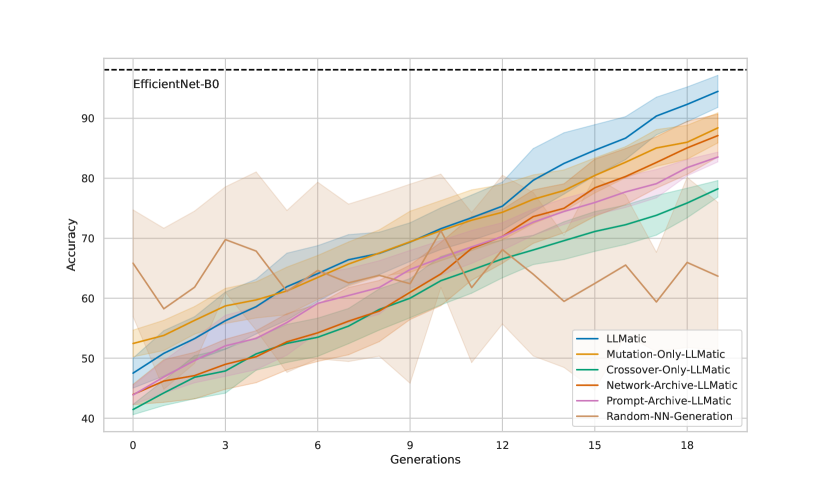
- The ablation study confirmed that each component of LLMatic—LLM generation, prompt QD archive, and network QD archive—is essential, as removing any component degraded performance significantly.
- Despite using only 2,000 evaluations and a smaller 6.1B-parameter LLM, LLMatic outperformed simple GPT-4-based NAS (GENIUS) and matched the performance of Λ-DARTS, a state-of-the-art method.
- The framework demonstrated that efficient, low-resource NAS is feasible by combining LLMs with QD optimization, even without prior exposure to top-performing models or extensive hyperparameter tuning.
Better researchstarts right now
From reading papers to final review, dramatically reduce your research time.
No credit card · Free plan available
This review was created by AI and reviewed by human editors.