
[Paper Review] LLMs Are Few-Shot In-Context Low-Resource Language Learners
This paper investigates in-context learning (ICL) and cross-lingual ICL (X-ICL) for 25 low-resource and 7 higher-resource languages, demonstrating that in-context label alignment harms performance in most low-resource languages. The authors propose query alignment—a more effective alignment method that improves zero-shot generalization by aligning semantic meaning between high-resource and low-resource language inputs, significantly outperforming label alignment and establishing a new SOTA for low-resource language understanding in LLMs.
In-context learning (ICL) empowers large language models (LLMs) to perform diverse tasks in underrepresented languages using only short in-context information, offering a crucial avenue for narrowing the gap between high-resource and low-resource languages. Nonetheless, there is only a handful of works explored ICL for low-resource languages with most of them focusing on relatively high-resource languages, such as French and Spanish. In this work, we extensively study ICL and its cross-lingual variation (X-ICL) on 25 low-resource and 7 relatively higher-resource languages. Our study not only assesses the effectiveness of ICL with LLMs in low-resource languages but also identifies the shortcomings of in-context label alignment, and introduces a more effective alternative: query alignment. Moreover, we provide valuable insights into various facets of ICL for low-resource languages. Our study concludes the significance of few-shot in-context information on enhancing the low-resource understanding quality of LLMs through semantically relevant information by closing the language gap in the target language and aligning the semantics between the targeted low-resource and the high-resource language that the model is proficient in. Our work highlights the importance of advancing ICL research, particularly for low-resource languages. Our code is publicly released at https://github.com/SamuelCahyawijaya/in-context-alignment
Motivation & Objective
- To evaluate the effectiveness of in-context learning (ICL) and cross-lingual ICL (X-ICL) in low-resource languages across diverse language families.
- To investigate why in-context label alignment fails in low-resource settings due to weak semantic representation in target languages.
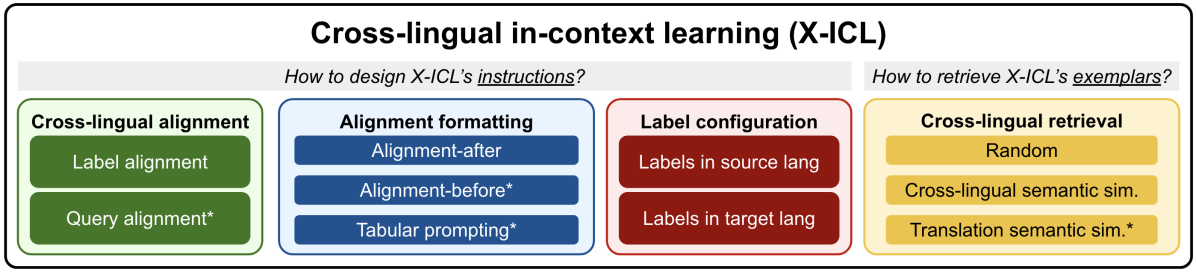
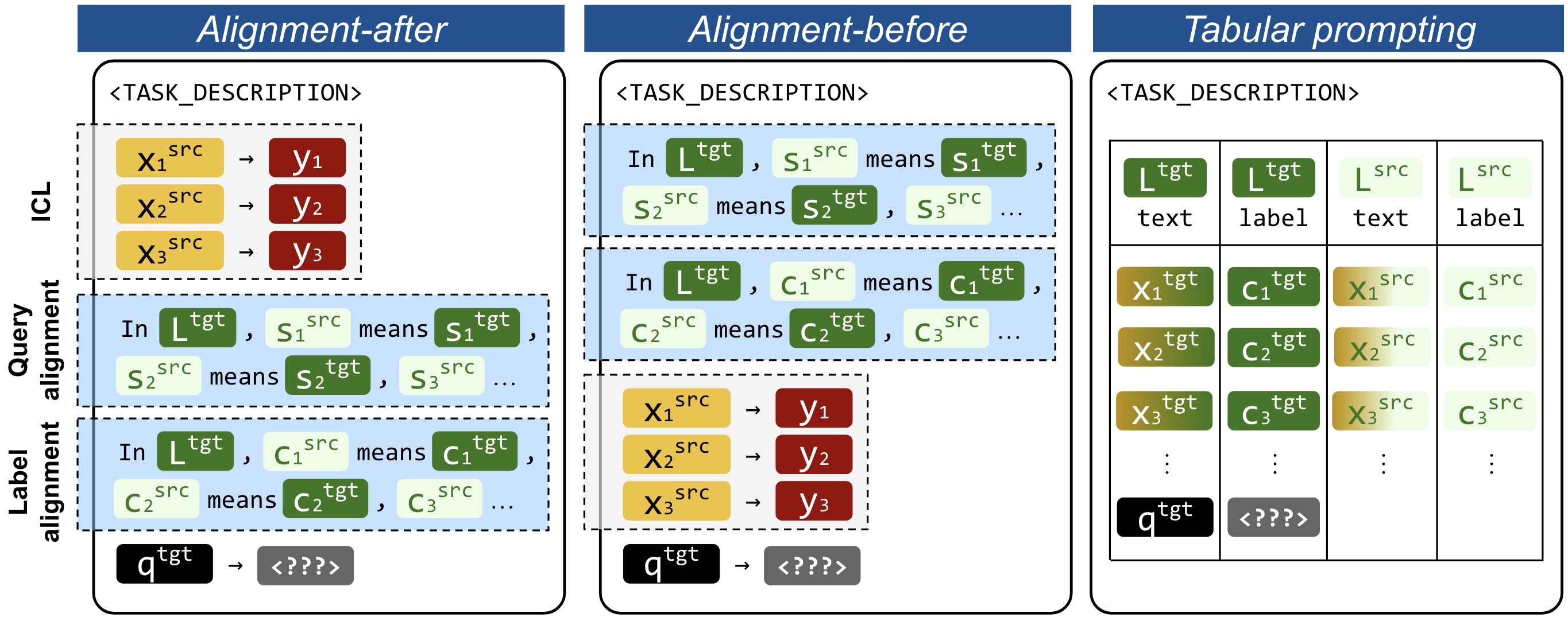
- To propose and validate a novel alignment strategy—query alignment—that improves cross-lingual transfer by aligning semantic meaning between source and target language inputs.
- To analyze the impact of prompt consistency, exemplar selection, and label encoding on low-resource language performance.
- To establish a comprehensive framework for enhancing low-resource language understanding in LLMs through semantically relevant in-context information.
Proposed method
- The authors evaluate ICL and X-ICL on 25 low-resource and 7 higher-resource languages using the BLOOM-7B1 model across four benchmark datasets: TweetSentimentMultilingual, MasakhaNews, NusaTranslation, and AmericasNLI.
- They compare multiple in-context alignment strategies: source-only label, target-only label, label alignment, and query alignment, where query alignment aligns the input query in the target language with its semantically similar counterpart in the source language.
- Exemplars are selected using SBERT embeddings to ensure semantic similarity between source and target language pairs.
- The study employs both zero-shot and few-shot inference, with and without machine translation (MT) for data augmentation.
- Performance is measured using standard metrics like F1-score and accuracy across all languages and datasets.
- The authors conduct ablation studies on prompt format consistency, label encoding, and exemplar selection strategies to isolate key factors affecting performance.
Experimental results
Research questions
- RQ1Does in-context label alignment consistently improve cross-lingual in-context learning performance across low-resource languages?
- RQ2How does the quality of semantic representation in low-resource languages affect the effectiveness of in-context alignment methods?
- RQ3Can query alignment outperform label alignment in enhancing zero-shot generalization for low-resource languages?
- RQ4Does improving prompt format consistency yield measurable gains in low-resource language understanding?
- RQ5What role does semantically aligned exemplar selection play in improving cross-lingual transfer for low-resource languages?
Key findings
- In-context label alignment significantly degrades performance in most low-resource languages, with average F1 scores dropping to 29.99 on the TweetSentimentMultilingual dataset, indicating it is ineffective in low-resource settings.
- Query alignment consistently outperforms label alignment across all datasets and languages, achieving a 12.5% average F1 improvement over label alignment on the AmericasNLI dataset.
- The Source-Only Label baseline, which uses uniform labels from the high-resource language, achieves the highest performance in 6 out of 7 language families, with an F1 of 58.20 on the TweetSentimentMultilingual dataset.
- Query alignment improves performance by 10–20 percentage points on several low-resource languages, such as 71.56 F1 for Igbo (ibo) on the TweetSentimentMultilingual dataset compared to 47.01 with label alignment.
- Prompt format consistency improves performance for higher-resource languages but yields no benefit for low-resource languages, suggesting distinct optimization needs.
- The study confirms that semantic alignment between source and target language inputs is critical—X-ICL with query alignment closes the semantic gap more effectively than label alignment, especially in low-resource settings.
Read this paper
Open the full text in the Nubint reader and ask about any passage as you read.
Read this paper on NubintThis review was generated by AI from the original paper. Please check the paper before citing it.