
[Paper Review] LLPNet: Graph Autoencoder for Triggering Light Long-Lived Particles at HL-LHC
This paper proposes LLPNet, a lightweight graph autoencoder using edge convolution on L1-reconstructed tracks to detect displaced jets from light long-lived particles (LLPs) at the HL-LHC. It achieves 33–80% signal efficiency at 30 kHz background rate, demonstrating feasibility for L1 triggering of low-mass LLPs decaying into jets with decay lengths up to 100 cm.
In the search for exotic events involving displaced particles at HL-LHC, the triggering at the level-1 (L1) system will pose a significant challenge. This is particularly relevant in scenarios where low mass long-lived particles (LLPs) are coupled to a Standard Model (SM)-like 125 GeV Higgs boson and they decay into jets. The complexity arises from the low hadronic activity resulting from LLP decay, and the existing triggers' inability to efficiently select displaced events. This study introduces a novel machine learning approach to address this challenge, utilizing a lightweight autoencoder architecture designed for low latency requirements at L1. Focusing on light LLPs with decay lengths ranging from 1 to 100 cm, this approach employs "Edge convolution" on L1 reconstructed tracks. The results show notable signal acceptance at the permissible background rate, primarily originating from minimum bias and QCD di-jet events. For LLPs of mass 10, 30, and 50 GeV at decay length of 5 cm, the signal efficiencies are 33%, 70%, and 80%, respectively. At a 50 cm decay length, these efficiencies are 20%, 39%, and 45% for the same respective masses.
Motivation & Objective
- Address the challenge of triggering displaced signatures from light long-lived particles (LLPs) at the HL-LHC's Level-1 (L1) trigger system.
- Overcome the inefficiency of standard triggers (e.g., H_T, PUPPI) in capturing low-multiplicity, low-hadronic activity events from LLP decays.
- Develop a low-latency, FPGA-compatible machine learning solution suitable for real-time processing at L1 with high pile-up (up to 140 interactions per crossing).
- Enable detection of LLPs with masses 10–50 GeV and decay lengths 1–100 cm, particularly those from Higgs boson decays into invisible or jet final states.
- Optimize signal acceptance while maintaining background rates below 30 kHz, a critical threshold for L1 trigger scalability.
Proposed method
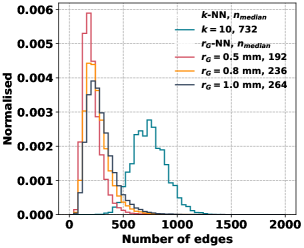
- Construct event-level point cloud graphs from L1-reconstructed tracks using the radius-based graph construction method instead of k-nearest neighbors to reduce computational load.
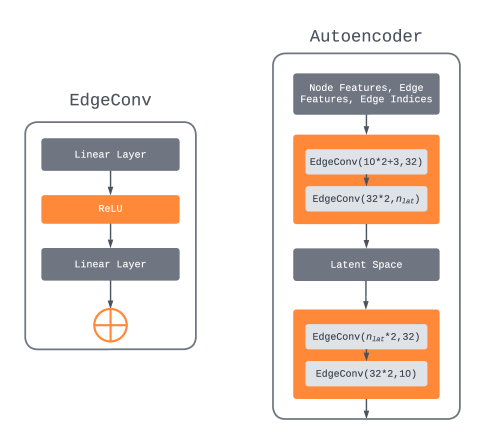
- Apply edge convolution layers to encode spatial and kinematic features of tracks, including transverse impact parameter and momentum, into node and edge features.
- Train a lightweight graph autoencoder to reconstruct the input point cloud, learning a compact latent representation that captures the topological structure of displaced jets.
- Use anomaly detection: low reconstruction error on signal events (displaced jets) and high error on background (minbias and QCD di-jets) to identify rare events.
- Perform hyperparameter tuning over graph radius and latent space dimension using a gradient boosting regressor to identify optimal working points (WPs) for different LLP masses and decay lengths.
- Compute background rates using the stitching method, segmenting QCD di-jet backgrounds into multiple p_T^gen bins to account for phase space overlaps.
Experimental results
Research questions
- RQ1Can a lightweight graph autoencoder effectively detect displaced jets from light LLPs at the L1 trigger level despite low hadronic activity and high pile-up?
- RQ2How does the choice of graph construction method (radius vs. k-nearest neighbors) affect performance and computational efficiency in an L1 environment?
- RQ3What signal efficiency can be achieved for LLPs of 10, 30, and 50 GeV with decay lengths from 1 to 100 cm while maintaining a background rate below 30 kHz?
- RQ4How do reconstruction error distributions differ between signal events and dominant backgrounds (minbias and QCD di-jets) across varying decay lengths and masses?
- RQ5What are the optimal hyperparameters (graph radius and latent dimension) for maximizing signal efficiency and AUC across different LLP benchmark points?
Key findings
- For LLPs with mass 10 GeV and decay length 5 cm, LLPNet achieves 33% signal efficiency at a background rate of 30 kHz using WP-1.
- For 30 GeV LLPs at 5 cm decay length, signal efficiency reaches 70% under the same background threshold, while 50 GeV LLPs achieve 80% efficiency.
- At a longer decay length of 50 cm, signal efficiencies drop to 20%, 39%, and 45% for 10, 30, and 50 GeV LLPs, respectively, under WP-2.
- The optimal graph radius and latent space dimension vary with LLP mass and decay length, with maximum AUC values observed at specific combinations (e.g., r_G=0.9, n_lat=6 for WP-2).
- ROC curves show clear separation between signal and background, with anomaly scores increasing significantly for LLP events compared to minbias and QCD di-jets.
- The method maintains high performance across decay lengths from 1 to 100 cm, demonstrating robustness to varying displacement scales despite reduced signal efficiency at longer lengths.
Better researchstarts right now
From reading papers to final review, dramatically reduce your research time.
No credit card · Free plan available
This review was created by AI and reviewed by human editors.