
[Paper Review] LMCanvas: Object-Oriented Interaction to Personalize Large Language Model-Powered Writing Environments
LMCanvas proposes a canvas-based, object-oriented interface that enables writers to personalize large language model (LLM)-powered writing tools by creating, connecting, and arranging text blocks, model blocks, and pipeline blocks. The system supports modular writing, customizable LLM configurations, and flexible composition of LLM pipelines to create tailored writing environments that reduce tool-switching and support iterative, user-driven prompt engineering.
Large language models (LLMs) can enhance writing by automating or supporting specific tasks in writers' workflows (e.g., paraphrasing, creating analogies). Leveraging this capability, a collection of interfaces have been developed that provide LLM-powered tools for specific writing tasks. However, these interfaces provide limited support for writers to create personal tools for their own unique tasks, and may not comprehensively fulfill a writer's needs -- requiring them to continuously switch between interfaces during writing. In this work, we envision LMCanvas, an interface that enables writers to create their own LLM-powered writing tools and arrange their personal writing environment by interacting with "blocks" in a canvas. In this interface, users can create text blocks to encapsulate writing and LLM prompts, model blocks for model parameter configurations, and connect these to create pipeline blocks that output generations. In this workshop paper, we discuss the design for LMCanvas and our plans to develop this concept.
Motivation & Objective
- To address the lack of support for writers to create custom LLM-powered tools tailored to their unique writing workflows.
- To reduce the need for constant interface switching by enabling a unified, composable writing environment.
- To support personalized prompt engineering and parameter configuration through modular, reusable components.
- To explore how modular, history-aware text blocks and visualized output containers can enhance writing productivity and creativity.
- To investigate interactive mechanisms for improving prompt engineering in open-ended, creative writing tasks.
Proposed method
- The interface uses a canvas metaphor where users create and connect three block types: text blocks for writing and prompts, model blocks for LLM hyperparameters, and pipeline blocks for generating outputs.
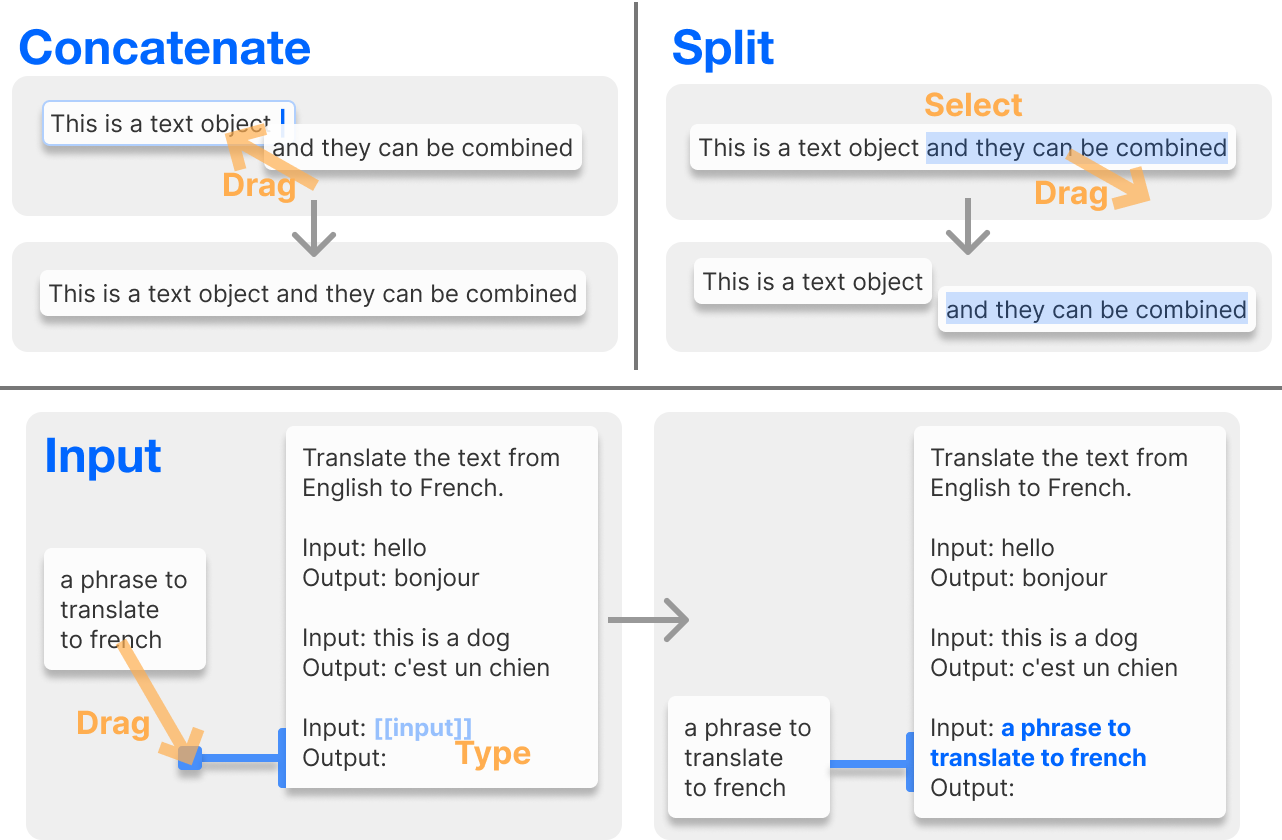
- Text blocks store writing, prompts, examples, and generated content, enabling modular organization and versioning.
- Model blocks allow users to configure and save LLM parameters (e.g., temperature, max tokens) and reuse them across pipelines.
- Pipeline blocks are created by connecting a text block (input) to a model block (configuration), triggering LLM generation and outputting results as new text blocks.
- Outputs from pipeline blocks can be connected via drag-and-drop to other text blocks (for continuation) or to input prongs of other pipelines (for chaining).
- The interface supports advanced interactions such as replacing selected text with pipeline outputs and enabling modular history tracking per text block.
Experimental results
Research questions
- RQ1How can writers effectively compose personalized LLM-powered tools without relying on pre-built, rigid interfaces?
- RQ2What interaction patterns enable flexible, reusable, and composable LLM pipelines in a writing environment?
- RQ3How can modular text blocks and configurable model blocks support iterative prompt engineering and workflow personalization?
- RQ4What role do visual output containers and history tracking play in enhancing writer control and reflection during LLM-assisted writing?
- RQ5How can the interface support effective prompt engineering in open-ended, creative writing tasks?
Key findings
- The LMCanvas prototype successfully implements core block types—text, model, and pipeline blocks—along with basic interactions such as connection, generation, and drag-and-drop composition.
- The modular design enables writers to organize writing, prompts, and generations into discrete, manageable units, reducing cognitive load from tool-switching.
- The system supports dynamic reuse of model configurations through model blocks, allowing writers to test and compare different LLM settings efficiently.
- Pipeline blocks can generate multiple outputs simultaneously by pairing multiple inputs with multiple configurations, enabling exploratory writing.
- The interface supports replacing selected text across the canvas with pipeline outputs, enhancing integration into existing writing workflows.
- Preliminary findings suggest that modular history tracking per text block enables writers to inspect, revert, and reflect on past generations and input configurations.

Read this paper
Open the full text in the Nubint reader and ask about any passage as you read.
Read this paper on NubintThis review was generated by AI from the original paper. Please check the paper before citing it.