
[Paper Review] Local Implicit Normalizing Flow for Arbitrary-Scale Image Super-Resolution
This paper proposes Local Implicit Normalizing Flow (LINF), a novel framework that combines coordinate-conditional normalizing flows with local implicit neural representations to enable arbitrary-scale image super-resolution with photo-realistic, high-fidelity results. By modeling the distribution of local texture patches conditioned on low-resolution input, scale factor, and Fourier features, LINF generates detailed, perceptually realistic images across any upscaling factor while outperforming prior methods in perceptual quality and inference speed.
Flow-based methods have demonstrated promising results in addressing the ill-posed nature of super-resolution (SR) by learning the distribution of high-resolution (HR) images with the normalizing flow. However, these methods can only perform a predefined fixed-scale SR, limiting their potential in real-world applications. Meanwhile, arbitrary-scale SR has gained more attention and achieved great progress. Nonetheless, previous arbitrary-scale SR methods ignore the ill-posed problem and train the model with per-pixel L1 loss, leading to blurry SR outputs. In this work, we propose "Local Implicit Normalizing Flow" (LINF) as a unified solution to the above problems. LINF models the distribution of texture details under different scaling factors with normalizing flow. Thus, LINF can generate photo-realistic HR images with rich texture details in arbitrary scale factors. We evaluate LINF with extensive experiments and show that LINF achieves the state-of-the-art perceptual quality compared with prior arbitrary-scale SR methods.
Motivation & Objective
- Address the ill-posed nature of super-resolution by modeling high-resolution image generation as a distributional problem rather than a deterministic regression task.
- Overcome the limitation of fixed-scale super-resolution models that cannot generalize to arbitrary upscaling factors without architectural changes.
- Improve perceptual quality by replacing per-pixel L1 loss with a flow-based generative approach that captures texture detail distributions.
- Enable efficient inference for arbitrary-scale super-resolution through a patch-based, coordinate-conditional normalizing flow architecture with Fourier feature ensembling.
- Balance fidelity and perceptual quality by controlling sampling temperature in the normalizing flow, allowing trade-offs between PSNR and LPIPS metrics.
Proposed method
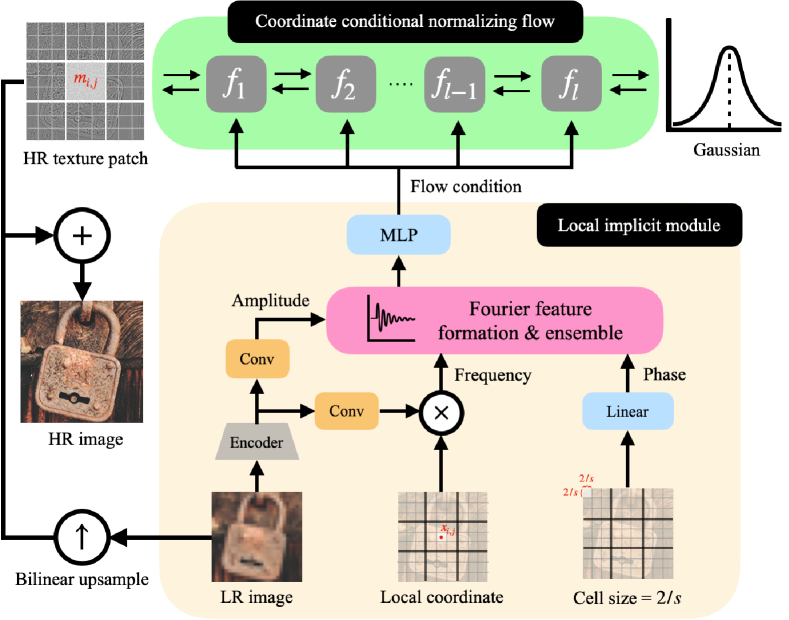
- LINF formulates super-resolution as learning the distribution of local texture patches using a coordinate-conditional normalizing flow model.
- The flow model is conditioned on the low-resolution image, the central coordinate of each local patch, and the desired scaling factor.
- A local implicit neural representation estimates Fourier features at each patch location to provide conditional signals for the flow model.
- Fourier feature ensembling is employed to improve inference speed and performance, replacing less efficient local ensemble mechanisms.
- The model uses a patch-based approach (n×n regions) to preserve local texture coherency and reduce the number of forward passes during generation.
- Sampling temperature is controlled to balance fidelity (PSNR) and perceptual quality (LPIPS), enabling trade-off optimization.

Experimental results
Research questions
- RQ1Can normalizing flows be effectively adapted to arbitrary-scale super-resolution while maintaining high perceptual quality?
- RQ2How does modeling local texture patch distributions improve image detail recovery compared to per-pixel regression?
- RQ3Can a local implicit representation provide sufficient conditional supervision for a normalizing flow to generate diverse, realistic textures at arbitrary scales?
- RQ4What is the impact of patch size on texture coherency and inference efficiency in flow-based super-resolution?
- RQ5How does temperature-controlled sampling in normalizing flows affect the trade-off between PSNR and LPIPS in arbitrary-scale super-resolution?
Key findings
- LINF achieves state-of-the-art perceptual quality on the DIV2K validation set, with an LPIPS of 0.158 at τ=0.6, significantly outperforming prior methods.
- The model reduces inference time by approximately 33% compared to local ensemble baselines, achieving 1.44s per image on a TITAN X.
- The Fourier feature ensemble mechanism enables 27.2x faster inference than autoregressive models and 2.6x faster than flow-based baselines.
- A patch-based model (n>1) produces more perceptually coherent results than a pixel-based model (n=1), avoiding local incoherence issues in random sampling.
- At τ=0, the pixel-based model achieves higher PSNR (28.85) but lower perceptual quality (LPIPS 0.273), while the patch-based model achieves better LPIPS (0.158) at τ=0.6 with improved visual quality.
- Removing amplitude scaling in Fourier feature ensembling leads to a slight performance drop (LPIPS 0.271 vs. 0.270), validating the importance of weighted amplitude scaling.
Read this paper
Open the full text in the Nubint reader and ask about any passage as you read.
Read this paper on NubintThis review was generated by AI from the original paper. Please check the paper before citing it.