
[Paper Review] Localization Distillation for Dense Object Detection
This paper proposes Localization Distillation (LD), a novel knowledge distillation method for dense object detectors that reformulates bounding box regression as probability distribution matching to efficiently transfer localization knowledge from teacher to student networks. By decoupling semantic and localization knowledge distillation and introducing a valuable localization region (VLR) for selective knowledge transfer, LD achieves state-of-the-art performance—boosting AP from 40.1 to 42.1 on COCO with ResNet-50 under a single-scale 1× schedule—without increasing inference cost.
Knowledge distillation (KD) has witnessed its powerful capability in learning compact models in object detection. Previous KD methods for object detection mostly focus on imitating deep features within the imitation regions instead of mimicking classification logit due to its inefficiency in distilling localization information and trivial improvement. In this paper, by reformulating the knowledge distillation process on localization, we present a novel localization distillation (LD) method which can efficiently transfer the localization knowledge from the teacher to the student. Moreover, we also heuristically introduce the concept of valuable localization region that can aid to selectively distill the semantic and localization knowledge for a certain region. Combining these two new components, for the first time, we show that logit mimicking can outperform feature imitation and localization knowledge distillation is more important and efficient than semantic knowledge for distilling object detectors. Our distillation scheme is simple as well as effective and can be easily applied to different dense object detectors. Experiments show that our LD can boost the AP score of GFocal-ResNet-50 with a single-scale 1x training schedule from 40.1 to 42.1 on the COCO benchmark without any sacrifice on the inference speed. Our source code and trained models are publicly available at https://github.com/HikariTJU/LD
Motivation & Objective
- To address the inefficiency of existing knowledge distillation (KD) methods in dense object detection, particularly their reliance on feature imitation and neglect of localization knowledge.
- To investigate whether logit mimicking—previously considered ineffective in object detection—can outperform feature-based distillation when properly reformulated.
- To develop a mechanism that selectively distills semantic and localization knowledge based on region-specific utility, improving distillation efficiency and performance.
- To demonstrate that localization knowledge distillation is more critical and effective than semantic knowledge distillation for improving object detector accuracy.
- To create a plug-and-play distillation method that enhances performance across diverse dense object detectors without introducing inference overhead.
Proposed method
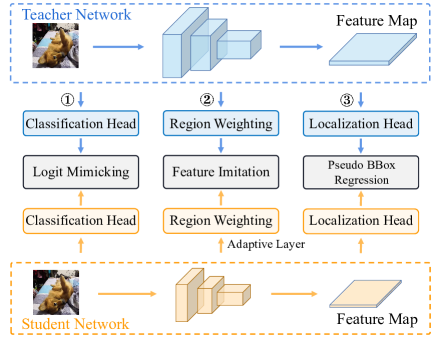
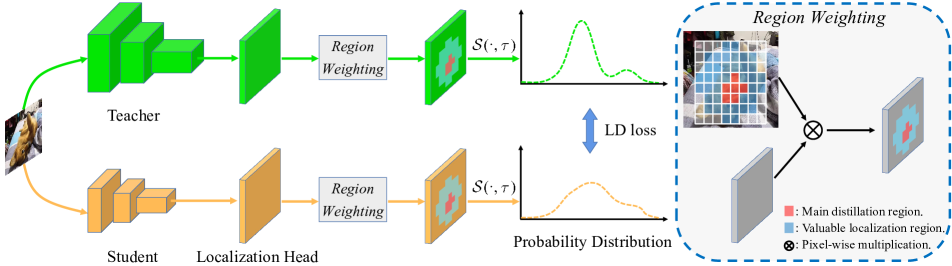
- Reformulates object detection distillation by representing bounding boxes as probability distributions instead of Dirac delta functions, enabling richer localization knowledge transfer.
- Proposes a novel Localization Distillation (LD) module that matches the probability distribution of predicted bounding boxes between teacher and student networks.
- Introduces the concept of a Valuable Localization Region (VLR), a heuristic mechanism to identify and prioritize regions that are most beneficial for localization knowledge transfer.
- Decouples knowledge distillation into two separate streams: semantic knowledge via standard logit mimicking and localization knowledge via LD, applied in distinct spatial regions.
- Employs a separate distillation region strategy to apply LD only in high-value regions identified by the VLR, improving training efficiency and performance.
- Integrates LD seamlessly into existing dense detectors (e.g., GFocal, RetinaNet, FCOS) with no architectural changes or additional parameters.
Experimental results
Research questions
- RQ1Can logit mimicking, previously considered ineffective in object detection, outperform feature-based distillation when properly reformulated?
- RQ2Is localization knowledge distillation more important and efficient than semantic knowledge distillation for improving object detector performance?
- RQ3Can a selective distillation strategy based on valuable localization regions improve the efficiency and accuracy of knowledge distillation in object detection?
- RQ4Does decoupling semantic and localization knowledge transfer lead to better performance than joint, hybrid distillation on feature maps?
- RQ5Can LD be universally applied to various dense object detectors without introducing inference overhead while achieving consistent performance gains?
Key findings
- Logit mimicking, when properly reformulated for localization, can outperform traditional feature imitation methods in object detection distillation.
- Localization knowledge distillation is more effective and efficient than semantic knowledge distillation for improving object detector performance.
- The proposed LD method improves the AP score of GFocal-ResNet-50 from 40.1 to 42.1 on COCO under a single-scale 1× training schedule, a +2.0 AP gain.
- With a multi-scale 2× schedule, LD boosts GFocalV2 with ResNeXt-101-32x4d-DCN backbone to 50.5 AP on COCO test-dev 2019, surpassing all existing detectors under the same settings.
- The method achieves consistent improvements of approximately 2 AP across multiple dense detectors (e.g., RetinaNet, FCOS, ATSS) without increasing model parameters or inference time.
- The VLR mechanism effectively identifies regions that are most beneficial for localization learning, enabling selective and efficient distillation.
Read this paper
Open the full text in the Nubint reader and ask about any passage as you read.
Read this paper on NubintThis review was generated by AI from the original paper. Please check the paper before citing it.