
[Paper Review] Localized Data Work as a Precondition for Data-Centric ML: A Case Study of Full Lifecycle Crop Disease Identification in Ghana
This paper presents the CADI AI project, a data-centric machine learning approach for full lifecycle crop disease identification in Ghana using drone-collected multispectral imagery. Through localized data work—stakeholder engagement, annotated data collection (4,736 images), and model training with YOLOv5X—the team developed a desktop application achieving 64.8% mAP, enabling farmers to diagnose insect, disease, and abiotic stress in cashew crops with spatial precision.
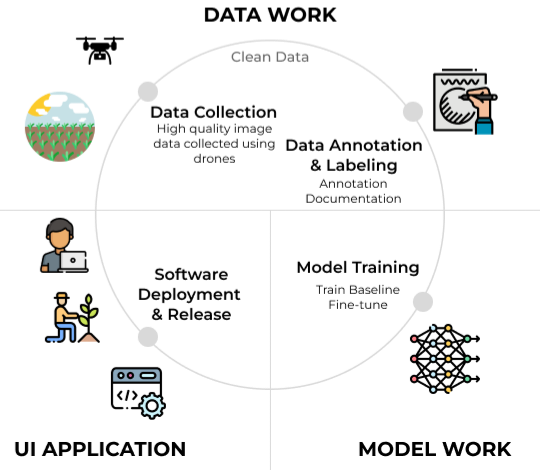
The Ghana Cashew Disease Identification with Artificial Intelligence (CADI AI) project demonstrates the importance of sound data work as a precondition for the delivery of useful, localized datacentric solutions for public good tasks such as agricultural productivity and food security. Drone collected data and machine learning are utilized to determine crop stressors. Data, model and the final app are developed jointly and made available to local farmers via a desktop application.
Motivation & Objective
- Address food security and agricultural productivity challenges in Ghana’s cashew sector by developing a localized, data-driven AI solution.
- Overcome limitations of existing agricultural AI tools by emphasizing rigorous, localized data work as a precondition for effective model deployment.
- Create a publicly accessible, open-source pipeline for crop disease detection that supports smallholder farmers through actionable insights.
- Ensure model usability in real-world farming contexts by integrating spatial localization and user-friendly software deployment.
- Establish a sustainable, community-informed data and model ecosystem for future agricultural AI innovation in low-resource settings.
Proposed method
- Collected 4,736 multispectral drone images from cashew farms in Ghana’s Bono Region across two trips to capture seasonal and morphological diversity.
- Annotated images using label guidelines developed with a local agricultural scientist, classifying stressors as 'insect', 'disease', or 'abiotic' via MakeSense and Roboflow tools.
- Split the dataset into 3,788 training, 710 validation, and 238 test images, preserving class skew to reflect real-world prevalence.
- Trained a YOLOv5X object detection model on the DFKI GIZ cluster, applying data augmentation to balance underrepresented classes while maintaining real-world skew.
- Integrated the trained model into a Flutter-based desktop application enabling farmers to upload images and receive localized diagnoses with spatial metadata.
- Hosted the dataset on Kaggle and Hugging Face, and the model on Hugging Face, enabling open access, reuse, and community contributions.
Experimental results
Research questions
- RQ1How can localized data work serve as a precondition for effective data-centric machine learning in agricultural AI applications?
- RQ2What challenges arise in collecting and annotating diverse, real-world crop imagery in low-resource, smallholder farming contexts, and how can they be mitigated?
- RQ3To what extent does model performance in detecting crop stressors depend on data quality, annotation consistency, and class distribution in real-world farming data?
- RQ4Can a transparent, open-source pipeline for data collection, model training, and application deployment be effectively implemented to support smallholder farmers?
- RQ5What role does stakeholder collaboration and domain expertise play in ensuring the relevance and accuracy of agricultural AI systems?
Key findings
- The CADI AI project successfully developed a data-centric pipeline for full lifecycle crop disease identification in Ghana, with 4,736 annotated drone images collected from real farms.
- The final YOLOv5X model achieved a mean average precision (mAP) of 0.648 on the test set, demonstrating strong performance for practical deployment.
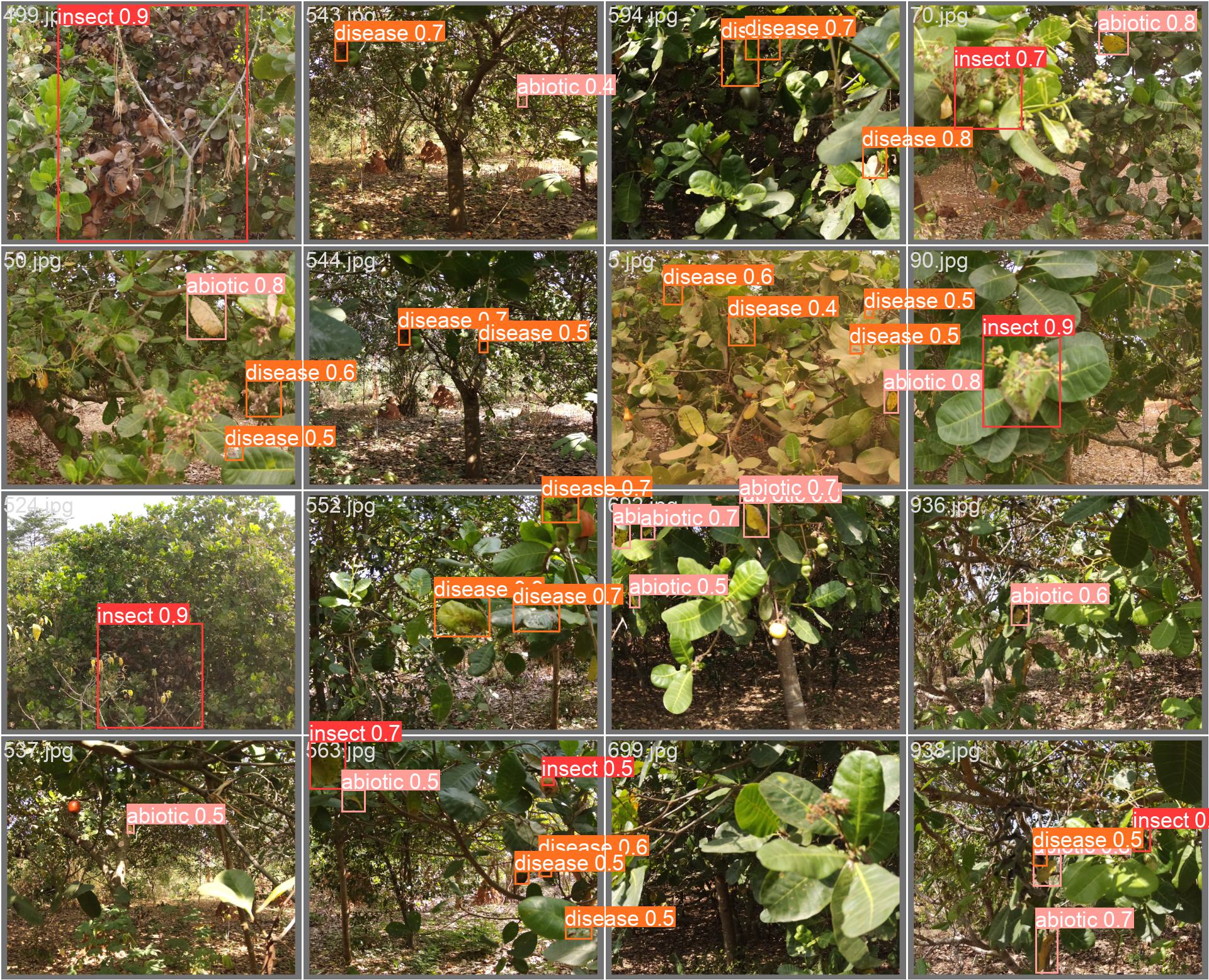
- The model performed best on the 'insect' class due to distinct visual characteristics, while distinguishing 'disease' and 'abiotic' classes remained challenging due to visual similarity.
- The dataset's significant skew toward 'abiotic' stressors was preserved to reflect real-world conditions, enhancing model robustness in field settings.
- The desktop application enables farmers to diagnose crop stressors with spatial localization, improving actionable insights for targeted farm interventions.
- The project established open access to data, model, and code via Kaggle and Hugging Face, enabling reuse, extension, and community contributions with versioning and curation support.
Better researchstarts right now
From reading papers to final review, dramatically reduce your research time.
No credit card · Free plan available
This review was created by AI and reviewed by human editors.