
[Paper Review] Logs with zeros? Some problems and solutions
The paper shows that ATEs for log-like transformations with zero-valued outcomes are arbitrarily scale-dependent and cannot be interpreted as unit-invariant percentage effects; it outlines alternatives and a trilemma, with empirical illustrations.
When studying an outcome $Y$ that is weakly-positive but can equal zero (e.g. earnings), researchers frequently estimate an average treatment effect (ATE) for a "log-like" transformation that behaves like $\log(Y)$ for large $Y$ but is defined at zero (e.g. $\log(1+Y)$, $\mathrm{arcsinh}(Y)$). We argue that ATEs for log-like transformations should not be interpreted as approximating percentage effects, since unlike a percentage, they depend on the units of the outcome. In fact, we show that if the treatment affects the extensive margin, one can obtain a treatment effect of any magnitude simply by re-scaling the units of $Y$ before taking the log-like transformation. This arbitrary unit-dependence arises because an individual-level percentage effect is not well-defined for individuals whose outcome changes from zero to non-zero when receiving treatment, and the units of the outcome implicitly determine how much weight the ATE for a log-like transformation places on the extensive margin. We further establish a trilemma: when the outcome can equal zero, there is no treatment effect parameter that is an average of individual-level treatment effects, unit-invariant, and point-identified. We discuss several alternative approaches that may be sensible in settings with an intensive and extensive margin, including (i) expressing the ATE in levels as a percentage (e.g. using Poisson regression), (ii) explicitly calibrating the value placed on the intensive and extensive margins, and (iii) estimating separate effects for the two margins (e.g. using Lee bounds). We illustrate these approaches in three empirical applications.
Motivation & Objective
- Motivate the use of log-like transformations when outcomes can be zero and identify the interpretational issues that arise.
- Show that ATEs for log-like transformations are scale-dependent when the extensive margin is affected by treatment.
- Demonstrate a trilemma: no parameter is simultaneously an average of individual effects, unit-invariant, and point-identified under zero outcomes.
- Propose alternative target parameters and estimation strategies for settings with extensive and intensive margins.
- Illustrate approaches through empirical applications and discuss practical implications for researchers.
Proposed method
- Define log-like transformations m(y) that behave like log(y) for large y but are defined at zero (e.g., log(1+y), arcsinh(y)).
- Prove that if treatment affects the extensive margin (zero vs positive outcomes), the ATE for m(Y) can be scaled to any magnitude by rescaling units, implying unit dependence.
- Establish a trilemma: no parameter can be an average of individual effects, unit-invariant, and point-identified simultaneously under zero-valued outcomes.
- Discuss alternative parameters (e.g., ATE% in levels via Poisson regression, explicit calibration of margins, separate margins via bounds or additional assumptions).
- Provide a blueprint for estimating alternative parameters and apply to three empirical settings (RCT, DiD, IV).
Experimental results
Research questions
- RQ1How do log-like transformations behave when outcomes can be zero under treatment vs control?
- RQ2Can an ATE for log-like transformations be interpreted as a unit-invariant percentage effect when zeros and extensive margins are present?
- RQ3What alternative causal parameters and estimation strategies are sensible when zero-valued outcomes and margins exist?
- RQ4How do these alternatives perform in empirical applications with intensive and extensive margins?
Key findings
- ATEs for log-like transformations are arbitrarily sensitive to the units of Y when the extensive margin is affected.
- There is no treatment effect parameter that is an average of individual effects, unit-invariant, and point-identified when zeros are possible.
- Researchers can instead use level-based percentages (e.g., ATE% in levels via Poisson regression) or explicitly calibrate the value on intensive vs extensive margins, or estimate separate margins.
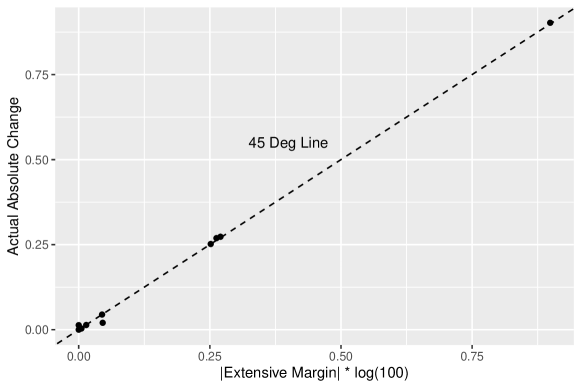
- Sensitivity analyses show that rescaling the outcome by a factor can change the ATE for log-like transforms by roughly the log of the scaling, driven by the extensive margin effect.
- The paper provides empirical illustrations showing substantial scaling sensitivity in papers using arcsinh(Y) or log(1+Y) in AER publications.
Better researchstarts right now
From reading papers to final review, dramatically reduce your research time.
No credit card · Free plan available
This review was created by AI and reviewed by human editors.