
[Paper Review] Long-form factuality in large language models
The paper introduces LongFact for long-form factuality benchmarking, SAFE as an automated factuality evaluator using Google Search, a new F1-based metric F1@K, and benchmarks 13 models across 4 families on 38 topics.
Large language models (LLMs) often generate content that contains factual errors when responding to fact-seeking prompts on open-ended topics. To benchmark a model's long-form factuality in open domains, we first use GPT-4 to generate LongFact, a prompt set comprising thousands of questions spanning 38 topics. We then propose that LLM agents can be used as automated evaluators for long-form factuality through a method which we call Search-Augmented Factuality Evaluator (SAFE). SAFE utilizes an LLM to break down a long-form response into a set of individual facts and to evaluate the accuracy of each fact using a multi-step reasoning process comprising sending search queries to Google Search and determining whether a fact is supported by the search results. Furthermore, we propose extending F1 score as an aggregated metric for long-form factuality. To do so, we balance the percentage of supported facts in a response (precision) with the percentage of provided facts relative to a hyperparameter representing a user's preferred response length (recall). Empirically, we demonstrate that LLM agents can outperform crowdsourced human annotators - on a set of ~16k individual facts, SAFE agrees with crowdsourced human annotators 72% of the time, and on a random subset of 100 disagreement cases, SAFE wins 76% of the time. At the same time, SAFE is more than 20 times cheaper than human annotators. We also benchmark thirteen language models on LongFact across four model families (Gemini, GPT, Claude, and PaLM-2), finding that larger language models generally achieve better long-form factuality. LongFact, SAFE, and all experimental code are available at https://github.com/google-deepmind/long-form-factuality.
Motivation & Objective
- Propose LongFact, a large-scale long-form factuality prompt set spanning 38 topics.
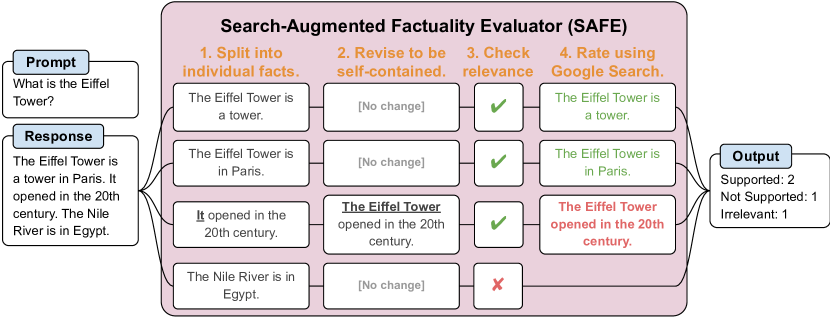
- Introduce SAFE, an LLM-based autorater that decomposes responses and verifies facts via Google Search.
- Define F1@K as a recall-aware aggregation metric for long-form factuality.
- Benchmark 13 models across four families to assess scaling effects on factuality.
Proposed method
- Generate LongFact prompts via GPT-4 to cover long-form fact-seeking questions across 38 topics (LongFact-Concepts and LongFact-Objects).
- Develop SAFE: an LLM agent that splits responses into self-contained facts, assesses relevance, and uses multi-step Google Search reasoning to label facts as supported/not supported/irrelevant.
- Aggregate factuality with F1@K, a precision-recall hybrid where recall is tied to a user-specified ideal length K.
- Benchmark 13 models (Gemini, GPT, Claude, PaLM-2) using SAFE on a fixed set of prompts, reporting F1@K at K=64 and K=178.
Experimental results
Research questions
- RQ1How well can a large-scale prompt set (LongFact) probe long-form factuality across diverse topics?
- RQ2Can an LLM-based autorater (SAFE) reliably assess factuality of long-form responses compared with human annotators?
- RQ3How does model size/architecture affect long-form factuality across major families (Gemini, GPT, Claude, PaLM-2)?
- RQ4Does incorporating a recall component via a hyperparameter K improve the usefulness of factuality metrics for long-form responses?
Key findings
- LongFact provides a broad, long-form factuality benchmark across 38 topics with 2,280 prompts.
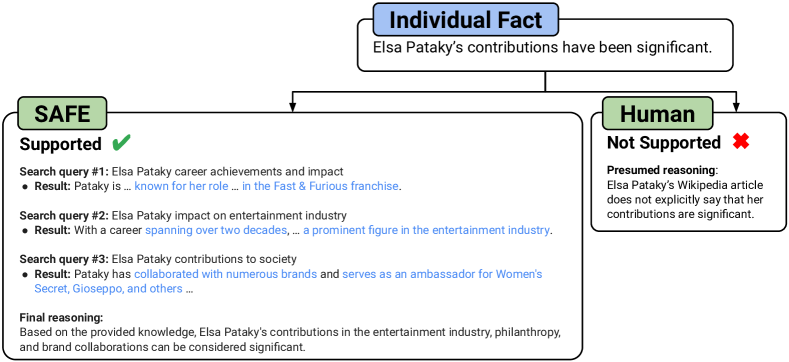
- SAFE agrees with human annotations on 72% of individual facts and outperforms human raters on disagreement cases (76% correctness in a sampled subset).
- SAFE costs roughly $0.19 per response, over 20x cheaper than crowdsourced human annotations.
- Across 13 models, larger models generally show higher long-form factuality, with GPT-4-Turbo, Gemini-Ultra, and PaLM-2-L-IT-RLHF leading the rankings at fixed K values.
- The F1@K metric captures precision and recall (via a human-preferred length K) to quantify long-form factuality consistently.
Read this paper
Open the full text in the Nubint reader and ask about any passage as you read.
Read this paper on NubintThis review was generated by AI from the original paper. Please check the paper before citing it.