
[Paper Review] Long-Tailed Recognition via Weight Balancing
This paper proposes a simple yet effective two-stage training approach for long-tailed recognition by balancing classifier weights using weight decay and MaxNorm regularization, achieving state-of-the-art accuracy of 53.35% on CIFAR100-LT (imbalance factor 100) without complex architectures or data augmentation.
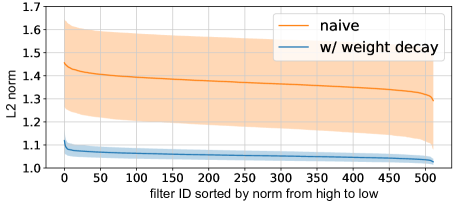
In the real open world, data tends to follow long-tailed class distributions, motivating the well-studied long-tailed recognition (LTR) problem. Naive training produces models that are biased toward common classes in terms of higher accuracy. The key to addressing LTR is to balance various aspects including data distribution, training losses, and gradients in learning. We explore an orthogonal direction, weight balancing, motivated by the empirical observation that the naively trained classifier has "artificially" larger weights in norm for common classes (because there exists abundant data to train them, unlike the rare classes). We investigate three techniques to balance weights, L2-normalization, weight decay, and MaxNorm. We first point out that L2-normalization "perfectly" balances per-class weights to be unit norm, but such a hard constraint might prevent classes from learning better classifiers. In contrast, weight decay penalizes larger weights more heavily and so learns small balanced weights; the MaxNorm constraint encourages growing small weights within a norm ball but caps all the weights by the radius. Our extensive study shows that both help learn balanced weights and greatly improve the LTR accuracy. Surprisingly, weight decay, although underexplored in LTR, significantly improves over prior work. Therefore, we adopt a two-stage training paradigm and propose a simple approach to LTR: (1) learning features using the cross-entropy loss by tuning weight decay, and (2) learning classifiers using class-balanced loss by tuning weight decay and MaxNorm. Our approach achieves the state-of-the-art accuracy on five standard benchmarks, serving as a future baseline for long-tailed recognition.
Motivation & Objective
- Address the bias in deep learning models toward common classes in long-tailed data distributions.
- Investigate the root cause of performance disparity: artificially large classifier weight norms for common classes due to abundant training data.
- Explore orthogonal regularization techniques to balance per-class weight norms and improve rare-class performance.
- Develop a simple, effective two-stage training paradigm that decouples feature learning from classifier learning for improved generalization.
Proposed method
- Apply L2-normalization to enforce unit norm on all per-class classifier weights, though found too restrictive for optimal performance.
- Use weight decay to penalize large weights more heavily, encouraging smaller, more balanced weight norms across all classes.
- Implement MaxNorm constraint to cap weight norms within a fixed radius, allowing small weights to grow while preventing over-optimization.
- Adopt a two-stage training strategy: first train features with cross-entropy loss and tuned weight decay, then fine-tune the classifier with class-balanced loss and combined weight decay and MaxNorm.
- Visualize weight evolution during training using a 2D pre-logit layer to demonstrate norm balancing dynamics.
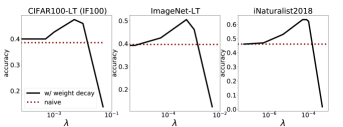
- Conduct extensive ablation studies on CIFAR100-LT to evaluate the impact of each regularization technique and training stage.
Experimental results
Research questions
- RQ1Why do naively trained models perform poorly on rare classes in long-tailed datasets?
- RQ2To what extent can weight norm balancing improve long-tailed recognition accuracy compared to existing data or loss reweighting methods?
- RQ3How do different regularization techniques—L2-normalization, weight decay, and MaxNorm—affect the balance and magnitude of classifier weights?
- RQ4What is the optimal training strategy (e.g., two-stage fine-tuning) for leveraging weight balancing in long-tailed recognition?
- RQ5Can simple, well-known regularizers outperform complex state-of-the-art methods in long-tailed recognition without architectural or data augmentation changes?
Key findings
- Weight decay alone improves accuracy from 38.38% (naive training) to 46.08% on CIFAR100-LT (IF=100), a relative gain of +8%.
- Fine-tuning the last layer with class-balanced loss and weight decay increases accuracy to 52.42%, showing the benefit of combining loss and regularization.
- Adding MaxNorm to the best setup (CB + WD) yields an additional 1% improvement, achieving 53.35% top-1 accuracy on CIFAR100-LT.
- Fine-tuning the last two layers with CB, WD, and MaxNorm achieves 53.55% accuracy, slightly better than last-layer fine-tuning.
- Over-fine-tuning more layers degrades performance, likely due to gradient conflicts introduced by class-balanced loss during feature learning.
- Visualization confirms that weight decay and MaxNorm lead to more balanced weight norms across classes, especially reducing the dominance of common-class weights.
Read this paper
Open the full text in the Nubint reader and ask about any passage as you read.
Read this paper on NubintThis review was generated by AI from the original paper. Please check the paper before citing it.