
[Paper Review] Long-term predictions of turbulence by implicit U-Net enhanced Fourier neural operator
The paper proposes IU-FNO, an implicit U-Net enhanced Fourier neural operator, to achieve stable, accurate, and fast long-term predictions of 3D turbulence in LES, outperforming vanilla FNO, IFNO, and U-FNO and DSM in various statistics.
Long-term predictions of nonlinear dynamics of three-dimensional (3D) turbulence are very challenging for machine learning approaches. In this paper, we propose an implicit U-Net enhanced Fourier neural operator (IU-FNO) for stable and efficient predictions on the long-term large-scale dynamics of turbulence. The IU-FNO model employs implicit recurrent Fourier layers for deeper network extension and incorporates the U-net network for the accurate prediction on small-scale flow structures. The model is systematically tested in large-eddy simulations of three types of 3D turbulence, including forced homogeneous isotropic turbulence (HIT), temporally evolving turbulent mixing layer, and decaying homogeneous isotropic turbulence. The numerical simulations demonstrate that the IU-FNO model is more accurate than other FNO-based models including vanilla FNO, implicit FNO (IFNO) and U-Net enhanced FNO (U-FNO), and dynamic Smagorinsky model (DSM) in predicting a variety of statistics including the velocity spectrum, probability density functions (PDFs) of vorticity and velocity increments, and instantaneous spatial structures of flow field. Moreover, IU-FNO improves long-term stable predictions, which has not been achieved by the previous versions of FNO. Besides, the proposed model is much faster than traditional LES with DSM model, and can be well generalized to the situations of higher Taylor-Reynolds numbers and unseen flow regime of decaying turbulence.
Motivation & Objective
- Motivate the challenge of long-term nonlinear turbulence prediction in 3D flows and the limitations of existing ML approaches.
- Develop a surrogate model (IU-FNO) that combines implicit Fourier layers with a U-Net to capture large- and small-scale structures.
- Demonstrate superior accuracy and stability for long-term predictions across multiple turbulent regimes.
- Show that IU-FNO is faster than DSM-based LES and can generalize to higher Reynolds numbers and unseen flow regimes.
Proposed method
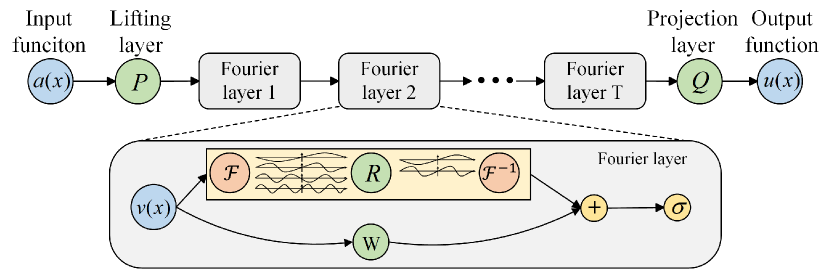
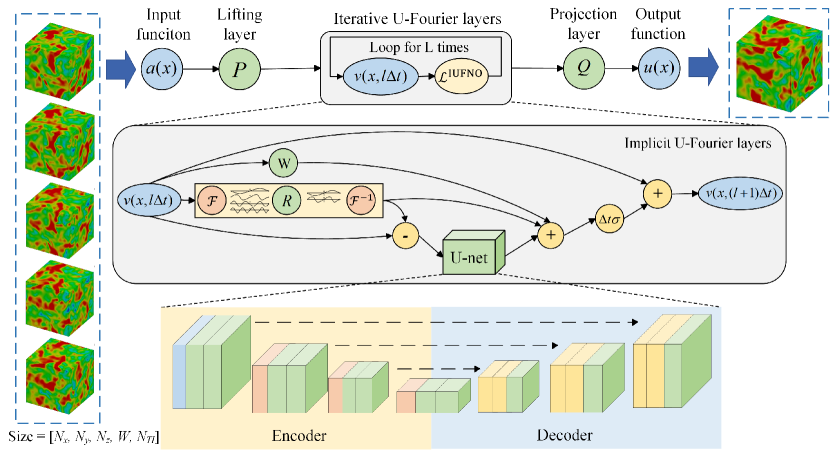
- Introduce IU-FNO by integrating an implicit Fourier layer with a U-Net to predict velocity increments between time steps.
- Use a shared hidden layer to enable deep networks with a fixed parameter count, enabling long-time integration.
- Compute small-scale corrections via a U-Net applied to the difference between full field and large-scale FFT reconstruction.
- Train on fDNS-derived data from forced HIT and evaluate a posteriori against DSM and other FNO variants across several turbulent flows.
- Compare performance using velocity spectra, PDFs of vorticity and velocity increments, structure functions, and instantaneous flow structures.
Experimental results
Research questions
- RQ1Can IU-FNO achieve stable long-term predictions for 3D turbulence in LES beyond the capabilities of vanilla FNO, IFNO, and U-FNO?
- RQ2Do implicit shared-layer architectures reduce parameter count while maintaining or improving accuracy for deep FNO models?
- RQ3How does IU-FNO perform across different turbulent regimes (forced HIT, mixing layer, decaying HIT) in terms of spectral, statistical, and structural metrics?
- RQ4Is IU-FNO faster and more generalizable than traditional DSM-based LES and other ML surrogates at higher Reλ or unseen regimes?
Key findings
- IU-FNO yields accurate velocity spectra for short- and long-term predictions up to t/τ ≤ 50 and remains stable for t/τ ≥ 100 in forced HIT.
- Incorporating U-Net to learn small-scale structures improves training and testing losses over baseline FNO and U-FNO, with IU-FNO achieving the smallest testing loss at L=40 (0.155).
- Implicit shared-layer models (IFNO and IU-FNO) reduce parameter count and maintain performance as depth increases, unlike standard FNO/U-FNO.
- IU-FNO maintains accurate second- and fourth-order structure functions across time, while DSM diverges in some regimes.
- PDFs of velocity increments under IU-FNO remain close to fDNS over time, outperforming IFNO and U-FNO in later times.
- Overall, IU-FNO outperforms DSM, DMM, VGM, and prior FNO variants in pressureless turbulence statistics and instantaneous flow structures, and offers substantial computational speed gains over traditional LES.
Read this paper
Open the full text in the Nubint reader and ask about any passage as you read.
Read this paper on NubintThis review was generated by AI from the original paper. Please check the paper before citing it.