
[Paper Review] Long-Term Rhythmic Video Soundtracker
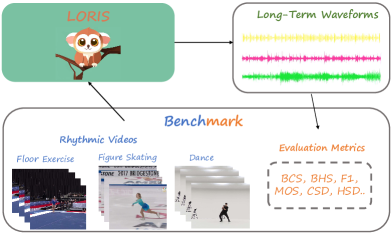
LORIS is a novel latent conditional diffusion model that generates long-term, rhythmically synchronized musical waveforms from rhythmic videos by integrating visual, motion, and temporal context via Hawkes processes and Bi-LSTM encoders. It achieves state-of-the-art performance in musical quality and rhythmic correspondence on a newly established benchmark with 86.43 hours of diverse video-music data across dancing and sports scenarios.
We consider the problem of generating musical soundtracks in sync with rhythmic visual cues. Most existing works rely on pre-defined music representations, leading to the incompetence of generative flexibility and complexity. Other methods directly generating video-conditioned waveforms suffer from limited scenarios, short lengths, and unstable generation quality. To this end, we present Long-Term Rhythmic Video Soundtracker (LORIS), a novel framework to synthesize long-term conditional waveforms. Specifically, our framework consists of a latent conditional diffusion probabilistic model to perform waveform synthesis. Furthermore, a series of context-aware conditioning encoders are proposed to take temporal information into consideration for a long-term generation. Notably, we extend our model's applicability from dances to multiple sports scenarios such as floor exercise and figure skating. To perform comprehensive evaluations, we establish a benchmark for rhythmic video soundtracks including the pre-processed dataset, improved evaluation metrics, and robust generative baselines. Extensive experiments show that our model generates long-term soundtracks with state-of-the-art musical quality and rhythmic correspondence. Codes are available at \url{https://github.com/OpenGVLab/LORIS}.
Motivation & Objective
- Address the lack of long-term, high-fidelity, video-conditioned music generation with rich audio expressiveness.
- Overcome limitations of prior methods relying on symbolic music representations (e.g., MIDI) or short, low-quality waveform generation.
- Enable generalization beyond dancing to complex rhythmic sports like floor exercise and figure skating.
- Establish a comprehensive benchmark with large-scale paired video-music data, improved evaluation metrics, and strong generative baselines for future research.
Proposed method
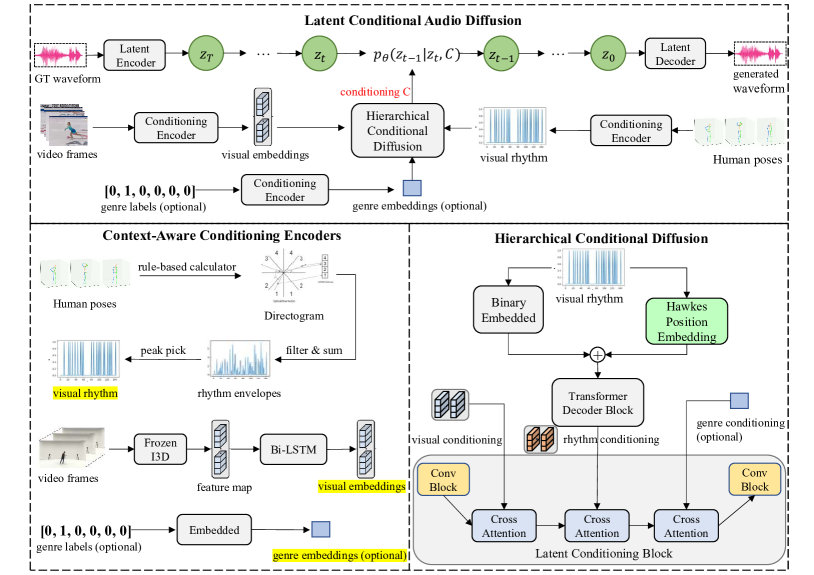
- Propose a latent conditional diffusion model (LDM) that compresses audio waveforms into latent space for efficient, high-fidelity generation.
- Integrate multiple conditionings—RGB video features, 2D pose motion sequences, and extracted visual rhythms—via cross-attention mechanisms.
- Model temporal context using a Bi-LSTM over RGB embeddings and a Hawkes process over visual rhythm events to capture long-range dependencies.
- Use positional encoding on visual rhythm embeddings to preserve temporal order and improve alignment with audio peaks.
- Condition the diffusion process by injecting visual rhythm envelopes into the latent audio features through cross-attention, not simple element-wise multiplication.
- Train the model end-to-end using a denoising objective on the latent space with a discrete T-step noise schedule.
Experimental results
Research questions
- RQ1Can a latent diffusion model effectively generate long-term, high-quality waveforms conditioned on rhythmic visual videos?
- RQ2How do context-aware temporal modeling components (e.g., Hawkes process, Bi-LSTM) improve rhythmic alignment and generation stability?
- RQ3To what extent does the model generalize across diverse rhythmic activities beyond dancing, such as floor exercise and figure skating?
- RQ4How do improved evaluation metrics capture long-term musical quality and rhythmic correspondence better than existing short-length metrics?
- RQ5What is the relative contribution of visual, motion, and rhythm features to the model’s performance in audio-visual alignment?
Key findings
- LORIS achieves the highest F1 score of 62.7 on the LORIS FE25 subset, significantly outperforming ablated models and baselines in both musical quality and rhythmic correspondence.
- The ablation study shows that removing the Bi-LSTM layer reduces coverage by 5.6 percentage points, proving the necessity of temporal modeling on visual features.
- The Hawkes process and positional encoding on rhythm embeddings contribute meaningfully to rhythmic alignment, outperforming simple multiplication (rhymul) by 4.1 F1 points.
- LORIS w/ visual rhythm conditioning achieves better performance than models using only RGB or motion features, confirming the importance of rhythm-aware conditioning.
- Qualitative results show accurate alignment between visual rhythm peaks and audio peaks, even when ground-truth rhythms are mismatched, indicating robust audio-visual correspondence learning.
- The model generates diverse, non-repetitive outputs due to the stochastic sampling nature of diffusion models, while maintaining consistent rhythmic structure across long sequences.
Read this paper
Open the full text in the Nubint reader and ask about any passage as you read.
Read this paper on NubintThis review was generated by AI from the original paper. Please check the paper before citing it.