
[Paper Review] LoRA+: Efficient Low Rank Adaptation of Large Models
LoRA+ improves Low Rank Adaptation by using asymmetric learning rates for the adapter matrices, achieving 1-2% performance gains and up to ~2x faster finetuning without extra computational cost.
In this paper, we show that Low Rank Adaptation (LoRA) as originally introduced in Hu et al. (2021) leads to suboptimal finetuning of models with large width (embedding dimension). This is due to the fact that adapter matrices A and B in LoRA are updated with the same learning rate. Using scaling arguments for large width networks, we demonstrate that using the same learning rate for A and B does not allow efficient feature learning. We then show that this suboptimality of LoRA can be corrected simply by setting different learning rates for the LoRA adapter matrices A and B with a well-chosen ratio. We call this proposed algorithm LoRA$+$. In our extensive experiments, LoRA$+$ improves performance (1-2 $\%$ improvements) and finetuning speed (up to $\sim$ 2X SpeedUp), at the same computational cost as LoRA.
Motivation & Objective
- Motivate and diagnose suboptimal finetuning of standard LoRA on wide models due to equal learning rates for A and B adapters.
- Propose a principled learning-rate scaling with a fixed ratio between the LoRA adapters A and B based on infinite-width scaling arguments.
- Demonstrate improvement in fine-tuning performance and speed across language models and tasks.
- Provide practical guidelines for choosing the ratio and operating regime for LoRA+ in real-world settings.
Proposed method
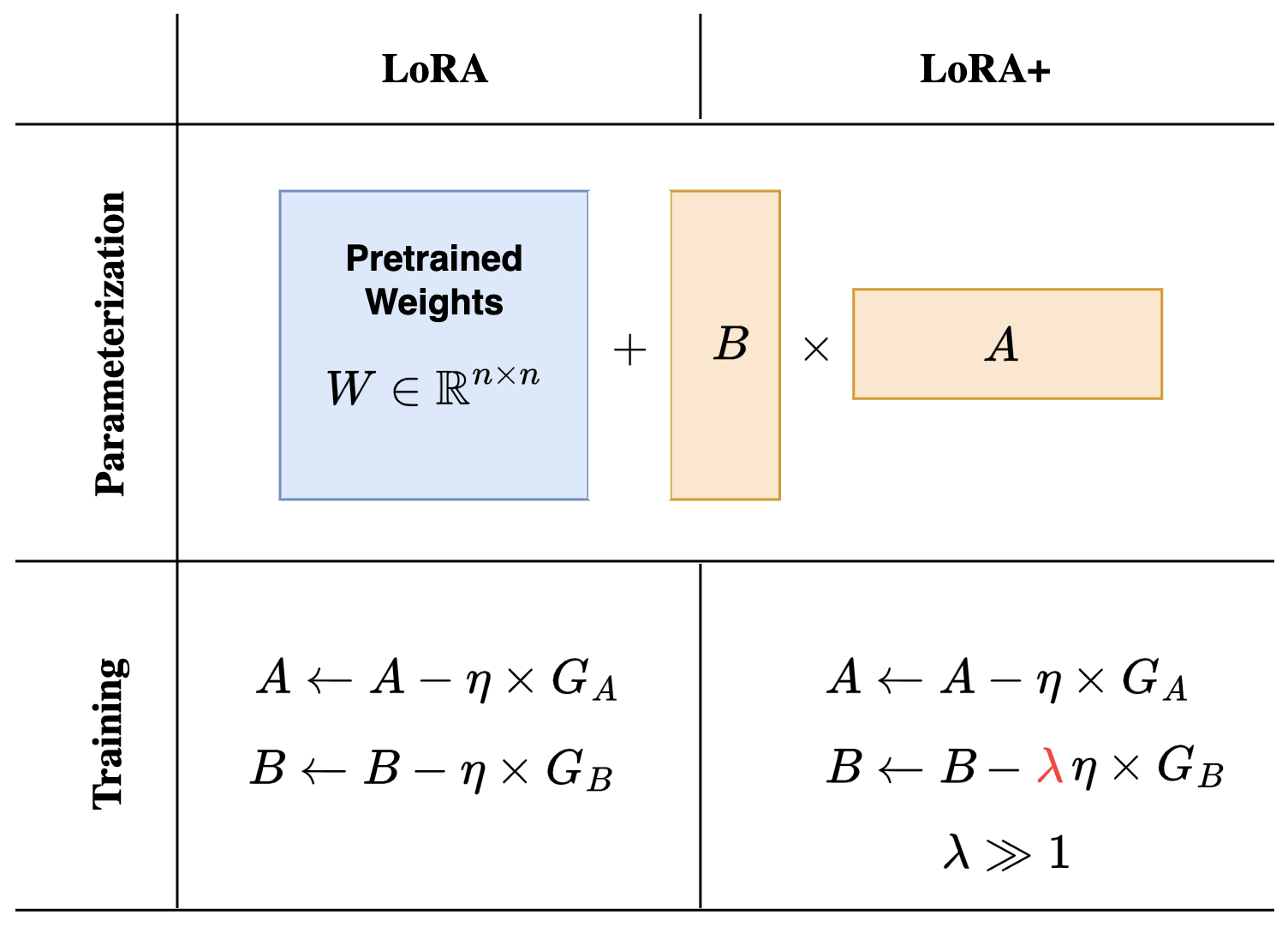
- Introduce LoRA adapters W = W* + (alpha/r) B A as in standard LoRA and analyze training dynamics in the infinite-width limit.
- Show that using the same learning rate for A and B is suboptimal for wide models and derive a fixed ratio where eta_A = Theta(n^{-1}) and eta_B = Theta(1).
- Develop theoretical scaling arguments based on network width to ensure stable and efficient feature learning (Delta f_t = Theta(1)).
- Validate the theory with toy linear and non-linear models and extensive experiments on language model finetuning.
- Compare LoRA+ against standard LoRA, reporting improvements in performance (1-2%) and finetuning speed (up to ~2x) at the same computational cost.
Experimental results
Research questions
- RQ1Does equal learning rate for LoRA adapters A and B hinder feature learning as model width grows?
- RQ2Can a principled ratio between the learning rates eta_A and eta_B restore efficient fine-tuning in the infinite-width regime?
- RQ3Do the proposed scaling rules improve practical finetuning performance and speed across language models and tasks?
- RQ4What guidelines emerge for choosing the fixed ratio between eta_B and eta_A in real-world settings?
Key findings
- Standard LoRA with the same learning rate for A and B is inefficient for wide models.
- A principled setting with eta_A = Theta(n^{-1}) and eta_B = Theta(1) yields stable and efficient LoRA fine-tuning (Delta Z_B^t = Theta(1)).
- LoRA+ achieves 1-2% performance improvements and up to 2x finetuning speedups at the same computational cost as LoRA.
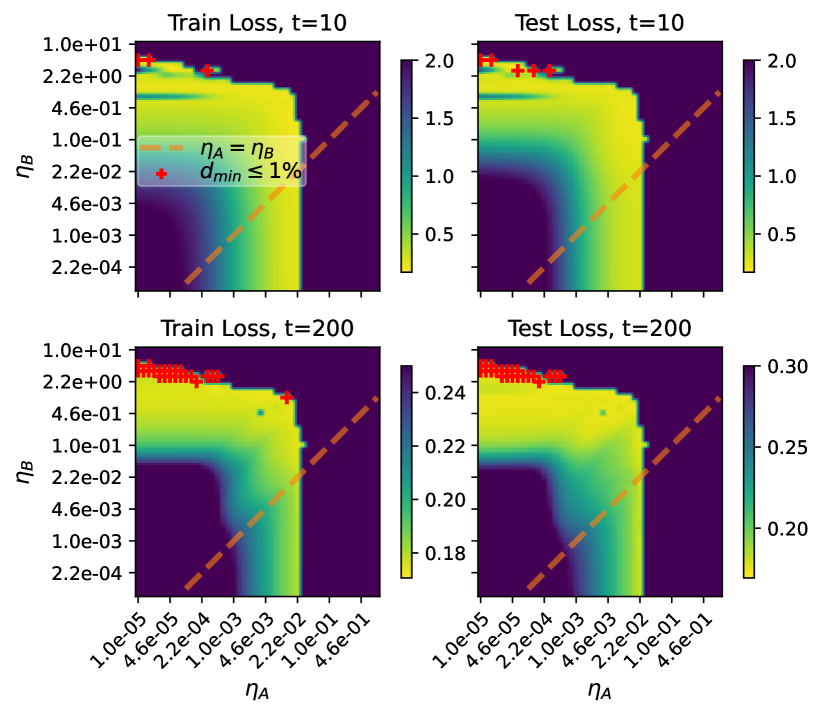
- Toy and neural-network experiments corroborate that eta_B >> eta_A generally yields near-optimal losses and stable feature learning.
- The approach provides guidance for choosing a fixed eta_B/eta_A ratio to simplify hyperparameter tuning while maintaining efficiency.
Read this paper
Open the full text in the Nubint reader and ask about any passage as you read.
Read this paper on NubintThis review was generated by AI from the original paper. Please check the paper before citing it.