
[Paper Review] LoRA Land: 310 Fine-tuned LLMs that Rival GPT-4, A Technical Report
The paper evaluates 310 LoRA-fine-tuned LLMs across 10 base models and 31 tasks, showing that 4-bit LoRA fine-tuning often surpasses base models and GPT-4 on average, and demonstrates real-world deployment with LoRAX and LoRA Land hosting 25 fine-tuned Mistral-7B models on a single A100 GPU.
Low Rank Adaptation (LoRA) has emerged as one of the most widely adopted methods for Parameter Efficient Fine-Tuning (PEFT) of Large Language Models (LLMs). LoRA reduces the number of trainable parameters and memory usage while achieving comparable performance to full fine-tuning. We aim to assess the viability of training and serving LLMs fine-tuned with LoRA in real-world applications. First, we measure the quality of LLMs fine-tuned with quantized low rank adapters across 10 base models and 31 tasks for a total of 310 models. We find that 4-bit LoRA fine-tuned models outperform base models by 34 points and GPT-4 by 10 points on average. Second, we investigate the most effective base models for fine-tuning and assess the correlative and predictive capacities of task complexity heuristics in forecasting the outcomes of fine-tuning. Finally, we evaluate the latency and concurrency capabilities of LoRAX, an open-source Multi-LoRA inference server that facilitates the deployment of multiple LoRA fine-tuned models on a single GPU using shared base model weights and dynamic adapter loading. LoRAX powers LoRA Land, a web application that hosts 25 LoRA fine-tuned Mistral-7B LLMs on a single NVIDIA A100 GPU with 80GB memory. LoRA Land highlights the quality and cost-effectiveness of employing multiple specialized LLMs over a single, general-purpose LLM.
Motivation & Objective
- Assess the viability of training and serving LoRA-fine-tuned LLMs in real-world applications.
- Quantify performance gains from LoRA fine-tuning across diverse base models and tasks under standardized prompts.
- Investigate which base models and task characteristics best predict fine-tuning benefits.
- Evaluate latency, concurrency, and practicality of serving multiple LoRA adapters with LoRAX in production.
Proposed method
- Standardized fine-tuning of 310 LLMs using LoRA with 4-bit quantization and rank 8 on 10 base models.
- Uniform training settings: 40,000 steps, batch size 1, paged Adam, learning rate 0.002, cosine schedule with 3% warm-up, 16 accumulation steps.
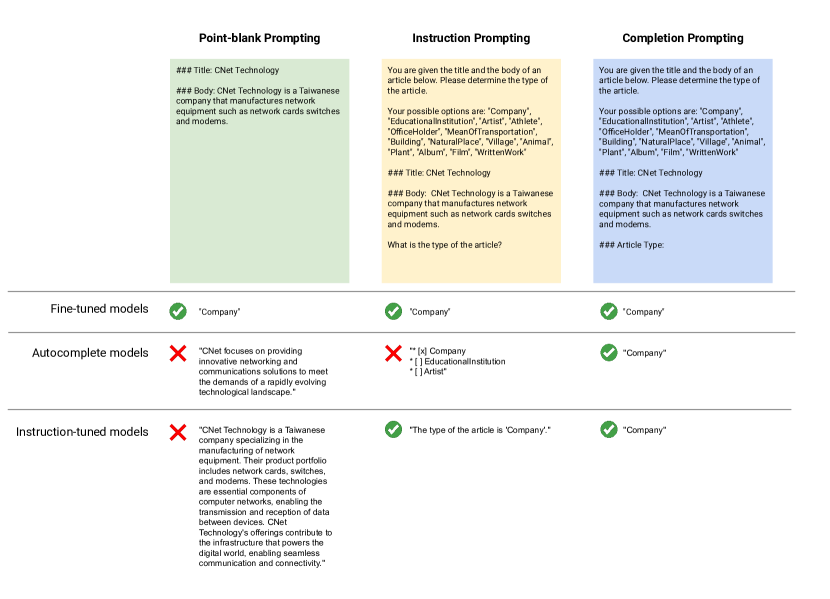
- Evaluation using zero or single-shot completion prompts, with regex extraction to map outputs to ground-truth vocabularies.
- ROUGE-L for generation tasks, accuracy for classification, MAE for regression, with task-specific adaptations (WikiSQL ROUGE as proxy).
- Use LoRAX to enable dynamic adapter loading and multi-model serving on a single GPU, and deploy 25 LoRA-finetuned Mistral-7B models in LoRA Land.
Experimental results
Research questions
- RQ1How effective is LoRA fine-tuning across a wide set of base models and tasks under standardized prompts?
- RQ2Which base models benefit most from LoRA fine-tuning, and how does model size influence gains?
- RQ3Can task complexity heuristics predict the magnitude of fine-tuning gains and lift over baselines?
- RQ4Is it viable to deploy and serve multiple LoRA adapters efficiently in production using LoRAX?
Key findings
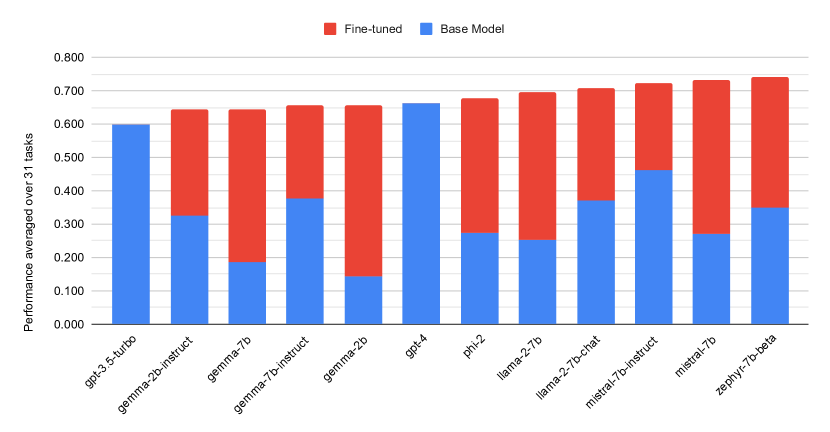
- 4-bit LoRA fine-tuned models outperform base models by 34 points on average and GPT-4 by 10 points on average across 31 tasks and 10 base models.
- The best fine-tuned LLMs surpass their base-model counterparts in 301 of 310 tasks, and 224 of 310 surpass GPT-4.
- Phi-2 (2B) is competitive with GPT-4 after fine-tuning; 7B models generally outperform their 2B counterparts post-tuning.
- Mistral-7B and Zephyr-7b-beta emerge as top base-models for LoRA fine-tuning, with Mistral-7B most frequently tops across tasks and Zephyr-7b-beta achieving the highest overall average.
- LoRAX enables serving 25 LoRA-finetuned Mistral-7B models on a single A100, demonstrating practical, cost-effective multi-model deployment.
Read this paper
Open the full text in the Nubint reader and ask about any passage as you read.
Read this paper on NubintThis review was generated by AI from the original paper. Please check the paper before citing it.