
[Paper Review] LoRA-XS: Low-Rank Adaptation with Extremely Small Number of Parameters
LoRA-XS introduces a highly parameter-efficient fine-tuning method that reduces trainable parameters by over 100x in 7B models by using SVD to freeze LoRA projection matrices and training only an $ r imes r $ adapter matrix between them. This approach achieves superior parameter efficiency and competitive performance compared to LoRA and VeRA, with storage requirements reduced by over 1500x for million-scale personalized models.
The growth of large language models underscores the need for parameter-efficient fine-tuning. Despite its popularity, LoRA encounters storage and computational challenges when deploying multiple task- or user-specific modules. To address this, we introduce LoRA-XS, a novel fine-tuning method backed by a theoretical derivation. LoRA-XS drastically reduces trainable parameters by incorporating a small, trainable weight matrix between frozen low-rank matrices derived from the Singular Value Decomposition of pre-trained weights. This design enables LoRA-XS to reduce storage requirements by over 100x in 7B models compared to LoRA. Additionally, unlike other methods, LoRA-XS imposes no lower bound on trainable parameters - it can scale from a single parameter per module to arbitrarily large values, adapting to any storage or computational constraint. Evaluations on GLUE, GSM8K, MATH, and commonsense reasoning benchmarks across different model scales reveal that LoRA-XS consistently outperforms or matches LoRA and VeRA in accuracy, offering unmatched parameter efficiency. Our ablation studies highlight the significance of singular vectors in transformer weights, establishing LoRA-XS as a powerful, storage-efficient solution for scaling and personalizing large language models.
Motivation & Objective
- Address the growing storage and computational burden of deploying numerous task-specific or personalized LoRA adapters on large language models.
- Overcome the dependency of existing PEFT methods like LoRA and VeRA on model hidden dimensions, which limits scalability for larger models.
- Achieve extreme parameter efficiency without sacrificing performance, enabling flexible and low-memory deployment of personalized models.
- Maintain inference efficiency by avoiding architectural modifications or additional latency during inference.
- Explore the impact of initialization strategies on convergence speed and final performance in ultra-low parameter regimes.
Proposed method
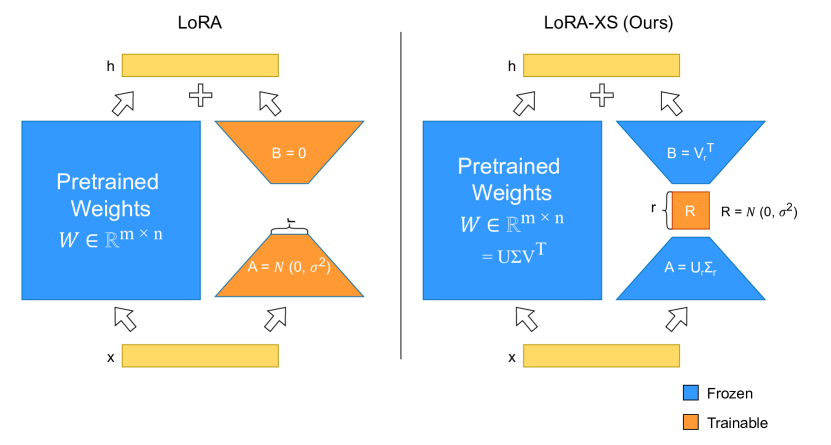
- Use Singular Value Decomposition (SVD) to decompose pretrained weight matrices into fixed, frozen LoRA projection matrices $ A $ and $ B $, initialized to the top principal components of the original weights.
- Introduce a small, trainable $ r imes r $ adapter matrix $ R $ between the frozen $ A $ and $ B $ matrices, which performs the low-rank adaptation.
- Train only the $ r imes r $ matrix $ R $, making the number of trainable parameters independent of model size and hidden dimension.
- Apply the LoRA-XS adapter to multiple attention and feed-forward layers (Query, Key, Value, Output, FFN) with low rank $ r $, enabling distributed parameter allocation.
- Use SVD-based initialization for $ A $ and $ B $ to align them with the dominant singular components of the pretrained weights, improving convergence and performance.
- Retain full inference compatibility with standard transformer inference by avoiding any architectural changes or additional modules.
Experimental results
Research questions
- RQ1Can we achieve extreme parameter efficiency in fine-tuning by decoupling trainable parameters from model hidden dimensions?
- RQ2Does SVD-based initialization of LoRA matrices improve convergence speed and final performance in low-rank adaptation?
- RQ3How does LoRA-XS compare to LoRA and VeRA in terms of parameter efficiency and performance across diverse benchmarks?
- RQ4Can LoRA-XS enable scalable personalization of large models with drastically reduced storage overhead?
- RQ5What is the impact of distributing LoRA-XS modules across multiple layers with low rank on overall performance and parameter efficiency?
Key findings
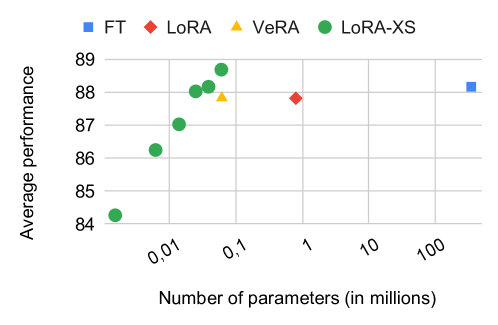
- LoRA-XS reduces the number of trainable parameters by over 100x in 7B models compared to standard LoRA, achieving extreme parameter efficiency.
- For GPT-3 with rank 16, LoRA-XS reduces storage for 1 million personalized models from 144TB (LoRA) to just 96GB, a 1500x reduction.
- LoRA-XS outperforms LoRA and VeRA in parameter efficiency on GLUE, GSM8k, and MATH benchmarks, achieving higher or comparable performance with far fewer parameters.
- SVD-based initialization of LoRA matrices leads to faster convergence and better performance, especially at low ranks, compared to random initialization.
- LoRA-XS maintains competitive performance on instruction tuning tasks with 7B models, demonstrating strong generalization despite minimal trainable parameters.
- The method enables flexible memory usage by allowing precise control over the number of trainable parameters through low-rank $ r $ and modular deployment across layers.
Read this paper
Open the full text in the Nubint reader and ask about any passage as you read.
Read this paper on NubintThis review was generated by AI from the original paper. Please check the paper before citing it.