
[Paper Review] Lorentz-Equivariant Geometric Algebra Transformers for High-Energy Physics
Introduces L-GATr, a Lorentz-equivariant geometric algebra Transformer for high-energy physics, and demonstrates regression, classification, and Lorentz-equivariant generative modeling via continuous normalizing flows trained with Riemannian flow matching.
Extracting scientific understanding from particle-physics experiments requires solving diverse learning problems with high precision and good data efficiency. We propose the Lorentz Geometric Algebra Transformer (L-GATr), a new multi-purpose architecture for high-energy physics. L-GATr represents high-energy data in a geometric algebra over four-dimensional space-time and is equivariant under Lorentz transformations, the symmetry group of relativistic kinematics. At the same time, the architecture is a Transformer, which makes it versatile and scalable to large systems. L-GATr is first demonstrated on regression and classification tasks from particle physics. We then construct the first Lorentz-equivariant generative model: a continuous normalizing flow based on an L-GATr network, trained with Riemannian flow matching. Across our experiments, L-GATr is on par with or outperforms strong domain-specific baselines.
Motivation & Objective
- Leverage Lorentz symmetry to design a data-efficient, versatile architecture for high-energy physics tasks.
- Represent particle data in a four-dimensional geometric algebra to enable natural Lorentz transformations.
- Develop Lorentz-equivariant layers and a Transformer architecture that scales to large particle systems.
- Demonstrate diverse tasks (regression, classification, and generative modeling) within a unified framework.
- Show that the proposed model outperforms or matches strong domain-specific baselines across tasks.
Proposed method
- Represent inputs as tokens in the geometric algebra G_{1,3} with particle-type scalars and four-momenta in the first grade.
- Construct Lorentz-equivariant linear maps between G_{1,3} channels with constrained parameter forms.
- Implement Lorentz-equivariant non-linear layers, including a scaled dot-product attention, a Lorentz-equivariant LayerNorm, and scalar-gated GELU nonlinearities.
- Integrate these layers into a Transformer architecture with multi-head attention and MLP blocks.
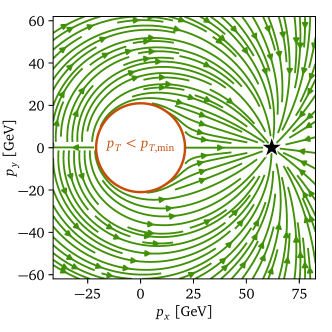
- Develop a Lorentz-equivariant continuous normalizing flow for generative modeling, trained via Riemannian flow matching to handle phase-space boundaries.
- Parameterize momentum-space constraints with physically meaningful coordinates and use geodesics on the momentum manifold to guide flow paths.
Experimental results
Research questions
- RQ1Can a Lorentz-equivariant geometric algebra representation improve accuracy and data efficiency for particle physics tasks compared to non-equivariant baselines?
- RQ2How does enforcing Lorentz symmetry influence regression, classification, and generative modeling performance in high-energy physics problems?
- RQ3Can a Lorentz-equivariant continuous normalizing flow produce high-fidelity, phase-space-boundary-aware generative samples for reconstructed particle data?
- RQ4What are the trade-offs in computation and scalability when using Lorentz-equivariant Transformers for dense, high-multiplicity particle data?
Key findings
- L-GATr achieves competitive or superior performance to strong baselines on regression, classification (top tagging), and generative modeling tasks.
- The Lorentz-equivariant generative model using Riemannian flow matching effectively respects phase-space boundaries and improves sample quality and likelihoods across jet multiplicities.
- L-GATr maintains data efficiency, performing well with varying dataset sizes due to its strong inductive biases and Transformer scalability.
- The approach scales comparably to standard Transformers in terms of attention-based computations and is more efficient than many Lorentz-equivariant message-passing architectures for dense graphs.
- Geodesic-based probability paths in RFM help preserve physical constraints and enhance learning of high-dimensional particle distributions.
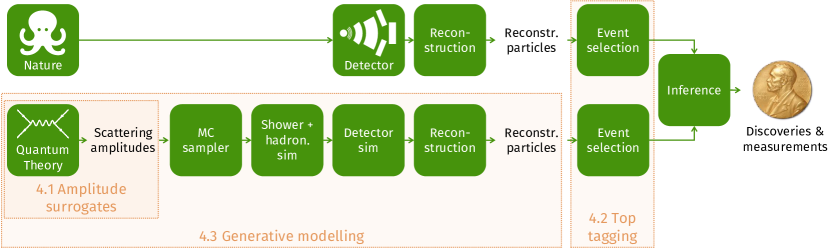
- The combination of Lorentz-equivariant representations with Transformer-style attention provides a versatile, general-purpose tool for multiple stages of the LHC analysis pipeline.
Read this paper
Open the full text in the Nubint reader and ask about any passage as you read.
Read this paper on NubintThis review was generated by AI from the original paper. Please check the paper before citing it.