
[Paper Review] Lorentz Local Canonicalization: How to Make Any Network Lorentz-Equivariant
LLoCa makes any backbone Lorentz-equivariant by predicting local reference frames and transforming features between frames, enabling exact Lorentz equivariance with modest overhead and improved performance across jet tagging and QFT amplitude regression tasks.
Lorentz-equivariant neural networks are becoming the leading architectures for high-energy physics. Current implementations rely on specialized layers, limiting architectural choices. We introduce Lorentz Local Canonicalization (LLoCa), a general framework that renders any backbone network exactly Lorentz-equivariant. Using equivariantly predicted local reference frames, we construct LLoCa-transformers and graph networks. We adapt a recent approach for geometric message passing to the non-compact Lorentz group, allowing propagation of space-time tensorial features. Data augmentation emerges from LLoCa as a special choice of reference frame. Our models achieve competitive and state-of-the-art accuracy on relevant particle physics tasks, while being $4 imes$ faster and using $10 imes$ fewer FLOPs.
Motivation & Objective
- Motivate the need for Lorentz-equivariant models in high-energy physics and address limitations of task-specific or costly architectures.
- Propose a general, backboned-agnostic framework (LLoCa) that canonicalizes inputs via locally predicted Lorentz frames.
- Enable exact Lorentz-equivariant processing by transforming features into local frames and back to the global frame.
- Demonstrate efficiency and accuracy gains on jet tagging and QFT amplitude regression, including comparisons to data augmentation.
- Show that LLoCa provides a fair basis to compare exact equivariance with augmentation and to quantify computational overhead.
Proposed method
- Predict local Lorentz frames per particle via equivariant modules and construct a local reference frame L that satisfies L^T g L = g and transforms as L -> L Λ^{-1}.
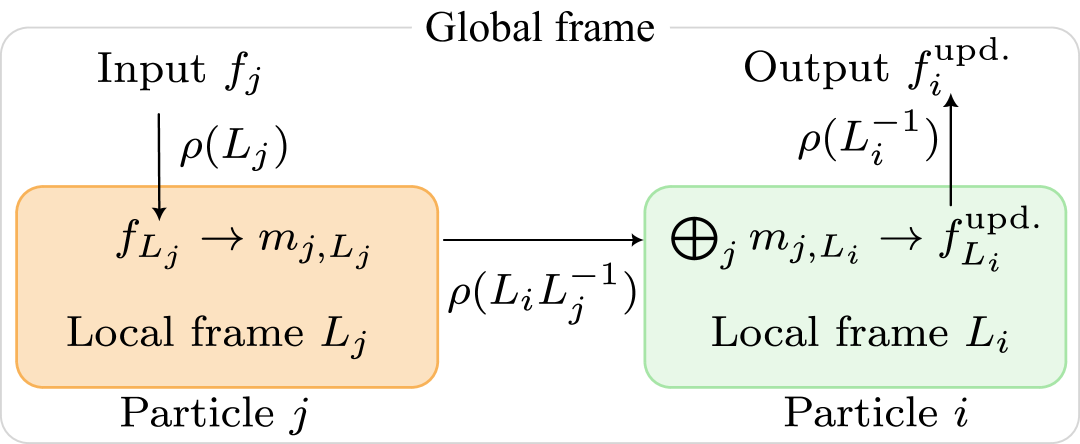
- Transform global four-vectors into local frames x_L = L x, yielding Lorentz-invariant local features that can be processed by any backbone (e.g., transformer, GNN).
- Perform tensorial messages between local frames using rho(L_i L_j^{-1}) to propagate Lorentz-equivariant information (including tensor representations beyond scalars).
- Implement tensorial scaled dot-product attention using Minkowski product for Lorentz-invariant attention weights, enabling efficient computation with standard attention backends.
- Construct local frames via a polar decomposition-based algorithm from equivariantly predicted vectors, ensuring L -> L Λ^{-1} under Lorentz transformations and numerical stability.
- Provide data-augmentation equivalence by showing non-equivariant and augmented baselines as special cases of the LLoCa framework.

Experimental results
Research questions
- RQ1Can a task-agnostic backbone be made exactly Lorentz-equivariant through local canonicalization?
- RQ2Does local canonicalization enable competitive or superior performance compared to specialized Lorentz architectures on HEP tasks?
- RQ3What is the computational trade-off (FLOPs, training time) of LLoCa relative to non-equivariant baselines and state-of-the-art Lorentz-equivariant models?
- RQ4How does LLoCa compare to data augmentation in terms of data efficiency and accuracy under varying training data regimes?
- RQ5To what extent do tensorial message representations within LLoCa contribute to performance gains?
Key findings
- LLoCa consistently improves non-equivariant backbones on jet tagging across multiple models, sometimes matching or surpassing domain-specific architectures.
- On QFT amplitude regression, LLoCa-transformers achieve state-of-the-art performance, outperforming more expensive SOTA models across Z+ng multiplicities.
- Tensorial message passing (e.g., multiple vectors/tensors) provides substantial gains over scalar-only messages in LLoCa.
- LLoCa incurs modest overhead (FLOPs +10–30%; training time +30–110%) yet trains faster and uses fewer FLOPs than other SOTA Lorentz-equivariant networks (e.g., L-GATr).
- Data augmentation can outperform exact equivariance for very small datasets, but LLoCa exhibits superior data efficiency in large-data regimes, highlighting its inductive bias benefits.
Read this paper
Open the full text in the Nubint reader and ask about any passage as you read.
Read this paper on NubintThis review was generated by AI from the original paper. Please check the paper before citing it.