
[Paper Review] LoViT: Long Video Transformer for Surgical Phase Recognition
LoViT proposes a two-stage Transformer-based method for surgical phase recognition that fuses local and global temporal features using cascaded L-Trans and ProbSparse self-attention modules, achieving state-of-the-art performance on Cholec80 (+2.4 pp) and AutoLaparo (+3.1 pp) by leveraging phase transition-aware supervision and video-clip level training.
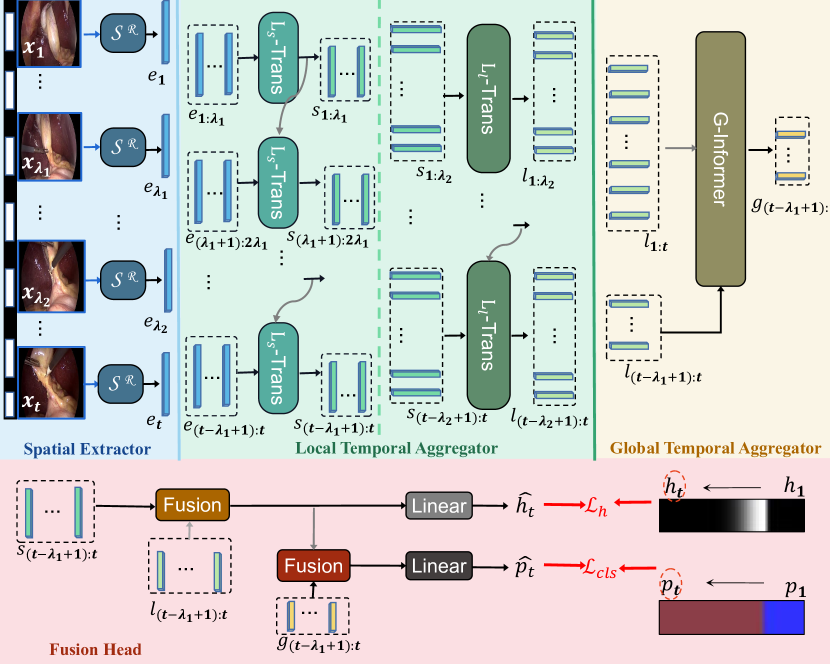
Online surgical phase recognition plays a significant role towards building contextual tools that could quantify performance and oversee the execution of surgical workflows. Current approaches are limited since they train spatial feature extractors using frame-level supervision that could lead to incorrect predictions due to similar frames appearing at different phases, and poorly fuse local and global features due to computational constraints which can affect the analysis of long videos commonly encountered in surgical interventions. In this paper, we present a two-stage method, called Long Video Transformer (LoViT) for fusing short- and long-term temporal information that combines a temporally-rich spatial feature extractor and a multi-scale temporal aggregator consisting of two cascaded L-Trans modules based on self-attention, followed by a G-Informer module based on ProbSparse self-attention for processing global temporal information. The multi-scale temporal head then combines local and global features and classifies surgical phases using phase transition-aware supervision. Our approach outperforms state-of-the-art methods on the Cholec80 and AutoLaparo datasets consistently. Compared to Trans-SVNet, LoViT achieves a 2.4 pp (percentage point) improvement in video-level accuracy on Cholec80 and a 3.1 pp improvement on AutoLaparo. Moreover, it achieves a 5.3 pp improvement in phase-level Jaccard on AutoLaparo and a 1.55 pp improvement on Cholec80. Our results demonstrate the effectiveness of our approach in achieving state-of-the-art performance of surgical phase recognition on two datasets of different surgical procedures and temporal sequencing characteristics whilst introducing mechanisms that cope with long videos.
Motivation & Objective
- Address the challenge of recognizing surgical phases in long-duration videos (1–2 hours) where standard models lose fine-grained temporal details.
- Overcome limitations of RNNs and TCNs in capturing long-range dependencies and preserving fine-grained features in surgical video sequences.
- Improve performance by fusing local short-term and global long-term temporal features through a multi-scale temporal aggregator.
- Introduce phase transition-aware supervision using a phase transition map to enhance modeling of phase transitions, improving recognition accuracy.
- Develop a method that maintains high accuracy and efficiency on long videos without relying on additional annotations like tool presence or instrument tracking.
Proposed method
- Train a temporally-rich spatial feature extractor using video-clip level supervision to avoid frame-level ambiguity from similar-looking frames across phases.
- Employ two cascaded L-Trans modules based on vanilla self-attention to aggregate local temporal features from short video clips.
- Apply a G-Informer module using ProbSparse self-attention to model global long-range dependencies across entire surgical videos.
- Combine local and global features via a multi-scale temporal head for phase classification.
- Introduce a phase transition map as a supervision signal to highlight transition regions between phases, improving model awareness of phase boundaries.
- Use end-to-end training with phase transition-aware supervision to enhance temporal reasoning without additional computational or annotation overhead.
Experimental results
Research questions
- RQ1Can a Transformer-based architecture effectively capture both local and global temporal dependencies in long surgical videos for phase recognition?
- RQ2How does phase transition-aware supervision improve the model's ability to recognize transitions between surgical phases?
- RQ3Does the fusion of local and global features through a multi-scale temporal aggregator outperform existing methods that rely on TCNs or RNNs?
- RQ4How does the model perform on datasets with complex phase repetition and small sample sizes, such as AutoLaparo?
- RQ5Can the proposed method maintain high accuracy and efficiency on long videos without suffering from memory or inference speed degradation?
Key findings
- LoViT achieves a 2.4 percentage point improvement in video-level accuracy over Trans-SVNet on the Cholec80 dataset.
- On the more challenging AutoLaparo dataset, LoViT achieves a 3.1 percentage point improvement over Trans-SVNet, demonstrating robustness to complex phase relationships.
- The model outperforms TMRNet, TeCNO, and Trans-SVNet on both datasets, indicating superior generalization and long-sequence modeling capability.
- Phase transition-aware supervision significantly improves recognition performance by enabling the model to better capture transitions between surgical phases.
- Local temporal features are more informative than global relationships in complex scenarios, especially in datasets with repeated phases like AutoLaparo.
- The use of ProbSparse self-attention enables efficient global modeling while preserving fine-grained features, outperforming dilated convolution-based TCN approaches that lose such details.
Read this paper
Open the full text in the Nubint reader and ask about any passage as you read.
Read this paper on NubintThis review was generated by AI from the original paper. Please check the paper before citing it.