
[Paper Review] Low Latency End-to-End Streaming Speech Recognition with a Scout Network
This paper proposes a low-latency end-to-end streaming speech recognition system using a scout network (SN) that detects word boundaries in real time, enabling the recognition network (RN) to dynamically adjust its look-ahead window. By leveraging the SN’s boundary predictions, the model achieves state-of-the-art WER of 2.7% (test-clean) and 6.4% (test-other) with only 639 ms frame-level latency on LibriSpeech, significantly reducing latency while maintaining high accuracy.
The attention-based Transformer model has achieved promising results for speech recognition (SR) in the offline mode. However, in the streaming mode, the Transformer model usually incurs significant latency to maintain its recognition accuracy when applying a fixed-length look-ahead window in each encoder layer. In this paper, we propose a novel low-latency streaming approach for Transformer models, which consists of a scout network and a recognition network. The scout network detects the whole word boundary without seeing any future frames, while the recognition network predicts the next subword by utilizing the information from all the frames before the predicted boundary. Our model achieves the best performance (2.7/6.4 WER) with only 639 ms latency on the test-clean and test-other data sets of Librispeech.
Motivation & Objective
- To address the high latency of streaming Transformer ASR models that rely on fixed look-ahead windows.
- To improve recognition accuracy in streaming settings by dynamically adapting the context window based on actual word boundaries.
- To enable a flexible trade-off between latency and word error rate (WER) through a learnable boundary detection mechanism.
- To reduce the computational and architectural overhead of fixed-chunk or fixed-window streaming approaches.
Proposed method
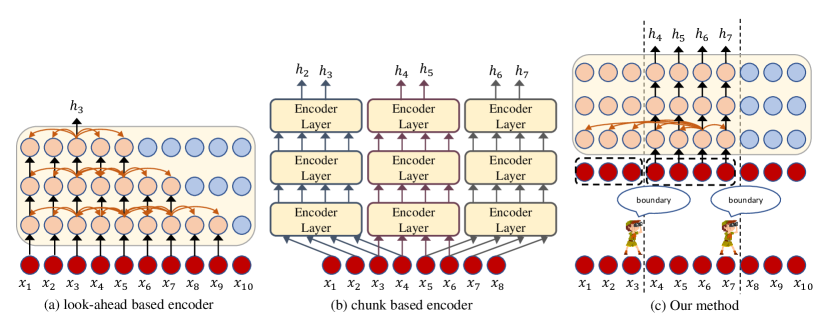
- Introduces a scout network (SN) that performs frame-level boundary classification (word start/end) without future context, ensuring zero latency overhead.
- Trains the SN as a sequence labeling task using forced alignment as ground truth, with a threshold-based decision to define word segments.
- Uses the predicted word boundaries from the SN to guide the recognition network (RN), which applies a dynamic, adaptive look-ahead window up to the detected boundary.
- Employs a trigger-attention (TA) based Transformer model as the RN for frame-synchronous, one-pass decoding with context limited to the predicted word boundary.
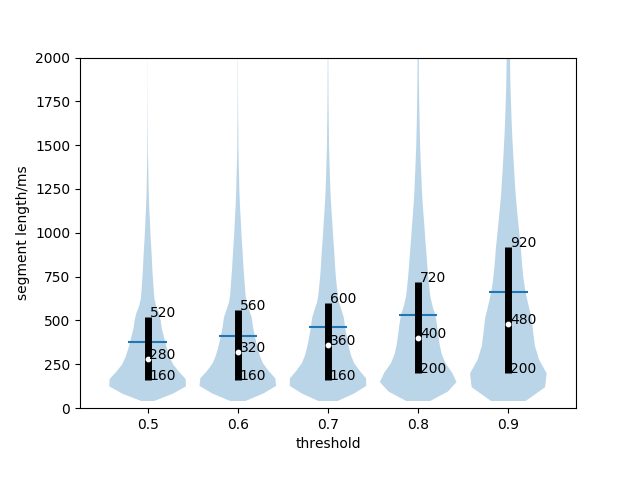
- Applies a threshold on the SN’s output probability to control precision/recall trade-offs, enabling latency-WER tuning.
- Computes frame-level and word-level latency metrics based on the difference between predicted and golden word boundaries.
Experimental results
Research questions
- RQ1Can a neural boundary detection component reduce latency in streaming end-to-end ASR without sacrificing recognition accuracy?
- RQ2How does dynamic, boundary-aware look-ahead compare to fixed-window or chunk-based approaches in terms of latency and WER?
- RQ3To what extent can the precision of word boundary detection influence the final recognition performance?
- RQ4Can golden word boundaries outperform even offline models in streaming settings?
Key findings
- The proposed method achieves a state-of-the-art WER of 2.7% on LibriSpeech test-clean and 6.4% on test-other with only 639 ms frame-level latency.
- Using a high SN threshold (σ=0.9) reduces WER to 2.9% (clean) and 7.4% (other) while maintaining low latency of 619 ms, outperforming fixed-window TA baselines with 2190 ms latency.
- The model with golden word boundaries achieves 2.1% and 5.3% WER, surpassing the offline model, demonstrating the value of accurate boundary information.
- Higher SN threshold increases boundary precision (lower recall), leading to lower WER, confirming that improved boundary detection enhances recognition quality.
- The large model with 138M parameters achieves 2.7% and 6.4% WER, setting the new SOTA for streaming E2E ASR on LibriSpeech.
- The word-level latency is 352 ms on average, indicating that the system is highly responsive and suitable for real-time applications.
Read this paper
Open the full text in the Nubint reader and ask about any passage as you read.
Read this paper on NubintThis review was generated by AI from the original paper. Please check the paper before citing it.