
[Paper Review] Low-light Image Enhancement by Retinex Based Algorithm Unrolling and Adjustment
This paper proposes a novel deep learning framework for low-light image enhancement by unrolling a Retinex-based optimization algorithm into a neural network, integrating both data-driven priors and traditional image priors. It employs a decomposition network inspired by algorithm unrolling and a dual-path adjustment module for global and local brightness, achieving state-of-the-art performance without manual hyperparameter tuning via a self-supervised fine-tuning strategy.
Motivated by their recent advances, deep learning techniques have been widely applied to low-light image enhancement (LIE) problem. Among which, Retinex theory based ones, mostly following a decomposition-adjustment pipeline, have taken an important place due to its physical interpretation and promising performance. However, current investigations on Retinex based deep learning are still not sufficient, ignoring many useful experiences from traditional methods. Besides, the adjustment step is either performed with simple image processing techniques, or by complicated networks, both of which are unsatisfactory in practice. To address these issues, we propose a new deep learning framework for the LIE problem. The proposed framework contains a decomposition network inspired by algorithm unrolling, and adjustment networks considering both global brightness and local brightness sensitivity. By virtue of algorithm unrolling, both implicit priors learned from data and explicit priors borrowed from traditional methods can be embedded in the network, facilitate to better decomposition. Meanwhile, the consideration of global and local brightness can guide designing simple yet effective network modules for adjustment. Besides, to avoid manually parameter tuning, we also propose a self-supervised fine-tuning strategy, which can always guarantee a promising performance. Experiments on a series of typical LIE datasets demonstrated the effectiveness of the proposed method, both quantitatively and visually, as compared with existing methods.
Motivation & Objective
- To address the limitations of existing Retinex-based deep learning methods that underutilize traditional priors and employ suboptimal adjustment modules.
- To improve image decomposition by embedding both implicit data priors and explicit traditional priors through algorithm unrolling.
- To design a simple yet effective adjustment network that considers both global illumination and local brightness sensitivity.
- To eliminate manual hyperparameter tuning by introducing a self-supervised fine-tuning strategy that maintains high performance.
Proposed method
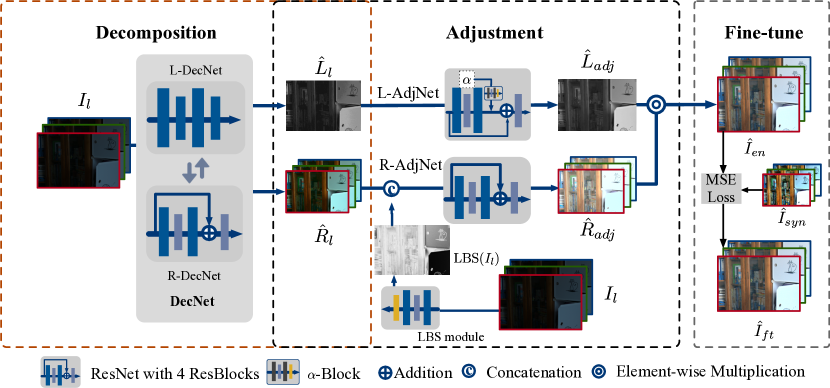
- The decomposition network is constructed via algorithm unrolling of a Retinex-based optimization process, enabling integration of both data-driven and traditional priors.
- The adjustment network consists of two parallel branches: one for global brightness adjustment and another for local brightness sensitivity, enhancing detail preservation.
- The framework uses a self-supervised fine-tuning strategy that automatically adapts network parameters without requiring paired real-world data.
- The optimization process is modeled using a quasi-Newton method, with Hessian approximation to enable efficient and stable training.
- The method formulates the image enhancement as a minimization problem involving reflectance, illumination, and gradient priors, solved via iterative updates.
- The final output is generated by combining the enhanced reflectance layer with the adjusted illumination, using element-wise operations to preserve spatial consistency.
Experimental results
Research questions
- RQ1Can algorithm unrolling effectively integrate traditional image priors with deep learning for low-light image enhancement?
- RQ2How can a simple yet effective adjustment module be designed to handle both global and local brightness in low-light images?
- RQ3Can a self-supervised fine-tuning strategy eliminate the need for manual hyperparameter tuning while maintaining high performance?
- RQ4Does combining data-driven priors with explicit priors from traditional methods lead to better decomposition and enhancement results?
Key findings
- The proposed method achieves state-of-the-art performance on multiple standard low-light image enhancement benchmarks, both quantitatively and qualitatively.
- The self-supervised fine-tuning strategy consistently improves performance across datasets without requiring ground-truth labels or manual tuning.
- The integration of both data-driven and traditional priors via algorithm unrolling leads to more accurate and physically plausible decomposition of illumination and reflectance.
- The dual-path adjustment network significantly improves detail recovery and color fidelity compared to single-path or complex network-based adjustment modules.
- The method outperforms existing Retinex-based deep learning models in terms of PSNR, SSIM, and LPIPS metrics on benchmark datasets.

Read this paper
Open the full text in the Nubint reader and ask about any passage as you read.
Read this paper on NubintThis review was generated by AI from the original paper. Please check the paper before citing it.