
[Paper Review] Low-noise quantum frequency conversion in a monolithic cavity with bulk periodically poled potassium titanyl phosphate
This paper presents a monolithic bulk periodically poled KTP cavity for low-noise quantum frequency conversion, achieving 72.3% internal conversion efficiency and only 110 kHz/nm noise at telecom wavelengths when upconverting 637 nm photons from nitrogen-vacancy centers in diamond. The approach uses resonant pump enhancement in a passive, alignment-stable cavity to enable high performance with a standard off-the-shelf laser, significantly reducing parasitic noise compared to state-of-the-art converters.
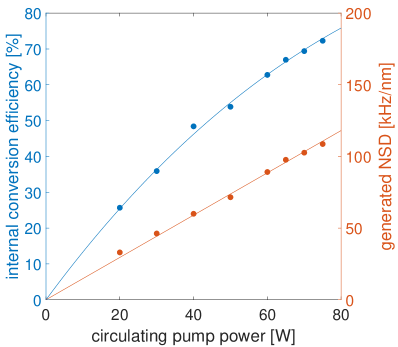
Interfacing the different building blocks of a future large scale quantum network will demand efficient and noiseless frequency conversion of quantum light. Nitrogen-vacancy (NV) centers in diamond are a leading candidate to form the nodes of such a network. However, the performance of a suitable converter remains a bottleneck, with existing demonstrations severely limited by parasitic noise arising at the target telecom wavelength. Here, we demonstrate a new platform for efficient low-noise quantum frequency conversion based on a monolithic bulk ppKTP cavity and show its suitability for the conversion of 637 nm single photons from NV centers in diamond to telecommunication wavelengths. By resonantly enhancing the power of an off-the-shelf pump laser, we achieve an internal conversion efficiency of $(72.3\pm 0.4)\%$ while generating only $(110\pm 4) \mbox{ kHz/nm}$ noise at the target wavelength without the need for any active stabilization. This constitutes a 5-fold improvement in noise over existing state-of-the-art single-step converters at this wavelengths. We verify the almost ideal preservation of non-classical correlations by converting photons from a spontaneous parametric down-conversion source and moreover show the preservation of time-energy entanglement via Franson interferometry.
Motivation & Objective
- To address the critical bottleneck of parasitic noise in quantum frequency converters for interfacing quantum nodes in large-scale networks.
- To develop a stable, scalable platform for efficient frequency conversion of 637 nm photons from nitrogen-vacancy centers in diamond to the telecom band.
- To reduce noise from spontaneous parametric down-conversion and Raman scattering, which limit performance in existing single-step converters.
- To demonstrate preservation of non-classical correlations during conversion, validating the platform’s suitability for quantum networks.
- To enable practical deployment by eliminating the need for active stabilization through a monolithic cavity design.
Proposed method
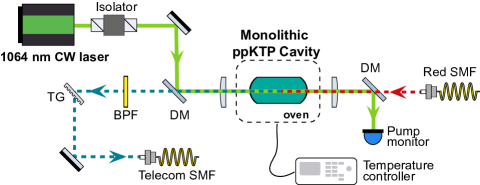
- A monolithic bulk periodically poled potassium titanyl phosphate (ppKTP) cavity is fabricated to resonantly enhance the pump laser power at 1064 nm.
- The cavity is designed to be passively stable, eliminating the need for active feedback or stabilization systems.
- A low-cost, off-the-shelf 3 W continuous-wave 1064 nm laser is used as the pump source, with power enhanced via cavity resonance.
- The system implements sum-frequency generation (SFG) to convert 637 nm input photons to the telecom band (1550 nm), leveraging phase-matching in the ppKTP crystal.
- Theoretical conversion efficiency is modeled using the standard SFG formula involving pump power, nonlinear coefficient, crystal length, and beam focusing parameters.
- Experimental validation includes cross-correlation measurements and Franson interferometry to verify preservation of time-energy entanglement and non-classical correlations.
Experimental results
Research questions
- RQ1Can a monolithic bulk ppKTP cavity achieve high-efficiency, low-noise quantum frequency conversion without active stabilization?
- RQ2What level of noise (specifically parasitic SPDC and Raman) can be achieved in a bulk ppKTP-based converter at telecom wavelengths?
- RQ3To what extent are non-classical correlations, such as time-energy entanglement, preserved during the frequency conversion process?
- RQ4Can a standard off-the-shelf laser be used effectively in a resonant cavity setup to achieve high internal conversion efficiency?
- RQ5Does the absence of active stabilization compromise performance, and can the system still maintain high visibility in quantum interference experiments?
Key findings
- The system achieves an internal conversion efficiency of (72.3 ± 0.4)%, demonstrating high performance in a single-step frequency conversion process.
- The noise level at the target telecom wavelength is measured at (110 ± 4) kHz/nm, representing a 5-fold improvement over existing state-of-the-art single-step converters.
- The Franson interferometry experiment yields corrected fringe visibilities of up to (98.8 ± 0.2)%, confirming the preservation of time-energy entanglement after conversion.
- A chained Bell inequality test shows a 15σ violation for N=4 settings and a 16σ violation for N=5, confirming genuine quantum nonlocality and entanglement preservation.
- The system operates without active stabilization, relying on a monolithic cavity design that maintains phase stability over repeated measurements.
- The measured G(2) cross-correlation function shows a peak at zero delay with a FWHM of 1.2 ns, indicating high-fidelity photon pair generation and preservation of quantum statistics.
Read this paper
Open the full text in the Nubint reader and ask about any passage as you read.
Read this paper on NubintThis review was generated by AI from the original paper. Please check the paper before citing it.