
[Paper Review] LSQ+: Improving low-bit quantization through learnable offsets and better initialization
LSQ+ improves low-bit quantization by introducing learnable asymmetric quantization with trainable scale and offset parameters, enabling accurate quantization of activations with negative values—common in modern networks using Swish-like activations—while also using an MSE-based initialization to stabilize training. It achieves state-of-the-art performance on EfficientNet and MixNet, with up to 5.6% accuracy gain at W2A2 quantization compared to LSQ.
Unlike ReLU, newer activation functions (like Swish, H-swish, Mish) that are frequently employed in popular efficient architectures can also result in negative activation values, with skewed positive and negative ranges. Typical learnable quantization schemes [PACT, LSQ] assume unsigned quantization for activations and quantize all negative activations to zero which leads to significant loss in performance. Naively using signed quantization to accommodate these negative values requires an extra sign bit which is expensive for low-bit (2-, 3-, 4-bit) quantization. To solve this problem, we propose LSQ+, a natural extension of LSQ, wherein we introduce a general asymmetric quantization scheme with trainable scale and offset parameters that can learn to accommodate the negative activations. Gradient-based learnable quantization schemes also commonly suffer from high instability or variance in the final training performance, hence requiring a great deal of hyper-parameter tuning to reach a satisfactory performance. LSQ+ alleviates this problem by using an MSE-based initialization scheme for the quantization parameters. We show that this initialization leads to significantly lower variance in final performance across multiple training runs. Overall, LSQ+ shows state-of-the-art results for EfficientNet and MixNet and also significantly outperforms LSQ for low-bit quantization of neural nets with Swish activations (e.g.: 1.8% gain with W4A4 quantization and upto 5.6% gain with W2A2 quantization of EfficientNet-B0 on ImageNet dataset). To the best of our knowledge, ours is the first work to quantize such architectures to extremely low bit-widths.
Motivation & Objective
- Address the significant accuracy drop in low-bit quantization (2-, 3-, 4-bit) when using ReLU-like activation functions in modern networks such as EfficientNet and MixNet.
- Overcome the limitation of standard learnable quantization schemes (e.g., LSQ) that discard negative activations by assuming unsigned quantization ranges.
- Enable efficient quantization of modern architectures with signed, non-negative-restricted activations (e.g., Swish, H-swish) without requiring an extra sign bit.
- Reduce training instability in gradient-based quantization by proposing a more robust initialization scheme for scale and offset parameters.
- Demonstrate that LSQ+ enables the first successful quantization of EfficientNet and MixNet to extremely low bit-widths (e.g., W2A2) with high accuracy.
Proposed method
- Propose an asymmetric quantization scheme for activations using learnable scale $ s $ and offset $ \beta $, allowing the quantization range to shift to accommodate negative activation values.
- Introduce a differentiable quantization function $ \hat{x} = \text{clamp}\left( \text{round}\left( \frac{x - \beta}{s} \right), 0, 2^b - 1 \right) \cdot s + \beta $, where $ b $ is the bit-width.
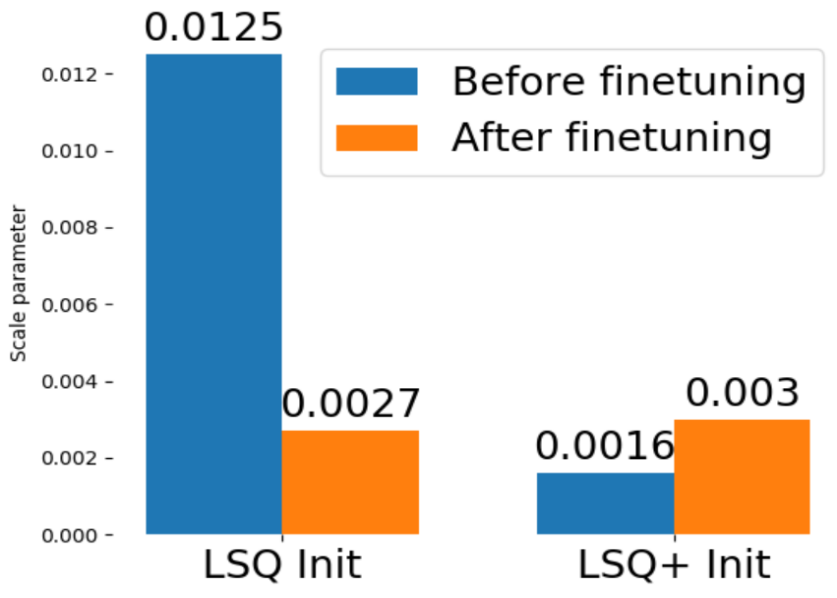
- Use a mean-squared-error (MSE)-based initialization for $ s $ and $ \beta $, minimizing the reconstruction error between original and quantized activations during initialization.
- Train the model with quantization-aware training (QAT), jointly optimizing network weights and the quantization parameters $ s $ and $ \beta $ via backpropagation.
- Apply the method to both weights and activations, with symmetric quantization used for layers without activation (e.g., squeeze-excite or final layers).
- Evaluate the method on ImageNet using standard configurations, comparing performance across multiple random seeds to assess training stability.
Experimental results
Research questions
- RQ1Can learnable asymmetric quantization with a trainable offset significantly reduce accuracy loss in low-bit quantization of modern networks with Swish-like activations?
- RQ2Does the proposed MSE-based initialization scheme lead to more stable training performance across multiple runs compared to min-max or LSQ-style initialization?
- RQ3Can LSQ+ successfully quantize EfficientNet and MixNet to extremely low bit-widths (e.g., W2A2, W3A3) with high accuracy, setting a new SOTA in this regime?
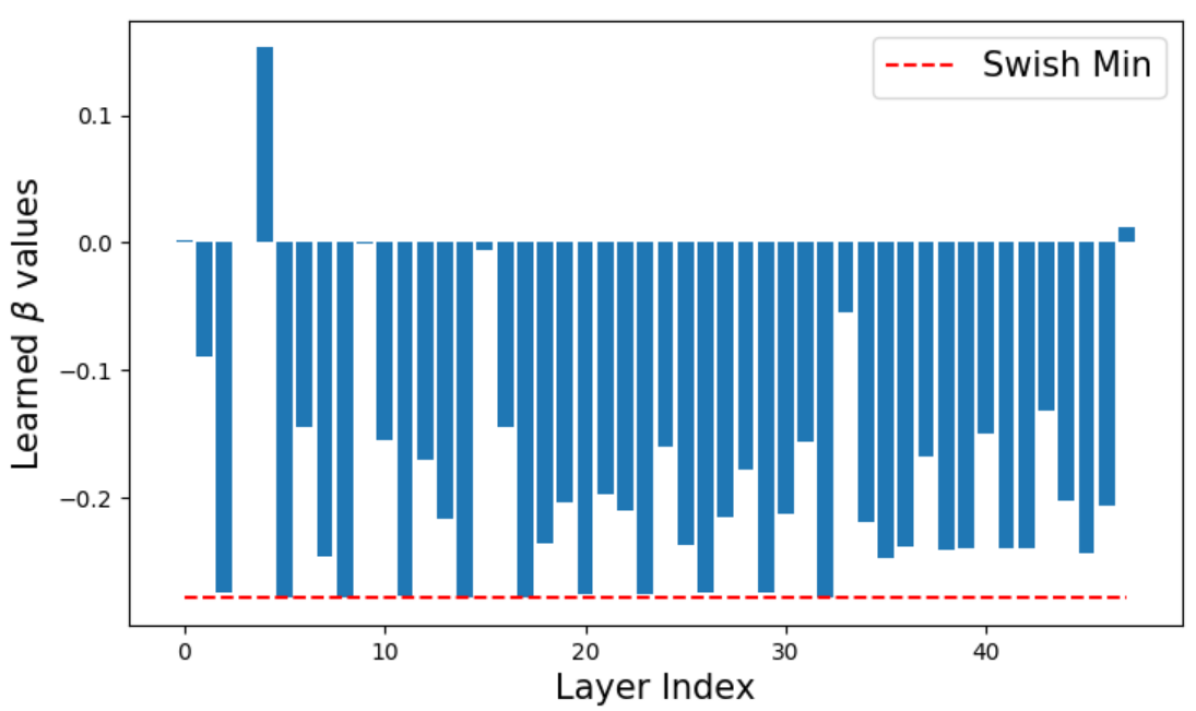
- RQ4How does the learned offset $ \beta $ vary across layers, and does it adapt to the activation distribution rather than being fixed to the minimum activation value?
- RQ5Is the performance gain of LSQ+ limited to Swish-based architectures, or can it be generalized to other activation functions and network types?
Key findings
- LSQ+ achieves a 1.8% accuracy gain over LSQ at W4A4 quantization and up to 5.6% gain at W2A2 quantization on EfficientNet-B0, demonstrating state-of-the-art performance for low-bit quantization.
- The MSE-based initialization reduces performance variance across multiple training runs: LSQ+ achieves $ 46.8 \pm 1.9\% $ accuracy on W2A2 quantization, compared to $ 43.8 \pm 4.7\% $ with min-max initialization.
- The learned offset $ \beta $ values are typically negative and layer-specific, showing that the network learns to shift the quantization range to better cover the activation distribution.
- Fixing $ \beta $ to the minimum activation value ($ x_{\text{min}} $) yields only 72.5% top-1 accuracy at W4A4, while learned $ \beta $ achieves 73.8%, proving the benefit of end-to-end optimization.
- LSQ+ maintains or improves performance on ReLU-based ResNet18, showing it is safe to use as a drop-in replacement for LSQ in any network.
- The method incurs zero runtime overhead in inference, as the asymmetric quantization is implemented efficiently using standard fixed-point operations.
Read this paper
Open the full text in the Nubint reader and ask about any passage as you read.
Read this paper on NubintThis review was generated by AI from the original paper. Please check the paper before citing it.