
[Paper Review] LSTM-Autoencoder based Anomaly Detection for Indoor Air Quality Time Series Data
This paper proposes an LSTM-Autoencoder hybrid model for detecting anomalies in indoor air quality (IAQ) time series data, leveraging LSTM units to capture long-term temporal dependencies and an autoencoder to compute reconstruction loss for anomaly thresholding. Evaluated on a real-world Dunedin CO₂ dataset, the model achieves 99.50% detection accuracy, outperforming existing methods.
Anomaly detection for indoor air quality (IAQ) data has become an important area of research as the quality of air is closely related to human health and well-being. However, traditional statistics and shallow machine learning-based approaches in anomaly detection in the IAQ area could not detect anomalies involving the observation of correlations across several data points (i.e., often referred to as long-term dependences). We propose a hybrid deep learning model that combines LSTM with Autoencoder for anomaly detection tasks in IAQ to address this issue. In our approach, the LSTM network is comprised of multiple LSTM cells that work with each other to learn the long-term dependences of the data in a time-series sequence. Autoencoder identifies the optimal threshold based on the reconstruction loss rates evaluated on every data across all time-series sequences. Our experimental results, based on the Dunedin CO2 time-series dataset obtained through a real-world deployment of the schools in New Zealand, demonstrate a very high and robust accuracy rate (99.50%) that outperforms other similar models.
Motivation & Objective
- To address the limitation of traditional statistical and shallow ML methods in detecting anomalies involving long-term correlations in IAQ time series.
- To develop a deep learning model capable of learning complex temporal dependencies in indoor CO₂ concentration data.
- To improve anomaly detection accuracy in real-world, non-stationary IAQ environments where data quality is often compromised.
- To establish a robust, threshold-based anomaly detection system using reconstruction error from an autoencoder.
Proposed method
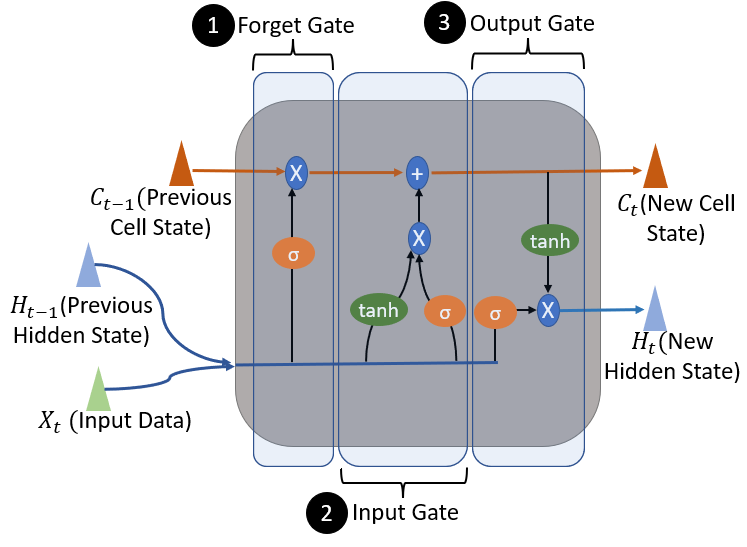
- The model uses a stacked LSTM encoder to learn long-term temporal dependencies across sequential IAQ data points.
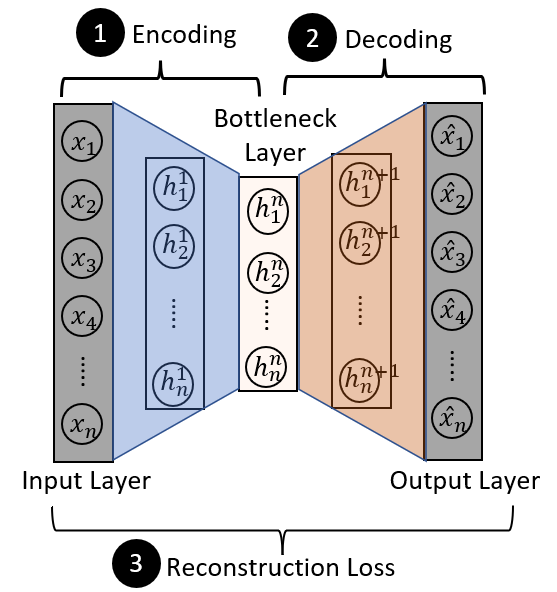
- An autoencoder reconstructs the input sequence using the encoded representation from the LSTM encoder.
- Reconstruction loss is computed for each time step, and the maximum mean absolute error (MAE) from the training set is used as the anomaly threshold.
- Anomalies are detected when the reconstruction loss of a test sample exceeds the learned threshold.
- The model is trained end-to-end on the Dunedin CO₂ dataset, which captures real-world classroom CO₂ levels.
- Performance is evaluated using standard metrics including accuracy, precision, recall, F1-score, and AUC-ROC.
Experimental results
Research questions
- RQ1Can an LSTM-Autoencoder model effectively detect anomalies in indoor air quality time series data that involve long-term dependencies?
- RQ2How does the reconstruction loss from an autoencoder compare to traditional statistical thresholds in identifying anomalous CO₂ readings?
- RQ3What is the optimal time window length for maximizing detection performance in this anomaly detection task?
- RQ4How does the proposed model compare in performance to other LSTM-Autoencoder variants on real-world IAQ data?
- RQ5Can the model generalize well to real-world, non-stationary IAQ data with potential data quality issues?
Key findings
- The proposed LSTM-Autoencoder model achieved a detection accuracy of 99.50% on the Dunedin CO₂ dataset, significantly outperforming other similar models.
- The model achieved 100% precision, indicating no false positives among detected anomalies, which is critical for reliable IAQ monitoring.
- The AUC-ROC score was 94.8%, demonstrating strong trade-off performance between true positive and false positive rates.
- The optimal time window length for maximum performance was found to be 10 time steps, with performance degrading as window size increased beyond 25.
- The model's threshold was set at a reconstruction loss of 1.742, and CO₂ readings above 1,000 ppm consistently exceeded this threshold and were classified as anomalous.
- Among compared models, only Nguyen et al. [28] with an additional One-Class SVM achieved a higher F1-score (96.98%), but at the cost of lower overall accuracy (98.36%) compared to the proposed model.
Read this paper
Open the full text in the Nubint reader and ask about any passage as you read.
Read this paper on NubintThis review was generated by AI from the original paper. Please check the paper before citing it.