
[Paper Review] LVCNet: Efficient Condition-Dependent Modeling Network for Waveform Generation
This paper proposes LVCNet, a novel conditional convolution network using location-variable convolutions that adapt kernel coefficients based on conditioning features like Mel-spectrograms to efficiently model long-term waveform dependencies. By replacing fixed kernels in Parallel WaveGAN with conditionally predicted, interval-specific kernels, LVCNet achieves four times faster inference speed than the original model without quality degradation, demonstrating significant efficiency gains in waveform generation.
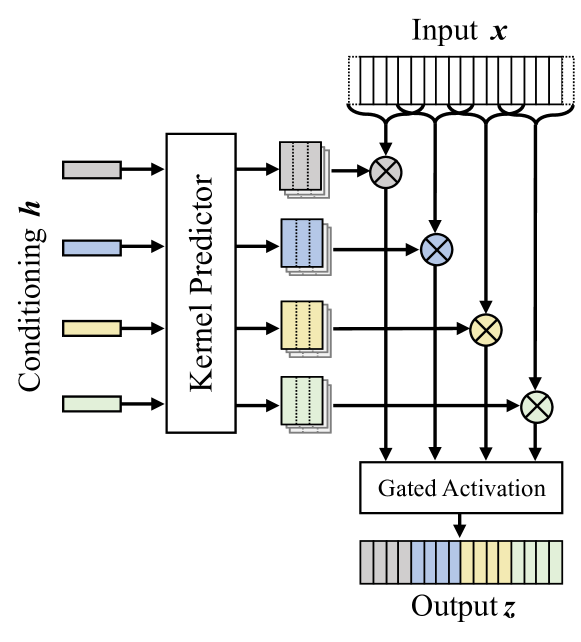
In this paper, we propose a novel conditional convolution network, named location-variable convolution, to model the dependencies of the waveform sequence. Different from the use of unified convolution kernels in WaveNet to capture the dependencies of arbitrary waveform, the location-variable convolution uses convolution kernels with different coefficients to perform convolution operations on different waveform intervals, where the coefficients of kernels is predicted according to conditioning acoustic features, such as Mel-spectrograms. Based on location-variable convolutions, we design LVCNet for waveform generation, and apply it in Parallel WaveGAN to design more efficient vocoder. Experiments on the LJSpeech dataset show that our proposed model achieves a four-fold increase in synthesis speed compared to the original Parallel WaveGAN without any degradation in sound quality, which verifies the effectiveness of location-variable convolutions.
Motivation & Objective
- To address the inefficiency of autoregressive and standard non-autoregressive vocoders in real-time speech synthesis.
- To improve modeling of long-term temporal dependencies in raw waveform generation with reduced computational cost.
- To design a more efficient vocoder architecture that maintains high-fidelity speech quality while accelerating inference.
- To explore conditional, adaptive convolution kernels that vary per waveform interval based on acoustic context.
Proposed method
- Introduces location-variable convolution (LVC), where convolution kernel coefficients are dynamically predicted per input interval using a kernel predictor conditioned on Mel-spectrograms.
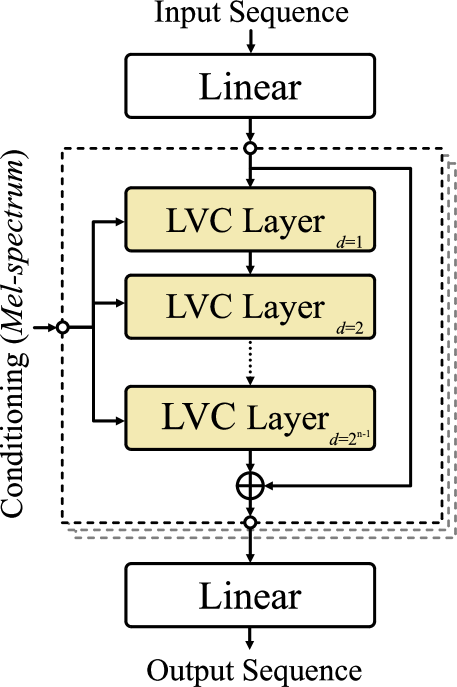
- Applies the LVC module within a Parallel WaveGAN framework to replace standard dilated causal convolutions with conditionally adaptive kernels.
- Uses a separate kernel predictor network that generates distinct kernel weights for different time intervals based on local conditioning features.
- Employs a gated residual block structure similar to WaveNet, but with LVC replacing standard convolutions to enable context-aware feature learning.
- Trains the model using a combination of adversarial loss and multi-scale discriminator to preserve audio quality.
- Optimizes inference by reducing residual channel counts while maintaining performance through adaptive kernel adaptation.
Experimental results
Research questions
- RQ1Can conditionally adaptive convolution kernels improve the efficiency of waveform generation without sacrificing audio quality?
- RQ2How does the location-variable convolution mechanism compare to fixed-kernel convolutions in modeling long-term dependencies in raw waveforms?
- RQ3To what extent can reducing residual channels in a non-autoregressive vocoder be compensated by adaptive kernel prediction?
- RQ4Does the proposed LVCNet achieve faster inference speeds than existing non-autoregressive vocoders like Parallel WaveGAN?
Key findings
- LVCNet achieves a fourfold increase in synthesis speed over the original Parallel WaveGAN on CPU, with an RTF of 0.73 compared to 3.58.
- The model maintains near-identical perceptual quality, achieving a MOS score of 4.15±0.10, matching the original Parallel WaveGAN with 128 residual channels.
- Even with only 4 residual channels, LVCNet achieves a MOS of 3.96±0.15, showing robustness to reduced capacity.
- On an NVIDIA V100 GPU, LVCNet synthesizes speech at ~300 MHz, significantly faster than Parallel WaveGAN’s 35 MHz.
- In TTS systems, LVCNet reduces synthesis time by 15% compared to Parallel WaveGAN when used with Transformer TTS, while maintaining comparable MOS scores.
- The kernel predictor enables effective modeling of long-range dependencies even with fewer parameters, demonstrating the efficacy of conditional kernel adaptation.
Read this paper
Open the full text in the Nubint reader and ask about any passage as you read.
Read this paper on NubintThis review was generated by AI from the original paper. Please check the paper before citing it.