
[Paper Review] LVLM-Interpret: An Interpretability Tool for Large Vision-Language Models
LVLM-Interpret is an interactive interpretability tool for large vision-language models (LVLMs) that visualizes attention, relevancy, and causal relationships between image patches and generated tokens. It enables users to diagnose hallucinations and model failures—demonstrated on LLaVA—by identifying which image regions and text tokens most influence outputs, revealing cases where models rely more on phrasing than visual input.
In the rapidly evolving landscape of artificial intelligence, multi-modal large language models are emerging as a significant area of interest. These models, which combine various forms of data input, are becoming increasingly popular. However, understanding their internal mechanisms remains a complex task. Numerous advancements have been made in the field of explainability tools and mechanisms, yet there is still much to explore. In this work, we present a novel interactive application aimed towards understanding the internal mechanisms of large vision-language models. Our interface is designed to enhance the interpretability of the image patches, which are instrumental in generating an answer, and assess the efficacy of the language model in grounding its output in the image. With our application, a user can systematically investigate the model and uncover system limitations, paving the way for enhancements in system capabilities. Finally, we present a case study of how our application can aid in understanding failure mechanisms in a popular large multi-modal model: LLaVA.
Motivation & Objective
- To address the challenge of interpreting complex reasoning in large vision-language models (LVLMs), especially regarding hallucination and misalignment with visual input.
- To develop an interactive interface that enables systematic exploration of how LVLMs ground their outputs in image and text inputs.
- To identify failure mechanisms in LVLMs, such as over-reliance on textual phrasing over visual content, through visualized attention and relevancy analysis.
- To demonstrate the tool’s utility in diagnosing model behavior on real-world failure cases, such as contradictory responses to the same image based on query wording.
- To provide a general-purpose interpretability framework applicable to any transformer-based LVLM with a vision encoder and frozen language model front-end.
Proposed method
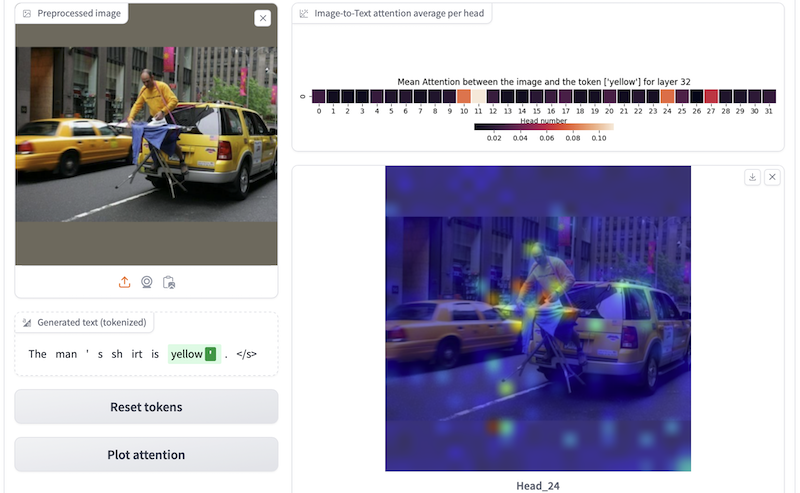
- The tool visualizes raw attention weights between image patches and text tokens across all transformer layers and heads, enabling users to inspect which image regions influence specific output tokens.
- It computes token-level relevancy scores using gradient-based attribution methods, highlighting which input features (image or text) most impact the model's output.
- A causal discovery algorithm constructs a partial ancestral graph from the final layer's attention matrix to identify minimal sets of image and text tokens that conditionally influence the output.
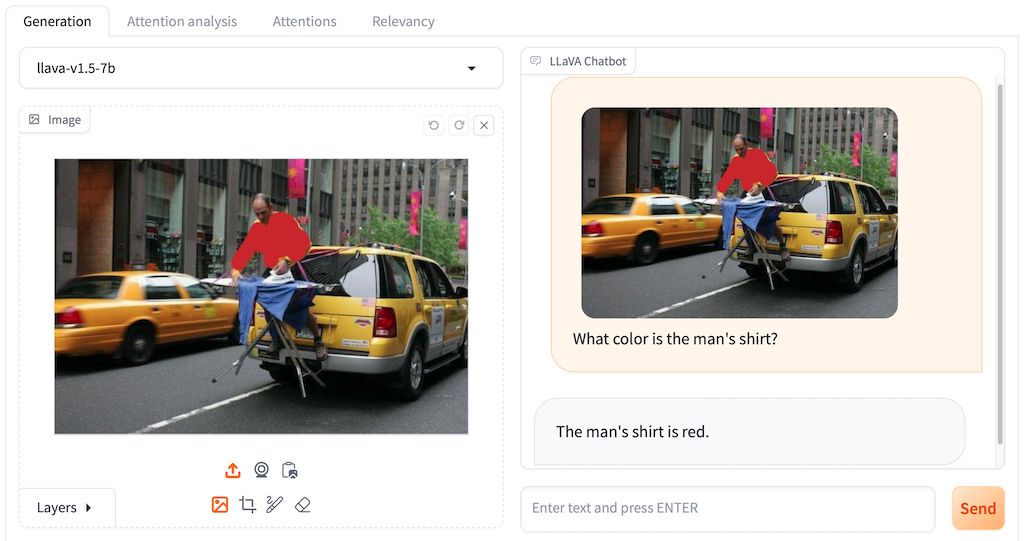
- The interface supports interactive probing via image editing, allowing users to modify input images and observe changes in attention and output.
- The system integrates multiple interpretability techniques—raw attention, relevancy maps, and causal graphs—into a unified, user-friendly dashboard built with Gradio.
- The framework is applied to LLaVA-v1.5-7b, using the MMVP benchmark to analyze cases where models fail due to visual ambiguity or textual manipulation.
Experimental results
Research questions
- RQ1How do attention patterns in LVLMs correlate with model hallucinations, particularly when visual input is ambiguous or misleading?
- RQ2To what extent do LVLMs rely on textual phrasing versus visual content when generating answers, and how can this be quantitatively measured?
- RQ3Can causal interpretation methods identify minimal sets of image and text tokens that influence a specific output token, enabling diagnosis of model failures?
- RQ4How do adversarial image edits affect attention and output, and what insights can be drawn about model robustness?
- RQ5Can interpretability tools like LVLM-Interpret reveal systematic biases in LVLMs, such as overfitting to prompt wording rather than visual features?
Key findings
- LLaVA exhibits inconsistent responses to the same image based solely on query phrasing—e.g., claiming a garbage truck door is open or closed—indicating over-reliance on textual cues.
- Relevancy maps show that in such failure cases, text tokens have significantly higher relevance scores than image tokens, confirming that the model is not grounding its output in visual input.
- In contrast, when LLaVA correctly identifies object attributes (e.g., shirt color), relevancy scores are higher for image tokens than for text, demonstrating visual consistency.
- The causal graph analysis successfully identifies minimal sets of image patches that influence specific output tokens, such as the color 'yellow', enabling targeted probing of model reasoning.
- The tool reveals that in CLIP-blind pairs from the MMVP dataset, LLaVA often fails due to misaligned attention between visual features and textual queries, even when images are visually distinct.
- Image editing experiments confirm that model outputs change predictably when visual features are altered, but only when the model attends to the correct image regions, highlighting the importance of attention visualization in diagnosing failures.
Read this paper
Open the full text in the Nubint reader and ask about any passage as you read.
Read this paper on NubintThis review was generated by AI from the original paper. Please check the paper before citing it.