
[Paper Review] LZR: Identifying Unexpected Internet Services
The paper reveals that Internet services are widely deployed on non-standard ports, many unresponsive to standard L7 handshakes, and introduces LZR to efficiently identify and fingerprint unexpected services, achieving fast, broad coverage.
Internet-wide scanning is a commonly used research technique that has helped uncover real-world attacks, find cryptographic weaknesses, and understand both operator and miscreant behavior. Studies that employ scanning have largely assumed that services are hosted on their IANA-assigned ports, overlooking the study of services on unusual ports. In this work, we investigate where Internet services are deployed in practice and evaluate the security posture of services on unexpected ports. We show protocol deployment is more diffuse than previously believed and that protocols run on many additional ports beyond their primary IANA-assigned port. For example, only 3% of HTTP and 6% of TLS services run on ports 80 and 443, respectively. Services on non-standard ports are more likely to be insecure, which results in studies dramatically underestimating the security posture of Internet hosts. Building on our observations, we introduce LZR ("Laser"), a system that identifies 99% of identifiable unexpected services in five handshakes and dramatically reduces the time needed to perform application-layer scans on ports with few responsive expected services (e.g., 5500% speedup on 27017/MongoDB). We conclude with recommendations for future studies.
Motivation & Objective
- Assess how Internet services are deployed across unexpected ports beyond IANA assignments.
- Evaluate the security posture of services hosted on non-standard ports.
- Develop a fast, scalable method to identify and fingerprint unexpected services during Internet-wide scans.
- Provide recommendations for future measurement studies and open-source tooling.
Proposed method
- Perform large-scale Internet-wide scans to compare L4 TCP responsiveness with application-layer (L7) handshakes across 37 popular ports and additional ports.
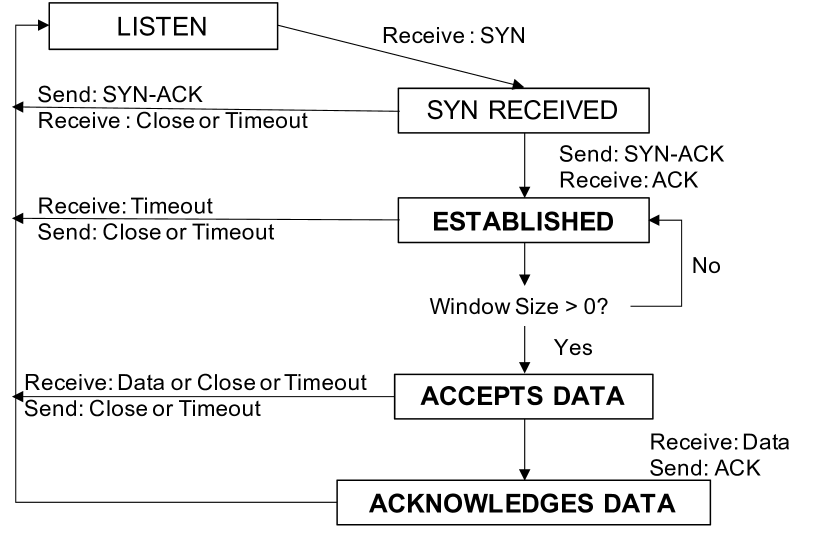
- Develop a TCP-state inference method to deduce server state (including accepts data and acknowledges data) from handshake behavior.
- Characterize middlebox and firewall protections that affect scan results (zero-window, connection shunning, dynamic blocking, etc.).
- Introduce LZR (Laser) to filter non-speaking hosts and identify unexpected services with high efficiency (88% fingerprinting with a single packet; 99% with five handshakes).
- Analyze distribution and security of unexpected services on unassigned ports and ports with assigned services, including IoT device involvement.
Experimental results
Research questions
- RQ1How diffuse is protocol deployment across non-standard ports compared to IANA-assigned ports?
- RQ2What is the security posture of services running on unexpected ports versus expected ports?
- RQ3Can a fast, scalable system identify and fingerprint unexpected Internet services with high accuracy and low overhead?
- RQ4What protections (middleboxes/firewalls) affect TCP liveness and L7 handshake success, and how do they impact scans?
Key findings
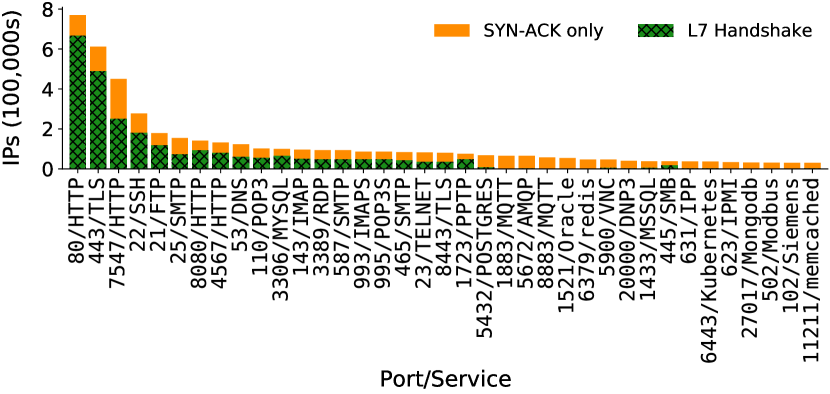
- Only 3.0% of HTTP and 6.4% of TLS services run on ports 80 and 443 respectively, revealing highly diffuse protocol deployment.
- Up to 96% of services (by port) do not complete the expected L7 handshake on 37 popular ports.
- An average of 16% of services on popular ports and 40% on unpopular ports fail to acknowledge data after a syn-ack, due to middleboxes or protections.
- LZR can fingerprint 88% of identifiable services with a single packet and 99% of identifiable unexpected services with five handshakes.
- On port 27017/MongoDB, LZR reduces scan time by 55x while identifying 99.6% of MongoDB services and uncovering additional 23K hosts with unexpected protocols.
- Unexpected services on non-standard ports tend to have weaker security postures and are frequently IoT-related (e.g., TLS on unexpected ports often linked to IoT devices).
Read this paper
Open the full text in the Nubint reader and ask about any passage as you read.
Read this paper on NubintThis review was generated by AI from the original paper. Please check the paper before citing it.