
[Paper Review] M2m: Imbalanced Classification via Major-to-minor Translation
This paper proposes M2m, a novel data augmentation method for imbalanced classification that generates synthetic minority-class samples by translating majority-class samples using a pre-trained classifier. By leveraging diverse majority features through adversarial-like perturbations, M2m significantly improves minority class generalization, outperforming state-of-the-art methods like LDAM by up to 17.1% in balanced accuracy on extreme long-tailed datasets such as Reuters.
In most real-world scenarios, labeled training datasets are highly class-imbalanced, where deep neural networks suffer from generalizing to a balanced testing criterion. In this paper, we explore a novel yet simple way to alleviate this issue by augmenting less-frequent classes via translating samples (e.g., images) from more-frequent classes. This simple approach enables a classifier to learn more generalizable features of minority classes, by transferring and leveraging the diversity of the majority information. Our experimental results on a variety of class-imbalanced datasets show that the proposed method improves the generalization on minority classes significantly compared to other existing re-sampling or re-weighting methods. The performance of our method even surpasses those of previous state-of-the-art methods for the imbalanced classification.
Motivation & Objective
- To address the challenge of poor generalization in deep neural networks trained on highly imbalanced datasets, especially for minority classes.
- To overcome the limitations of existing re-sampling and re-weighting methods that fail under extreme class imbalance due to insufficient minority data.
- To explore whether majority-class diversity can be leveraged to generate more generalizable features for minority classes.
- To develop a simple yet effective over-sampling strategy that avoids overfitting by not relying on existing minority samples for augmentation.
Proposed method
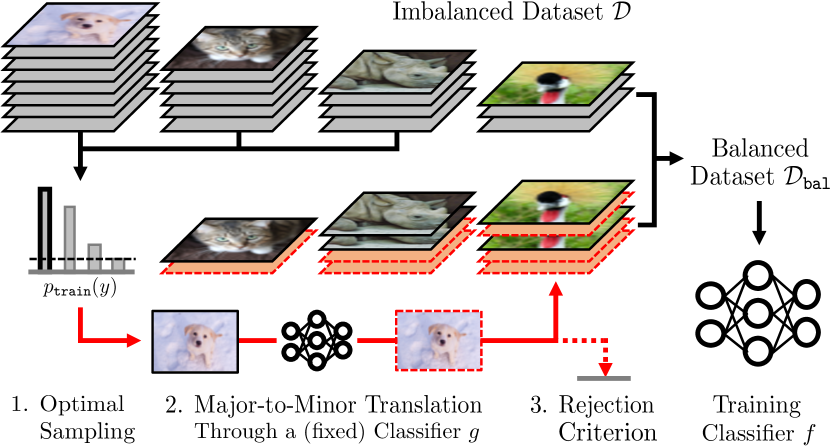
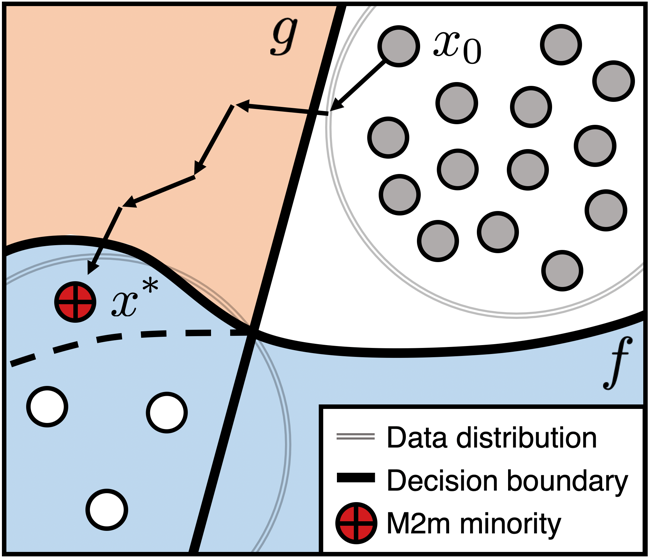
- M2m generates synthetic minority samples by optimizing a majority sample through adversarial perturbations to make it classified as a target minority class by a pre-trained classifier.
- It introduces a novel optimization objective that ensures the translated sample is close to the original while being correctly classified as the minority class, preserving the majority class's performance.
- A sample rejection criterion is designed to favor translation from more frequent majority classes, improving the quality and diversity of generated samples.
- An optimal sampling distribution is proposed for selecting majority seeds to translate, based on class frequency and rejection criteria.
- The method uses a two-stage training setup: first pre-train a classifier on the imbalanced dataset, then use it to guide the translation of majority samples into synthetic minority samples.
- The synthetic samples are used to over-sample the minority class during training, improving generalization without overfitting.
Experimental results
Research questions
- RQ1Can translating majority-class samples into minority-class representations improve generalization on minority classes in imbalanced learning?
- RQ2Does leveraging the diversity of majority samples through translation lead to better feature learning than traditional minority over-sampling methods?
- RQ3How does the use of adversarial-like perturbations in sample translation affect model generalization and robustness?
- RQ4Can a method that avoids using existing minority samples still achieve state-of-the-art performance on extreme long-tailed datasets?
- RQ5Is the performance gain from M2m due to the adversarial nature of the generated samples, or is it due to the diversity of the majority features?
Key findings
- M2m significantly improves balanced accuracy on all tested datasets, including CIFAR-LT-10, CIFAR-LT-100, ImageNet, CelebA, SUN397, Twitter, and Reuters, compared to standard ERM and re-sampling/re-weighting baselines.
- On the Reuters dataset with extreme class imbalance, M2m improves balanced accuracy by 17.1% over standard training and 9.2% over LDAM, a state-of-the-art margin-based method.
- The ablation study shows that using clean majority samples (M2m-Clean) instead of adversarially perturbed ones leads to a significant drop in performance, confirming the importance of the perturbations.
- t-SNE visualization confirms that M2m produces more separable and well-distributed feature representations for minority classes compared to other methods.
- The cumulative false positive curve for M2m is consistently below other methods and closer to linear, indicating more uniform and lower error distribution across all classes.
- The method outperforms SMOTE and other SMOTE variants in low-data regimes, demonstrating its effectiveness when minority classes have very few samples.
Better researchstarts right now
From reading papers to final review, dramatically reduce your research time.
No credit card · Free plan available
This review was created by AI and reviewed by human editors.