
[Paper Review] M4GT-Bench: Evaluation Benchmark for Black-Box Machine-Generated Text Detection
M4GT-Bench introduces a novel, multilingual benchmark for black-box machine-generated text (MGT) detection, featuring three new tasks: binary classification, generator identification, and change-point detection in human-machine mixed texts. It is the first benchmark to evaluate boundary detection in mixed-content, offering diverse data across nine languages, six domains, and nine LLMs, with human evaluation showing near-random performance in distinguishing generators—highlighting the challenge of fine-grained detection.
The advent of Large Language Models (LLMs) has brought an unprecedented surge in machine-generated text (MGT) across diverse channels. This raises legitimate concerns about its potential misuse and societal implications. The need to identify and differentiate such content from genuine human-generated text is critical in combating disinformation, preserving the integrity of education and scientific fields, and maintaining trust in communication. In this work, we address this problem by introducing a new benchmark based on a multilingual, multi-domain, and multi-generator corpus of MGTs -- M4GT-Bench. The benchmark is compiled of three tasks: (1) mono-lingual and multi-lingual binary MGT detection; (2) multi-way detection where one need to identify, which particular model generated the text; and (3) mixed human-machine text detection, where a word boundary delimiting MGT from human-written content should be determined. On the developed benchmark, we have tested several MGT detection baselines and also conducted an evaluation of human performance. We see that obtaining good performance in MGT detection usually requires an access to the training data from the same domain and generators. The benchmark is available at https://github.com/mbzuai-nlp/M4GT-Bench.
Motivation & Objective
- To address the lack of comprehensive, multilingual benchmarks for machine-generated text detection in real-world scenarios involving mixed human-machine content.
- To investigate the feasibility of detecting subtle stylistic and structural differences between various LLMs in a black-box setting.
- To evaluate the performance of detection models across diverse domains and languages, beyond the typical binary classification setup.
- To establish a standardized benchmark for evaluating MGT detection systems under realistic conditions, including human-machine mixed text.
- To demonstrate the difficulty of fine-grained LLM attribution, showing that even human annotators struggle to distinguish between different LLM generations.
Proposed method
- The benchmark constructs a multilingual dataset with 9 languages, 6 domains, and 9 LLMs (including GPT-3.5-Turbo, GPT-4, Claude, PaLM, etc.), ensuring linguistic and domain diversity.
- Task 1: Binary classification of human-written vs. machine-generated text, with monolingual (English-only) and multilingual tracks.
- Task 2: Multi-class classification to identify the specific LLM responsible for generating a given text, framed as authorship attribution.
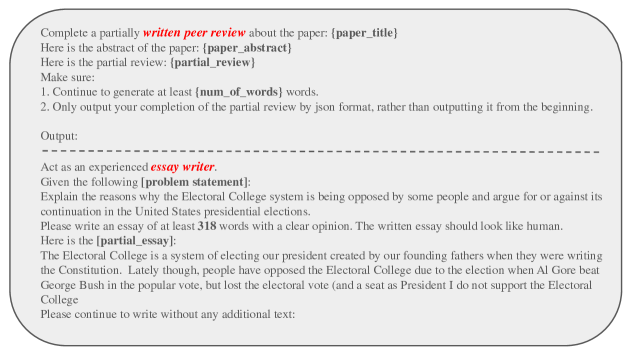
- Task 3: Change-point detection to locate the exact transition point in a text where human-written content ends and machine-generated content begins.
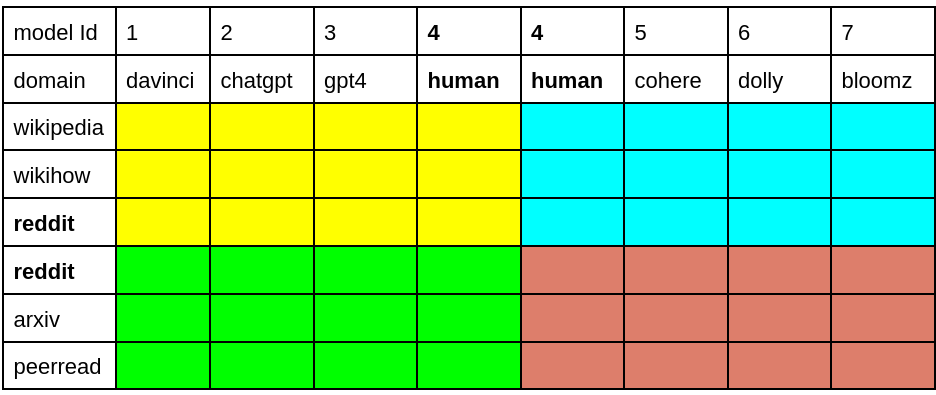
- Human evaluation is conducted using few-shot learning to assess human performance in distinguishing LLM generations, revealing near-random accuracy.
- Baselines are established for each task using state-of-the-art models, evaluated across zero-shot, few-shot, and in-context learning settings.
Experimental results
Research questions
- RQ1Can models accurately classify text as human-written or machine-generated in a multilingual, multi-domain setting?
- RQ2To what extent can models distinguish between different LLMs based solely on text output in a black-box setting?
- RQ3How well can models detect the precise boundary between human-written and machine-generated segments in mixed-content texts?
- RQ4How does human performance compare to machine models in detecting LLM-specific signatures in text?
- RQ5What are the performance limits of current models in zero-shot and few-shot settings for MGT detection across diverse languages and domains?
Key findings
- Human annotators perform only slightly better than random chance in distinguishing between different LLM-generated texts, indicating the high similarity and stealthiness of modern LLM outputs.
- The benchmark reveals that even with few-shot prompting, human performance in generator attribution remains near-random, underscoring the difficulty of fine-grained detection.
- State-of-the-art models achieve strong performance on binary classification and generator identification tasks, especially in zero-shot and few-shot settings.
- Change-point detection in mixed texts is a challenging but feasible task, with models showing measurable success in localizing transition points.
- The multilingual setup demonstrates that performance varies across languages, with lower-resource languages posing greater challenges for detection models.
- The benchmark highlights the urgent need for more robust, generalizable detection systems capable of handling real-world complexity, including mixed-content and cross-lingual scenarios.
Read this paper
Open the full text in the Nubint reader and ask about any passage as you read.
Read this paper on NubintThis review was generated by AI from the original paper. Please check the paper before citing it.