
[Paper Review] Machine Learning-Driven Open-Source Framework for Assessing QoE in Multimedia Networks
This paper proposes an open-source, machine learning-driven framework for real-time Quality of Experience (QoE) prediction in multimedia networks using network parameters as inputs. By training on over 20,000 data records, the Random Forest model achieved 95.8% accuracy in predicting Mean Opinion Score (MOS), enabling operators to dynamically optimize resource allocation for user satisfaction at minimal cost.
The Internet is integral to modern life, influencing communication, business, and lifestyles globally. As dependence on Internet services grows, the demand for high-quality service delivery increases. Service providers must maintain high standards of quality of service and quality of experience (QoE) to ensure user satisfaction. QoE, which reflects user satisfaction with service quality, is a key metric for multimedia services, yet it is challenging to measure due to its subjective nature and the complexities of real-time feedback. This paper introduces a machine learning-based framework for objectively assessing QoE in multimedia networks. The open-source framework complies with the ITU-T P.1203 standard. It automates data collection and user satisfaction prediction using key network parameters such as delay, jitter, packet loss, bitrate, and throughput. Using a dataset of over 20,000 records from various network conditions, the Random Forest model predicts the mean opinion score with 95.8% accuracy. Our framework addresses the limitations of existing QoE models by integrating real-time data collection, machine learning predictions, and adherence to international standards. This approach enhances QoE evaluation accuracy and allows dynamic network resource management, optimizing performance and cost-efficiency. Its open-source nature encourages adaptation and extension for various multimedia services. The findings significantly affect the telecommunications industry in managing and optimizing multimedia services. The network centric QoE prediction of the framework offers a scalable solution to improve user satisfaction without the need for content-specific data. Future enhancements could include advanced machine learning models and broader applicability to digital services. This research contributes a practical, standardized tool for QoE assessment across diverse networks and platforms.
Motivation & Objective
- To develop a practical, open-source framework for assessing and predicting Quality of Experience (QoE) in multimedia services.
- To address the challenge of accurately measuring user-centric QoE, which is complex and lacks precise real-time feedback models.
- To bridge the gap between objective QoS metrics and subjective user satisfaction by leveraging machine learning on real-world network and user data.
- To enable network operators to dynamically allocate resources based on predicted user satisfaction, improving service quality with minimal cost.
Proposed method
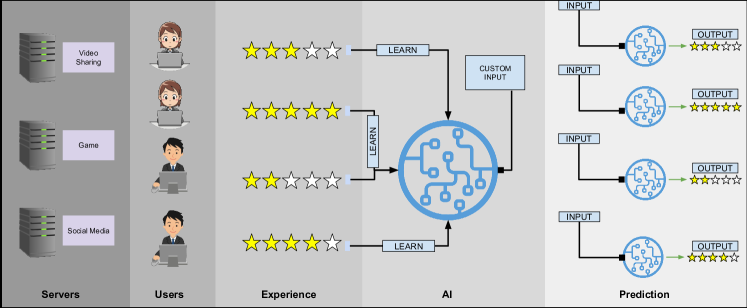
- The framework collects over 20,000 data records from diverse network conditions, capturing key network parameters: delay, jitter, packet loss, bit rate, and throughput.
- User Quality of Experience is quantified using the ITU-T P.1203 standard, which computes Mean Opinion Score (MOS) as the ground truth for model training.
- A supervised machine learning pipeline is implemented, with network parameters as features and MOS as the target variable.
- Multiple models—including Random Forest, XGBoost, and neural networks—were trained and evaluated using R² and accuracy metrics.
- The Random Forest model was selected as optimal due to its high R² (0.958) and robustness in predicting MOS from network inputs.
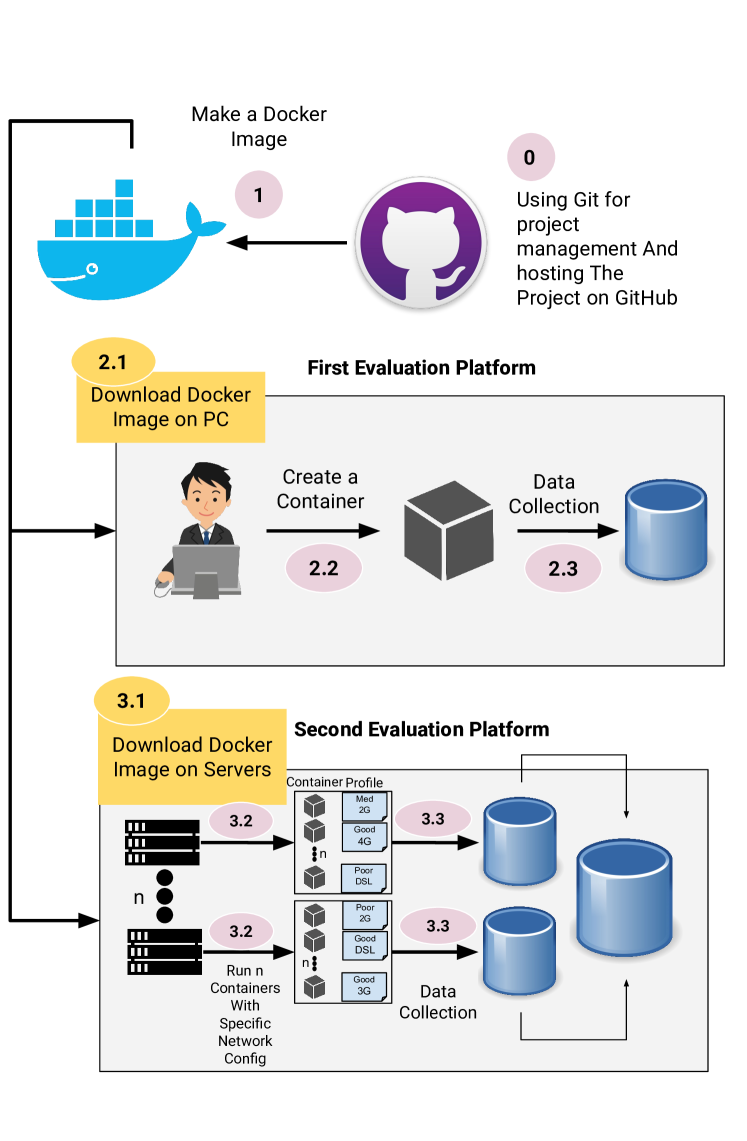
- The framework supports future integration with federated learning, enabling distributed model training on user devices while preserving privacy.
Experimental results
Research questions
- RQ1Can machine learning models accurately predict user-perceived Quality of Experience (QoE) in multimedia services using only network-level parameters?
- RQ2Which machine learning algorithm achieves the highest accuracy in predicting MOS scores derived from the ITU-T P.1203 standard?
- RQ3How can a scalable, open-source framework be designed to enable real-time QoE monitoring and dynamic network resource optimization?
- RQ4What are the key network parameters that most significantly influence user-perceived video quality in streaming services?
Key findings
- The Random Forest model achieved the highest prediction performance with an R² of 0.958, indicating strong correlation between predicted and actual MOS values.
- The model predicted user satisfaction with 95.8% accuracy using only five network parameters: delay, jitter, packet loss, bit rate, and throughput.
- The framework enables real-time QoE estimation, allowing network operators to proactively optimize resource allocation based on predicted user satisfaction.
- The study demonstrates that machine learning can effectively model the complex relationship between objective QoS metrics and subjective QoE.
- The open-source nature of the framework supports extensibility, including integration with federated learning for privacy-preserving model updates.
- Future enhancements such as deep learning, reinforcement learning, and multimodal feedback (e.g., facial expressions) are identified as promising directions for further accuracy gains.
Read this paper
Open the full text in the Nubint reader and ask about any passage as you read.
Read this paper on NubintThis review was generated by AI from the original paper. Please check the paper before citing it.