
[Paper Review] Machine Learning for Predicting Chaotic Systems
This paper evaluates lightweight and heavyweight machine learning models for predicting chaotic systems using a new benchmark database, DeebLorenz, and the Dysts dataset, introducing a novel cumulative maximum error (CME) metric. It finds that well-tuned simple models and untuned baselines often outperform complex deep learning architectures, highlighting the importance of method-data alignment and computational efficiency in chaotic system prediction.
Predicting chaotic dynamical systems is critical in many scientific fields, such as weather forecasting, but challenging due to the characteristic sensitive dependence on initial conditions. Traditional modeling approaches require extensive domain knowledge, often leading to a shift towards data-driven methods using machine learning. However, existing research provides inconclusive results on which machine learning methods are best suited for predicting chaotic systems. In this paper, we compare different lightweight and heavyweight machine learning architectures using extensive existing benchmark databases, as well as a newly introduced database that allows for uncertainty quantification in the benchmark results. In addition to state-of-the-art methods from the literature, we also present new advantageous variants of established methods. Hyperparameter tuning is adjusted based on computational cost, with more tuning allocated to less costly methods. Furthermore, we introduce the cumulative maximum error, a novel metric that combines desirable properties of traditional metrics and is tailored for chaotic systems. Our results show that well-tuned simple methods, as well as untuned baseline methods, often outperform state-of-the-art deep learning models, but their performance can vary significantly with different experimental setups. These findings highlight the importance of aligning prediction methods with data characteristics and caution against the indiscriminate use of overly complex models.
Motivation & Objective
- To address the lack of consensus in the literature on the best machine learning approach for predicting chaotic systems.
- To evaluate a broad range of lightweight and heavyweight models across diverse chaotic systems with rigorous, reproducible benchmarks.
- To introduce a new dataset, DeebLorenz, with 100 repetitions per system to enable uncertainty quantification and robust performance evaluation.
- To develop and apply a novel error metric, cumulative maximum error (CME), tailored for chaotic dynamics.
- To investigate the impact of hyperparameter tuning, noise, timestep schemes, and model architecture on predictive performance.
Proposed method
- Proposes a new benchmark dataset, DeebLorenz, containing three variants of the Lorenz63 system with 100 repeated simulations for robustness and uncertainty quantification.
- Introduces the cumulative maximum error (CME) metric, combining advantages of traditional metrics and optimized for sensitivity to chaotic divergence.
- Performs hyperparameter tuning guided by computational cost, allocating more resources to lightweight models and less to heavyweight ones.
- Employs a diverse set of 21 models, including polynomial fitting, Gaussian processes, reservoir computing, and deep learning architectures, across multiple data configurations.
- Uses both the Dysts database and DeebLorenz for cross-dataset comparison, evaluating performance under varying noise, timestep, and initial condition schemes.
- Applies statistical testing and ranking analysis to assess methodological differences and robustness across experimental conditions.
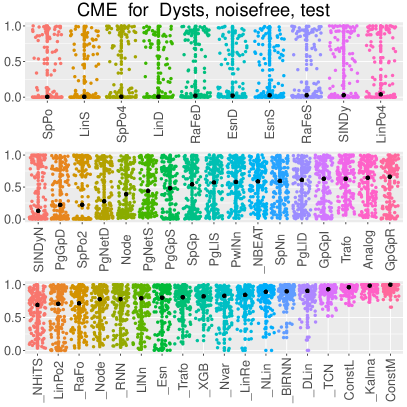
Experimental results
Research questions
- RQ1Which machine learning models consistently outperform others in predicting chaotic systems across diverse datasets and configurations?
- RQ2How does hyperparameter tuning impact the performance of lightweight versus heavyweight models in chaotic system prediction?
- RQ3To what extent do noise, fixed versus random timesteps, and observation schemes affect model generalization and error metrics?
- RQ4How effective is the proposed cumulative maximum error (CME) metric in capturing predictive divergence in chaotic systems compared to traditional metrics?
- RQ5Can simple, untuned models like polynomial fitting or linear regression outperform complex deep learning models in chaotic dynamics?
Key findings
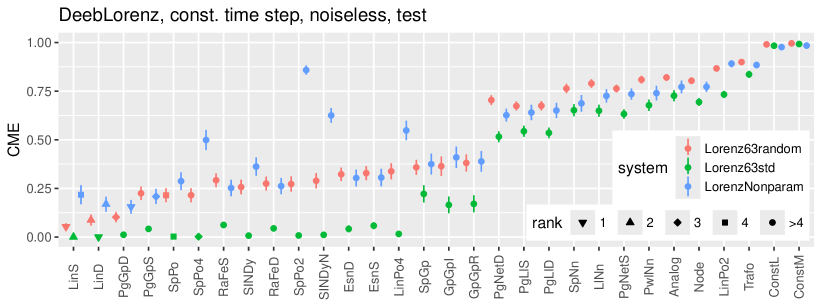
- Well-tuned lightweight models, such as polynomial fitting and linear regression, frequently outperform state-of-the-art deep learning models in predicting chaotic systems.
- Untuned baseline models often match or exceed the performance of complex architectures, especially under limited computational budgets.
- The cumulative maximum error (CME) metric effectively captures the divergence characteristic of chaotic systems and provides a more robust evaluation than traditional metrics like sMAPE or RMSE.
- Performance varies significantly across experimental setups, with noise, timestep scheme, and initial condition selection strongly influencing model rankings.
- Hyperparameter tuning improves performance for some models—particularly those with many tunable parameters—but offers diminishing returns for simpler, more stable methods.
- The DeebLorenz dataset enables reliable uncertainty quantification and reveals that model performance is highly sensitive to data characteristics and experimental design.
Read this paper
Open the full text in the Nubint reader and ask about any passage as you read.
Read this paper on NubintThis review was generated by AI from the original paper. Please check the paper before citing it.