
[Paper Review] Machine learning potentials for redox chemistry in solution
This work shows that fourth-generation HDNNP machine learning potentials can correctly describe redox chemistry in aqueous solution, including oxidation-state differentiation and electron transfer between Fe2+ and Fe3+ in water, unlike traditional second-generation potentials.
Machine learning potentials (MLPs) represent atomic interactions with quantum mechanical accuracy offering an efficient tool for atomistic simulations in many fields of science. However, most MLPs rely on local atomic energies without information about the global composition of the system. To date, this has prevented the application of MLPs to redox reactions in solution, which involve chemical species in different oxidation states and electron transfer between them. Here, we show that fourth-generation MLPs overcome this limitation and can provide a physically correct description of redox chemical reactions. For the example of ferrous (Fe$^{2+}$) and ferric (Fe$^{3+}$) ions in water we show that the correct oxidation states are obtained matching the number of chloride counter ions irrespective of their positions in the system. Moreover, we demonstrate that our method can describe electron-transfer processes between ferrous and ferric ions, paving the way to simulations of general redox chemistry in solution.
Motivation & Objective
- Motivate the challenge of simulating redox reactions in solution with ML potentials.
- Assess whether 4G-HDNNPs can encode system-wide oxidation-state information that 2G-HDNNPs lack.
- Benchmark 2G and 4G potentials on FeCl2/FeCl3 in water across multiple box sizes.
- Demonstrate capabilities for electron transfer modeling in Fe2Cl5 systems and discuss transferability and limitations.
Proposed method
- Train and test 2G-HDNNPs and 4G-HDNNPs on DFT reference data for FeCl2 and FeCl3 in water.
- Use Hirshfeld charges to identify oxidation states and generate 4G-HDNNP training targets.
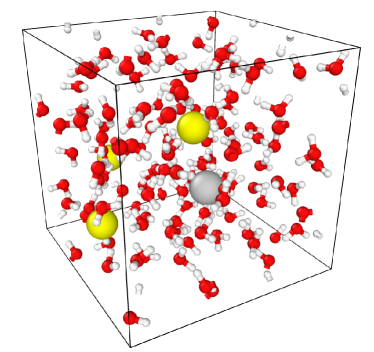
- Perform MD simulations in small, medium, and large boxes to probe solvation structures and oxidation-state verification.
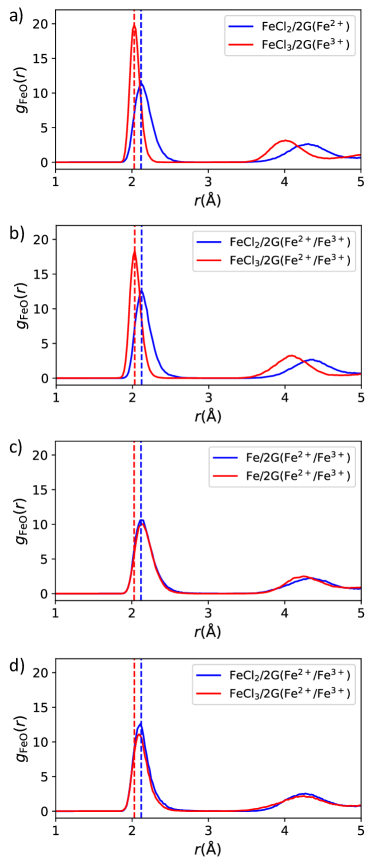
- Evaluate solvation shells via Fe–O radial distribution functions and Fe/Cl charge predictions over trajectories.
- Test system with two Fe ions and five Cl ions (Fe2Cl5) to observe potential electron-transfer events.
- Discuss computational cost and extrapolation limits of 4G vs 2G approaches.
Experimental results
Research questions
- RQ1Can 4G-HDNNPs correctly distinguish Fe2+ and Fe3+ solvation structures in liquid water?
- RQ2Do 2G-HDNNPs trained on mixed oxidation-state data fail to reproduce oxidation-state-specific interactions?
- RQ3Can 4G-HDNNPs describe electron transfer between Fe2+ and Fe3+ in solution (Fe2Cl5) and conserve overall system charge?
- RQ4What are the limitations and extrapolation boundaries of 4G-HDNNPs when larger chemical spaces are explored?
Key findings
- 2G-HDNNPs fail to distinguish oxidation states in solution when counterions are present, leading to incorrect solvation structures.
- 4G-HDNNPs correctly assign oxidation states and reproduce the proper Fe–O solvation shells for Fe2+ and Fe3+ across box sizes.
- 4G-HDNNPs trained on combined FeCl2/FeCl3 data maintain correct solvation structures even in large boxes where 2G fails.
- Hirshfeld charges from 4G-HDNNPs match the expected Fe2+/Fe3+ charges, confirming proper charge equilibration.
- In Fe2Cl5 simulations, 4G-HDNNP shows electron-transfer events between Fe2+ and Fe3+ consistent with qualitative expectations, though full quantitative extrapolation requires expanded training data.
- RMSEs alone do not guarantee physical correctness; 2G and 4G can have similar RMSEs yet differ qualitatively in redox behavior.
Read this paper
Open the full text in the Nubint reader and ask about any passage as you read.
Read this paper on NubintThis review was generated by AI from the original paper. Please check the paper before citing it.