
[Paper Review] Machine Learning Techniques for Sensor-based Human Activity Recognition with Data Heterogeneity -- A Review
This review systematically categorizes data heterogeneity types in sensor-based human activity recognition (HAR) and evaluates state-of-the-art machine learning techniques to address them. It proposes tailored ML approaches for modality, subject, spatial, streaming, and multi-heterogeneity scenarios, demonstrating improved model robustness and reduced annotation needs through transfer learning, domain generalization, and cross-modality knowledge transfer.
Sensor-based Human Activity Recognition (HAR) is crucial in ubiquitous computing, analysing behaviours through multi-dimensional observations. Despite research progress, HAR confronts challenges, particularly in data distribution assumptions. Most studies often assume uniform data distributions across datasets, contrasting with the varied nature of practical sensor data in human activities. Addressing data heterogeneity issues can improve performance, reduce computational costs, and aid in developing personalized, adaptive models with less annotated data. This review investigates how machine learning addresses data heterogeneity in HAR, by categorizing data heterogeneity types, applying corresponding suitable machine learning methods, summarizing available datasets, and discussing future challenges.
Motivation & Objective
- Address the critical challenge of data heterogeneity in sensor-based HAR, which undermines model generalization in real-world deployments.
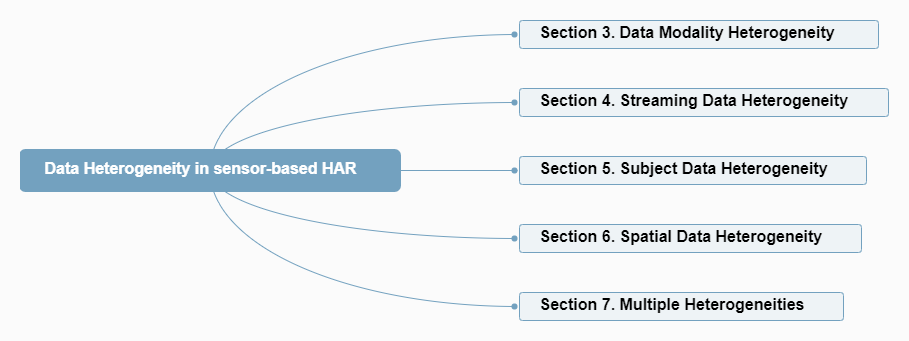
- Identify and categorize key types of data heterogeneity—modality, subject, spatial, streaming, and multi-heterogeneity—commonly encountered in real sensor data.
- Evaluate and compare machine learning paradigms such as transfer learning, domain generalization, and adaptive learning for handling each heterogeneity type.
- Provide a comprehensive summary of public datasets relevant to each heterogeneity type to support future research.
- Highlight open challenges and research gaps, especially in cross-modality knowledge transfer and handling concept drift in streaming data.
Proposed method
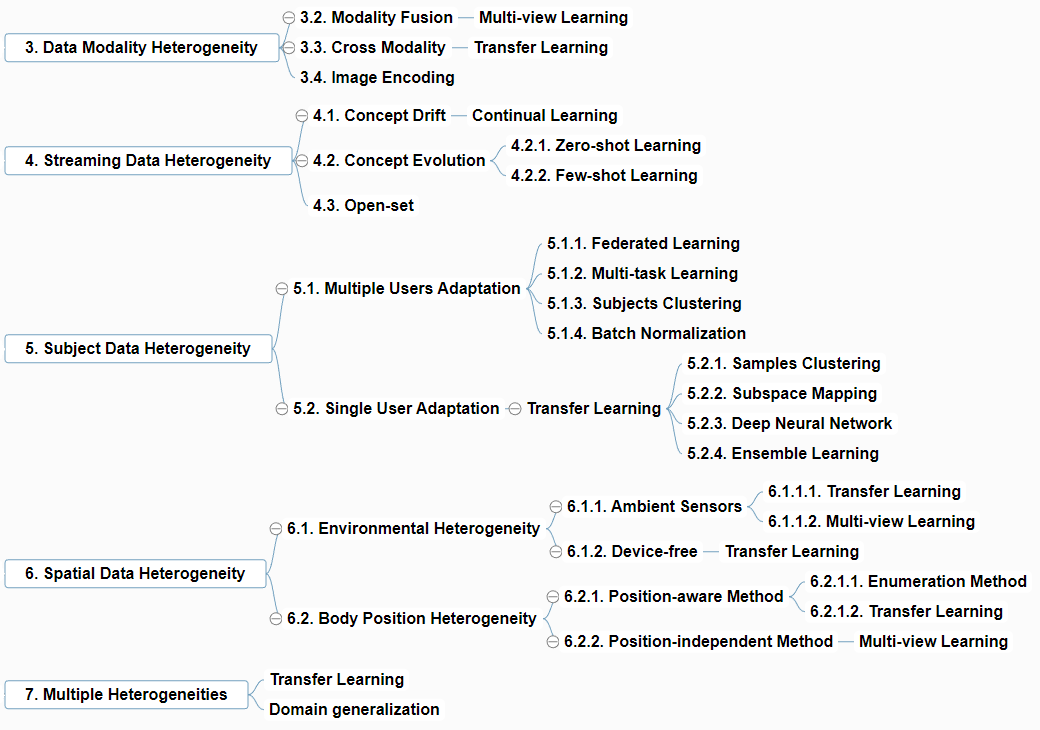
- Categorize data heterogeneity into five types: data modality, subject, spatial, streaming, and multi-heterogeneity, based on distribution shifts in sensor data.
- Survey and analyze machine learning techniques including transfer learning (e.g., transitive transfer learning), domain generalization, and self-supervised representation learning for each heterogeneity type.
- Evaluate methods for cross-modality knowledge transfer, particularly leveraging intermediate domains to bridge unrelated sensor modalities.
- Integrate external semantic information (e.g., Word2Vec embeddings) to enhance label space transfer and model generalization for unseen activities.
- Propose adaptive learning frameworks that generalize across multiple source domains without requiring access to the target domain.
- Assess the effectiveness of existing methods through comparative analysis of performance, computational cost, and robustness under distribution shifts.
Experimental results
Research questions
- RQ1What are the primary types of data heterogeneity in sensor-based HAR, and how do they affect model performance?
- RQ2Which machine learning techniques are most effective for addressing each type of data heterogeneity in HAR?
- RQ3How can transfer learning and domain generalization be leveraged to improve model robustness across diverse users and sensor configurations?
- RQ4What role does external semantic information play in enabling generalization to unseen activities?
- RQ5What are the current limitations in public datasets for evaluating data heterogeneity in HAR, and what new data needs to be developed?
Key findings
- Data heterogeneity—especially across subjects, modalities, and streaming conditions—significantly degrades the performance of HAR models trained under IID assumptions.
- Transfer learning, particularly transitive transfer learning (TTL), shows promise in bridging large distribution gaps between unrelated sensor modalities.
- Domain generalization methods enable models to generalize to unseen users or environments without requiring target domain data.
- Incorporating semantic embeddings (e.g., Word2Vec) into the label space improves generalization for unseen activities by aligning linguistic and action semantics.
- Current public datasets lack long-term streaming data with concept drift and multi-modal sensor fusion, limiting research on dynamic and real-world HAR scenarios.
- The integration of adaptive learning and cross-modality knowledge transfer remains underexplored, representing a key research frontier for robust HAR systems.
Read this paper
Open the full text in the Nubint reader and ask about any passage as you read.
Read this paper on NubintThis review was generated by AI from the original paper. Please check the paper before citing it.