
[Paper Review] Magic123: One Image to High-Quality 3D Object Generation Using Both 2D and 3D Diffusion Priors
Magic123 combines 2D and 3D diffusion priors in a two-stage coarse-to-fine pipeline to generate high-quality textured 3D meshes from a single image, with a tunable trade-off between exploration and exploitation of geometry.
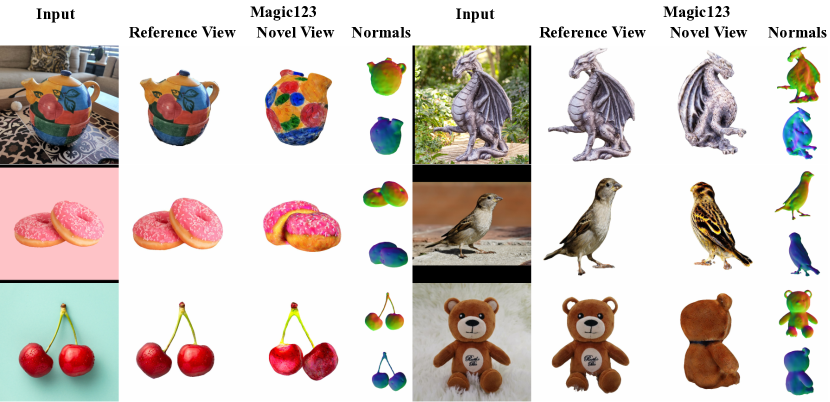
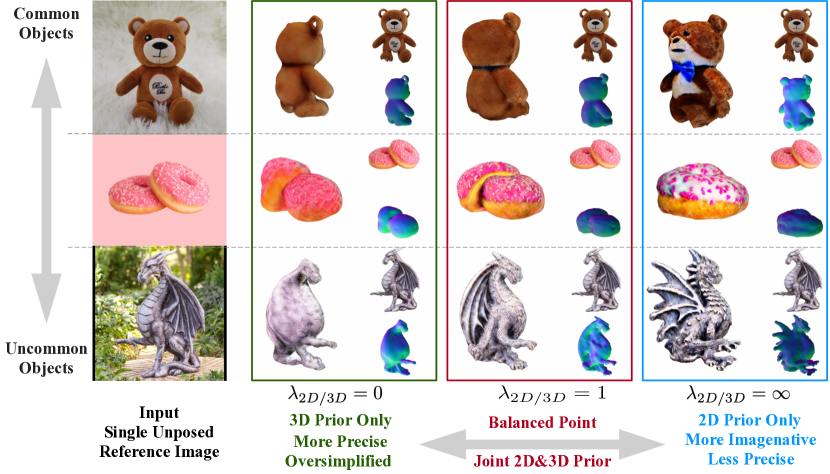
We present Magic123, a two-stage coarse-to-fine approach for high-quality, textured 3D meshes generation from a single unposed image in the wild using both2D and 3D priors. In the first stage, we optimize a neural radiance field to produce a coarse geometry. In the second stage, we adopt a memory-efficient differentiable mesh representation to yield a high-resolution mesh with a visually appealing texture. In both stages, the 3D content is learned through reference view supervision and novel views guided by a combination of 2D and 3D diffusion priors. We introduce a single trade-off parameter between the 2D and 3D priors to control exploration (more imaginative) and exploitation (more precise) of the generated geometry. Additionally, we employ textual inversion and monocular depth regularization to encourage consistent appearances across views and to prevent degenerate solutions, respectively. Magic123 demonstrates a significant improvement over previous image-to-3D techniques, as validated through extensive experiments on synthetic benchmarks and diverse real-world images. Our code, models, and generated 3D assets are available at https://github.com/guochengqian/Magic123.
Motivation & Objective
- Motivate single-image 3D reconstruction in the wild by leveraging both 2D and 3D diffusion priors.
- Propose a two-stage coarse-to-fine pipeline to produce high-resolution geometry and textures.
- Introduce a simple trade-off parameter to balance geometry exploration versus exploitation.
- Enable texture-preserving, view-consistent 3D content through textural inversion and depth regularization.
Proposed method
- Two-stage pipeline: coarse NeRF optimization followed by fine memory-efficient DMTet mesh refinement.
- Joint 2D and 3D diffusion priors guiding novel views via a combined loss L_g that blends 2D SDS guidance and a 3D view-conditioned prior.
- Monocular depth regularization and textural inversion to stabilize geometry and textures across views.
- Texture-decomposed mesh representation (DMTet) used in the second stage to achieve high-resolution mesh and texture.
- Reference-view supervision with foreground segmentation and depth prior to prevent degenerate geometry.
- Coarse stage uses reference view reconstruction loss L_rec and novel-view guidance L_g with depth L_d and normal smoothness L_n; fine stage replaces NeRF with DMTet but keeps the same guidance framework.
Experimental results
Research questions
- RQ1Can a single unposed image be used to generate high-fidelity, textured 3D meshes with consistent appearance across views?
- RQ2Does leveraging both 2D and 3D diffusion priors improve 3D fidelity and texture quality compared to using either prior alone?
- RQ3How does a tunable trade-off between priors affect geometry exploration versus exploitation for diverse objects?
Key findings
- Magic123 achieves state-of-the-art results on NeRF4 and RealFusion15 datasets across CLIP-Similarity, PSNR, and LPIPS metrics.
- Using both 2D and 3D priors with a balanced trade-off yields high-fidelity geometry and visually appealing textures.
- The coarse-to-fine approach with NeRF followed by DMTet enables higher-resolution, texture-aware 3D reconstructions from a single image.
- A fixed parameter setting (lambda_2D/3D = 1.0, lambda_3D = 40) plus stage-specific adjustments provides strong performance without per-object tuning.
- Ablation shows sole reliance on 2D priors can cause Janus-like geometry; sole reliance on 3D priors limits detail; the joint prior with balanced weights achieves robust results.
Read this paper
Open the full text in the Nubint reader and ask about any passage as you read.
Read this paper on NubintThis review was generated by AI from the original paper. Please check the paper before citing it.