
[Paper Review] MagicAnimate: Temporally Consistent Human Image Animation using Diffusion Model
MagicAnimate introduces a diffusion-based framework with temporal modeling and a novel appearance encoder to produce temporally consistent, high-fidelity human image animations guided by DensePose motions, outperforming baselines on TikTok and TED-talks datasets.
This paper studies the human image animation task, which aims to generate a video of a certain reference identity following a particular motion sequence. Existing animation works typically employ the frame-warping technique to animate the reference image towards the target motion. Despite achieving reasonable results, these approaches face challenges in maintaining temporal consistency throughout the animation due to the lack of temporal modeling and poor preservation of reference identity. In this work, we introduce MagicAnimate, a diffusion-based framework that aims at enhancing temporal consistency, preserving reference image faithfully, and improving animation fidelity. To achieve this, we first develop a video diffusion model to encode temporal information. Second, to maintain the appearance coherence across frames, we introduce a novel appearance encoder to retain the intricate details of the reference image. Leveraging these two innovations, we further employ a simple video fusion technique to encourage smooth transitions for long video animation. Empirical results demonstrate the superiority of our method over baseline approaches on two benchmarks. Notably, our approach outperforms the strongest baseline by over 38% in terms of video fidelity on the challenging TikTok dancing dataset. Code and model will be made available.
Motivation & Objective
- Address temporal inconsistency and reference appearance fidelity in human image animation.
- Develop a video diffusion model that encodes temporal information across frames.
- Introduce a dense appearance encoder to preserve identity, clothing, and background details.
- Enable long video animation through a simple video fusion strategy across overlapping segments.
- Improve per-frame fidelity via image-video joint training and segmentation-aware conditioning.
Proposed method
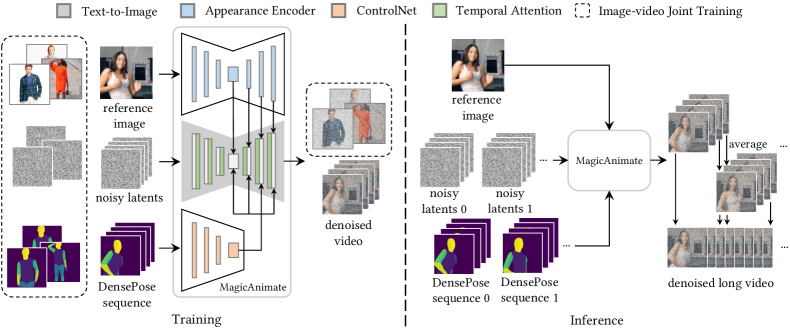
- Extend diffusion models to a video domain by inflating 2D UNet with temporal attention blocks to form a 3D temporal UNet.
- Introduce an appearance encoder that injects dense reference-image features into spatial self-attention during denoising, improving identity and background preservation.
- Condition animation on DensePose sequences via a pose ControlNet to drive motion transfer.
- Perform segment-by-segment processing of long videos with a sliding-window overlap and average predictions for overlapping frames to ensure smooth transitions.
- Train with an image-video joint strategy to leverage large image datasets for richer appearance cues and maintain per-frame fidelity.
- Use a simple video fusion technique at inference to blend overlapping segment outputs for seamless long-duration animation.
Experimental results
Research questions
- RQ1Can a diffusion-based framework achieve superior temporal coherence for human image animation compared to frame-by-frame methods?
- RQ2Does a dedicated appearance encoder improve identity preservation and background fidelity over CLIP-based appearance conditioning?
- RQ3What is the impact of temporal attention and image-video joint training on per-frame quality and video fidelity?
- RQ4How effective is simple overlap-based video fusion at inference for long video smoothness?
- RQ5To what extent does MagicAnimate generalize to unseen domains and multi-person scenarios?
Key findings
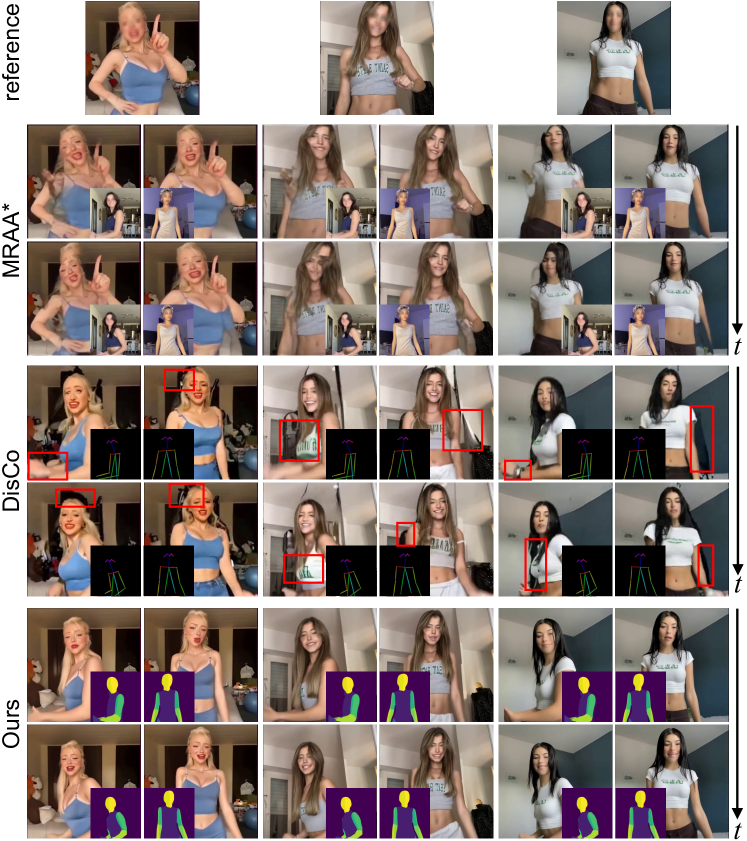
- MagicAnimate achieves state-of-the-art performance on TikTok and TED-talks datasets across image and video fidelity metrics.
- On TikTok, MagicAnimate surpasses the strongest baseline by over 38% in terms of video quality (FVD) and 38% in FID-VID.
- It attains the best FID-VID and FVD on TED-talks, with notable improvements over baselines.
- Ablations show temporal modeling and the appearance encoder substantially improve SSIM and LPIPS, and the image-video joint training enhances overall fidelity.
- The simple video fusion strategy yields smoother transitions for long videos and improves temporal consistency.
Read this paper
Open the full text in the Nubint reader and ask about any passage as you read.
Read this paper on NubintThis review was generated by AI from the original paper. Please check the paper before citing it.