
[Paper Review] MaGS: Reconstructing and Simulating Dynamic 3D Objects with Mesh-adsorbed Gaussian Splatting
MaGS unifies 3D reconstruction and dynamic object simulation by placing 3D Gaussians on a deforming mesh and learning a relative deformation field to hover Gaussians over the mesh during deformation, achieving high rendering quality and realistic motion.
3D reconstruction and simulation, although interrelated, have distinct objectives: reconstruction requires a flexible 3D representation that can adapt to diverse scenes, while simulation needs a structured representation to model motion principles effectively. This paper introduces the Mesh-adsorbed Gaussian Splatting (MaGS) method to address this challenge. MaGS constrains 3D Gaussians to roam near the mesh, creating a mutually adsorbed mesh-Gaussian 3D representation. Such representation harnesses both the rendering flexibility of 3D Gaussians and the structured property of meshes. To achieve this, we introduce RMD-Net, a network that learns motion priors from video data to refine mesh deformations, alongside RGD-Net, which models the relative displacement between the mesh and Gaussians to enhance rendering fidelity under mesh constraints. To generalize to novel, user-defined deformations beyond input video without reliance on temporal data, we propose MPE-Net, which leverages inherent mesh information to bootstrap RMD-Net and RGD-Net. Due to the universality of meshes, MaGS is compatible with various deformation priors such as ARAP, SMPL, and soft physics simulation. Extensive experiments on the D-NeRF, DG-Mesh, and PeopleSnapshot datasets demonstrate that MaGS achieves state-of-the-art performance in both reconstruction and simulation.
Motivation & Objective
- Motivate a unified approach for dynamic 3D reconstruction and simulation that avoids compromising rendering quality or deformation realism.
- Propose a mesh-adsorbed Gaussian representation that combines the flexibility of Gaussian splatting with mesh coherence.
- Introduce a learnable Relative Deformation Field (RDF) to model relative motion between mesh and Gaussians.
- Leverage ARAP-based mesh deformation with RDF to achieve realistic, controllable dynamics.
- Jointly optimize mesh, Gaussians, and RDF to improve both reconstruction accuracy and deformation realism.
Proposed method
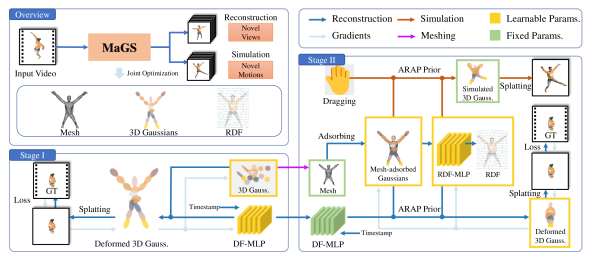
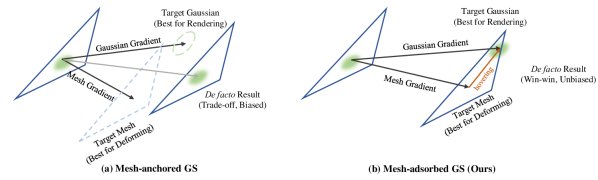
- Introduce Mesh-adsorbed Gaussian Splatting (MaGS), constraining Gaussians to hover on mesh surfaces for a hybrid representation.
- Stage I estimates a coarse deformation field using a deformation-field MLP (DF-MLP) to render frames and obtain a coarse mesh via depth-based Gaussian rendering and Marching Cubes.
- Stage II adsorbs Gaussians onto the mesh and employs RDF-MLP to compute the relative deformation field, allowing Gaussians to hover and deform with the mesh.
- Extend the ARAP prior to capture non-rigid, per-Gaussian motion during deformation.
- Use Poisson-disk sampling to place deformation handles and apply ARAP to ensure local rigidity while allowing the RDF to capture finer non-rigid motion.
- Enable differentiable rendering via 3D Gaussian splatting to optimize Gaussians, mesh, and RDF end-to-end.
- Provide user-interactive simulation by dragging the mesh and refining Gaussian positions through RDF-based adjustments.
Experimental results
Research questions
- RQ1Can a hybrid mesh-adsorbed Gaussian representation support both accurate 3D reconstruction and realistic dynamic deformation from monocular video?
- RQ2Does a learnable Relative Deformation Field (RDF) improve per-Gaussian motion modeling beyond ARAP-based mesh deformation?
- RQ3How does joint optimization of mesh, Gaussians, and RDF compare to fixed-mesh–Gaussian anchoring in rendering quality and deformation plausibility?
- RQ4Can the framework support interactive user-driven deformation while preserving texture and structure?
- RQ5What are the quantitative gains on dynamic scene benchmarks (D-NeRF, NeRF-DS) when using MaGS vs prior methods?
Key findings
- MaGS achieves higher rendering accuracy and more realistic deformation than prior mesh-Gaussian approaches, demonstrated on D-NeRF and NeRF-DS.
- Joint optimization of meshes, Gaussians, and RDF reduces artifacts and improves PSNR/SSIM metrics while lowering LPIPS on evaluated sequences.
- Allowing Gaussians to hover on the mesh and learning per-Gaussian relative deformations yields better rendering fidelity than fixed mesh-anchored representations.
- Ablation studies show that removing RDF or hovering reduces performance, with RDF having a larger impact on rendering quality.
Read this paper
Open the full text in the Nubint reader and ask about any passage as you read.
Read this paper on NubintThis review was generated by AI from the original paper. Please check the paper before citing it.