
[Paper Review] Make-It-3D: High-Fidelity 3D Creation from A Single Image with Diffusion Prior
Make-It-3D creates high-fidelity 3D content from a single image by leveraging a 2D diffusion model as a 3D-aware prior in a two-stage NeRF-to-textured-point-cloud pipeline, achieving faithful geometry and realistic textures at novel views.
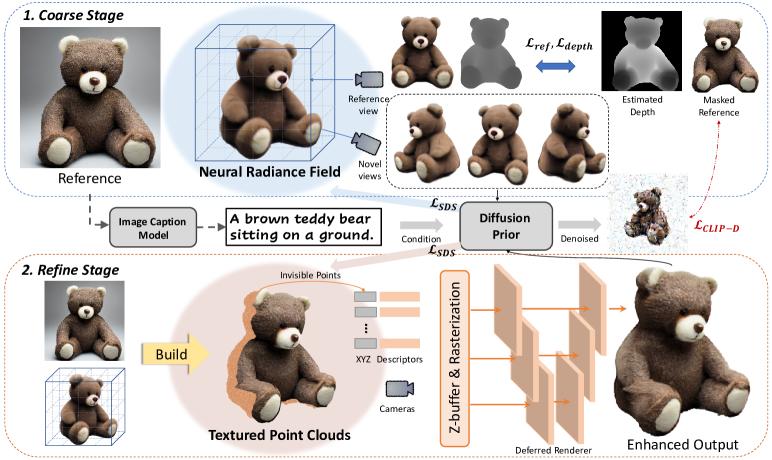
In this work, we investigate the problem of creating high-fidelity 3D content from only a single image. This is inherently challenging: it essentially involves estimating the underlying 3D geometry while simultaneously hallucinating unseen textures. To address this challenge, we leverage prior knowledge from a well-trained 2D diffusion model to act as 3D-aware supervision for 3D creation. Our approach, Make-It-3D, employs a two-stage optimization pipeline: the first stage optimizes a neural radiance field by incorporating constraints from the reference image at the frontal view and diffusion prior at novel views; the second stage transforms the coarse model into textured point clouds and further elevates the realism with diffusion prior while leveraging the high-quality textures from the reference image. Extensive experiments demonstrate that our method outperforms prior works by a large margin, resulting in faithful reconstructions and impressive visual quality. Our method presents the first attempt to achieve high-quality 3D creation from a single image for general objects and enables various applications such as text-to-3D creation and texture editing.
Motivation & Objective
- Motivate high-quality 3D reconstruction from a single image for general objects, enabling broader accessibility to 3D content creation.
Proposed method
- Two-stage framework using diffusion priors for 3D-aware supervision.
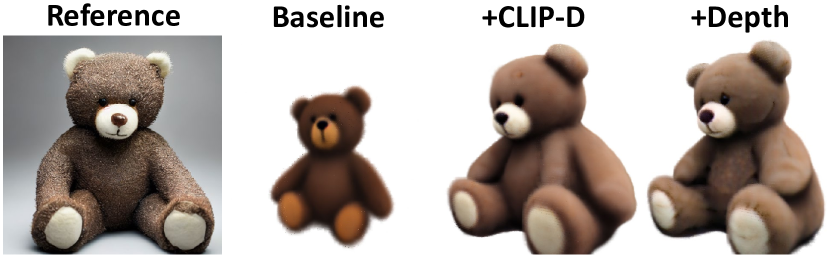
- Stage 1: coarse NeRF optimization with reference-view supervision, SDS loss, CLIP-D loss, and depth prior.
- Stage 2: convert to textured point clouds, project reference textures, and refine invisible textures with diffusion prior via a learnable deferred renderer.
Experimental results
Research questions
- RQ1Can high-fidelity 3D content be created from a single image for arbitrary objects using diffusion priors?
- RQ2How can a diffusion prior be integrated to enforce reference-view fidelity and novel-view plausibility?
- RQ3Does a two-stage NeRF-to-textured-point-cloud pipeline improve geometry and texture quality over prior single-stage methods?
Key findings
- Outperforms prior work on both geometry and texture quality across DTU and a new 400-image benchmark.
- Coarse NeRF with diffusion priors yields plausible geometry and faithful reference-view rendering.
- Texture refinement via textured point clouds and diffusion prior significantly enhances non-visible regions, producing higher fidelity textures.
- The approach enables 360° reconstructions from a single image and supports applications like text-to-3D creation and texture editing.
- The method achieves state-of-the-art metrics in LPIPS, contextual distance, and CLIP-based similarity on the tested datasets.
Read this paper
Open the full text in the Nubint reader and ask about any passage as you read.
Read this paper on NubintThis review was generated by AI from the original paper. Please check the paper before citing it.