
[Paper Review] Make Prompt-based Black-Box Tuning Colorful: Boosting Model Generalization from Three Orthogonal Perspectives
This paper proposes BBT-RGB, a plug-and-play framework that enhances black-box prompt tuning in large language models via three orthogonal techniques: a two-stage derivative-free optimization strategy to reduce overfitting, automatic verbalizer construction for improved context utilization, and instruction-based prompt initialization with in-context demonstrations. The method achieves state-of-the-art performance on multiple NLP tasks under few-shot settings, outperforming both gradient-based parameter-efficient tuning and prior black-box methods, while maintaining minimal tunable parameters.
Large language models (LLMs) have shown increasing power on various natural language processing (NLP) tasks. However, tuning these models for downstream tasks usually needs exorbitant costs or is unavailable due to commercial considerations. Recently, black-box tuning has been proposed to address this problem by optimizing task-specific prompts without accessing the gradients and hidden representations. However, most existing works have yet fully exploited the potential of gradient-free optimization under the scenario of few-shot learning. In this paper, we describe BBT-RGB, a suite of straightforward and complementary techniques for enhancing the efficiency and performance of black-box optimization. Specifically, our method includes three plug-and-play components: (1) Two-stage derivative-free optimization strategy that facilitates fast convergence and mitigates overfitting; (2) Automatic verbalizer construction with its novel usage under few-shot settings; (3) Better prompt initialization policy based on instruction search and auto-selected demonstration. Extensive experiments across various tasks on natural language understanding and inference demonstrate the effectiveness of our method. Our codes are publicly available at https://github.com/QiushiSun/BBT-RGB.
Motivation & Objective
- To address the challenge of overfitting and suboptimal convergence in black-box prompt tuning under few-shot settings.
- To improve model generalization by leveraging multiple verbalizers and in-context learning for better prompt initialization.
- To enhance derivative-free optimization stability and performance without access to model gradients or hidden states.
- To enable effective prompt tuning in a black-box API setting where only input-output pairs are accessible.
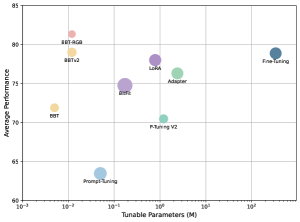
- To achieve performance comparable to full fine-tuning while tuning only a small number of continuous prompt parameters.
Proposed method
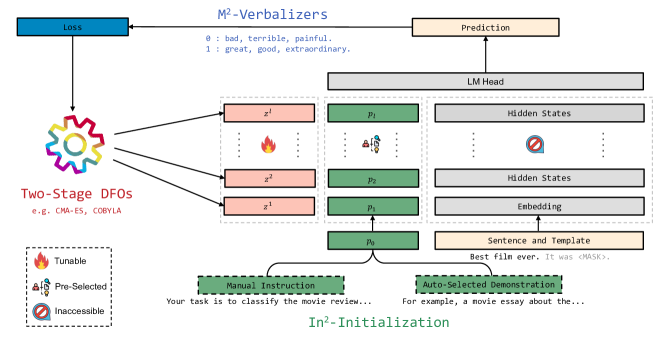
- Introduces a two-stage derivative-free optimization (DFO) strategy: first using CMA-ES for global exploration, then switching to COBYLA for local refinement to stabilize convergence and reduce overfitting.
- Proposes a multi-mixed verbalizer (M2 Verbalizers) approach that automatically generates and selects multiple label word candidates to improve robustness and exploit model outputs.
- Employs an In 2 initialization method combining task-specific manual instructions with auto-selected demonstrations from the training set to improve prompt quality from the start.
- Uses random projection matrices to reduce prompt dimensionality and maintain efficiency during derivative-free optimization.
- Designs a plug-and-play framework where each component can be independently applied or combined, enhancing compatibility and modularity.
- Leverages in-context learning by selecting the most effective demonstration sample from the training set based on validation performance.
Experimental results
Research questions
- RQ1Can a two-stage DFO strategy improve convergence stability and reduce overfitting in black-box prompt tuning under few-shot conditions?
- RQ2How does automatic verbalizer construction with multiple candidates enhance model generalization and robustness in black-box tuning?
- RQ3To what extent can instruction learning combined with in-context demonstration improve prompt initialization and downstream performance?
- RQ4Can black-box tuning with continuous prompts achieve performance comparable to full fine-tuning while minimizing tunable parameters?
- RQ5How does BBT-RGB compare to gradient-based parameter-efficient tuning methods in black-box settings?
Key findings
- BBT-RGB outperforms all prior gradient-free tuning methods on all evaluated NLP tasks, including sentiment analysis (SST-2 and Yelp) and natural language inference (SNLI, RTE, MRPC).
- On the SNLI and MRPC tasks, BBT-RGB achieves higher accuracy than full fine-tuning, demonstrating its ability to surpass standard fine-tuning under black-box constraints.
- The two-stage DFO strategy significantly reduces validation loss oscillation and improves generalization, especially on the Yelp dataset, where it mitigates overfitting compared to single-method CMA-ES.
- The In 2 initialization method, combining manual instructions and auto-selected demonstrations, leads to better initial prompt quality and faster convergence.
- BBT-RGB achieves state-of-the-art performance on the GLUE benchmark across seven diverse NLP tasks, including sentiment analysis, topic classification, and natural language inference.
- The method maintains strong performance with minimal tunable parameters, demonstrating high efficiency in black-box tuning scenarios.
Read this paper
Open the full text in the Nubint reader and ask about any passage as you read.
Read this paper on NubintThis review was generated by AI from the original paper. Please check the paper before citing it.