
[Paper Review] Making Recommender Systems Forget: Learning and Unlearning for Erasable Recommendation
This paper proposes LASER, a novel erasable recommendation framework that enables efficient and effective unlearning in collaborative filtering-based recommender systems. By leveraging hypergraph-based user clustering and sequential curriculum learning across balanced groups, LASER achieves complete unlearning of user data while preserving model utility, outperforming state-of-the-art unlearning methods in both efficiency and recommendation accuracy on real-world datasets.
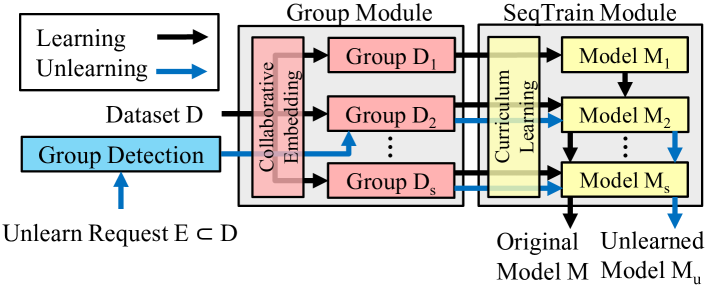
Privacy laws and regulations enforce data-driven systems, e.g., recommender systems, to erase the data that concern individuals. As machine learning models potentially memorize the training data, data erasure should also unlearn the data lineage in models, which raises increasing interest in the problem of Machine Unlearning (MU). However, existing MU methods cannot be directly applied into recommendation. The basic idea of most recommender systems is collaborative filtering, but existing MU methods ignore the collaborative information across users and items. In this paper, we propose a general erasable recommendation framework, namely LASER, which consists of Group module and SeqTrain module. Firstly, Group module partitions users into balanced groups based on their similarity of collaborative embedding learned via hypergraph. Then SeqTrain module trains the model sequentially on all groups with curriculum learning. Both theoretical analysis and experiments on two real-world datasets demonstrate that LASER can not only achieve efficient unlearning, but also outperform the state-of-the-art unlearning framework in terms of model utility.
Motivation & Objective
- To address the challenge of user-wise data erasure in recommender systems under privacy regulations like GDPR.
- To develop an unlearning framework that maintains model utility while efficiently removing user data lineage from collaborative filtering models.
- To overcome limitations of existing machine unlearning methods, which fail to preserve collaborative information across users and items.
- To design a scalable and theoretically grounded unlearning process that supports both learning and unlearning in a unified framework.
Proposed method
- LASER employs a Group module that partitions users into balanced clusters using collaborative embeddings derived from a hypergraph, ensuring high intra-group similarity and balanced data distribution.
- The SeqTrain module trains the model sequentially on these groups in an easy-to-hard order, emulating human curriculum learning to improve model convergence and utility.
- Collaborative cohesion is introduced as a metric to quantify the volume of collaborative information within each group, guiding the grouping and training process.
- The framework uses a balanced k-means clustering algorithm with constraints to ensure group size uniformity, optimizing unlearning efficiency.
- Theoretical analysis proves that balanced grouping minimizes expected unlearning cost, with the optimal configuration achieved when all groups have equal size.
- The model is trained using empirical risk minimization, with utility maximized via a Bayesian prior that incorporates group-specific loss and performance metrics.

Experimental results
Research questions
- RQ1Can a machine unlearning framework be designed to preserve collaborative information across users and items in collaborative filtering models?
- RQ2How does sequential training in an easy-to-hard curriculum order affect model utility during unlearning?
- RQ3Does balanced grouping of users based on collaborative embeddings improve unlearning efficiency and reduce computational cost?
- RQ4To what extent can the proposed LASER framework outperform existing unlearning baselines in terms of model utility and unlearning completeness?
Key findings
- LASER achieves complete unlearning (G1) by retraining on data subsets, ensuring that target user data lineage is fully erased from the model.
- The framework improves model utility (G3) by preserving collaborative information through sequential training on balanced groups, outperforming SOTA unlearning baselines on NDCG and HR metrics.
- Balanced grouping minimizes expected unlearning cost, with theoretical proof showing that equal-sized groups yield the lowest expected cost under the model's loss function.
- Empirical results on the ML-100K and Amazon-Books datasets confirm that LASER maintains high recommendation accuracy even after unlearning, with consistent improvements in NDCG@10 and HR@10 across different unlearning request types.
- The proposed collaborative embedding method significantly increases collaborative cohesion compared to sparse user-item interactions, validating its effectiveness in capturing high-order user-item relationships.
Read this paper
Open the full text in the Nubint reader and ask about any passage as you read.
Read this paper on NubintThis review was generated by AI from the original paper. Please check the paper before citing it.