
[Paper Review] Making Scalable Meta Learning Practical
This paper introduces SAMA, a scalable meta learning framework that enables efficient, distributed training of gradient-based meta learning by avoiding explicit second-order gradient computation and supporting adaptive optimizers. SAMA achieves up to 4.8× higher throughput and 3.8× lower memory usage on multi-GPU setups, demonstrating state-of-the-art performance in data pruning and fine-tuning for BERT and RoBERTa models.
Despite its flexibility to learn diverse inductive biases in machine learning programs, meta learning (i.e., learning to learn) has long been recognized to suffer from poor scalability due to its tremendous compute/memory costs, training instability, and a lack of efficient distributed training support. In this work, we focus on making scalable meta learning practical by introducing SAMA, which combines advances in both implicit differentiation algorithms and systems. Specifically, SAMA is designed to flexibly support a broad range of adaptive optimizers in the base level of meta learning programs, while reducing computational burden by avoiding explicit computation of second-order gradient information, and exploiting efficient distributed training techniques implemented for first-order gradients. Evaluated on multiple large-scale meta learning benchmarks, SAMA showcases up to 1.7/4.8x increase in throughput and 2.0/3.8x decrease in memory consumption respectively on single-/multi-GPU setups compared to other baseline meta learning algorithms. Furthermore, we show that SAMA-based data optimization leads to consistent improvements in text classification accuracy with BERT and RoBERTa large language models, and achieves state-of-the-art results in both small- and large-scale data pruning on image classification tasks, demonstrating the practical applicability of scalable meta learning across language and vision domains.
Motivation & Objective
- Address the poor scalability of gradient-based meta learning due to high compute/memory costs and lack of distributed training support.
- Overcome instability and inefficiency in existing implicit differentiation methods, especially for large models using adaptive optimizers like Adam.
- Develop a holistic system-algorithm co-design approach to enable practical deployment of meta learning in real-world NLP and vision applications.
- Enable efficient, scalable meta learning across diverse tasks, including data optimization, pruning, and fine-tuning of large models like BERT and RoBERTa.
- Bridge the gap between theoretical meta learning and practical deployment by supporting modern deep learning workflows with adaptive optimizers and distributed training.
Proposed method
- Approximate the base Jacobian inverse using an identity matrix to eliminate costly matrix inversion and reduce computational overhead.
- Extend the meta gradient computation via chain rule to support adaptive optimizers such as Adam, enabling compatibility with modern deep learning models.
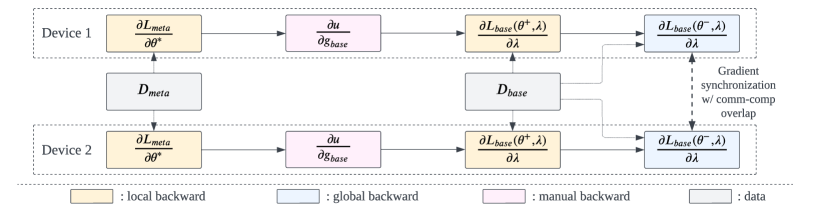
- Implement a novel communication-computation overlap strategy to efficiently utilize distributed training resources across multiple GPUs.
- Leverage the JaxOpt framework to implement SAMA with first-order gradient-based implicit differentiation, avoiding explicit second-order gradient computation.
- Design a system-optimized pipeline that supports efficient backward pass computation for meta gradients without custom autograd extensions.
- Integrate efficient distributed training techniques originally designed for first-order methods into the meta learning framework to scale across multiple GPUs.
Experimental results
Research questions
- RQ1Can implicit differentiation in meta learning be made scalable and efficient for large models trained with adaptive optimizers like Adam?
- RQ2How can the computational and memory overhead of base Jacobian inversion be reduced without sacrificing training stability?
- RQ3To what extent can distributed training techniques for first-order optimization be adapted to support scalable meta learning?
- RQ4Can SAMA achieve significant improvements in throughput and memory efficiency compared to existing GBML methods on large-scale benchmarks?
- RQ5Does SAMA enable consistent performance gains in practical applications such as data pruning and fine-tuning for large language models?
Key findings
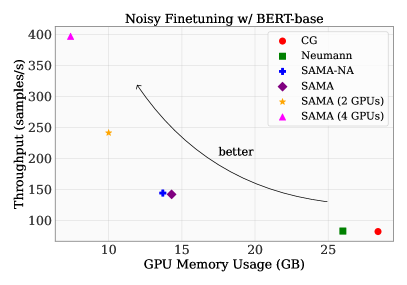
- SAMA achieves up to 1.7× higher throughput and 2.0× lower memory consumption on single-GPU setups compared to baseline meta learning algorithms.
- On multi-GPU setups, SAMA achieves up to 4.8× higher throughput and 3.8× lower memory consumption than baseline methods.
- SAMA-based data optimization improves fine-tuning accuracy on BERT and RoBERTa large language models across multiple text classification benchmarks.
- SAMA achieves state-of-the-art results in both small- and large-scale data pruning for image classification tasks on ImageNet-1k.
- The efficiency gap between SAMA and baseline methods widens with increasing model size, as SAMA shows the least increase in GPU memory usage.
- Efficient distributed training with SAMA on 4 GPUs achieves 15–20× speedup compared to MWN, which lacks distributed training support.
Read this paper
Open the full text in the Nubint reader and ask about any passage as you read.
Read this paper on NubintThis review was generated by AI from the original paper. Please check the paper before citing it.