
[Paper Review] MambaMixer: Efficient Selective State Space Models with Dual Token and Channel Selection
This paper introduces MambaMixer, a dual-token-and-channel selective state space model block, and builds Vision MambaMixer (ViM2) and Time Series MambaMixer (TSM2) to achieve competitive or superior performance with linear complexity for long sequences.
Recent advances in deep learning have mainly relied on Transformers due to their data dependency and ability to learn at scale. The attention module in these architectures, however, exhibits quadratic time and space in input size, limiting their scalability for long-sequence modeling. Despite recent attempts to design efficient and effective architecture backbone for multi-dimensional data, such as images and multivariate time series, existing models are either data independent, or fail to allow inter- and intra-dimension communication. Recently, State Space Models (SSMs), and more specifically Selective State Space Models, with efficient hardware-aware implementation, have shown promising potential for long sequence modeling. Motivated by the success of SSMs, we present MambaMixer, a new architecture with data-dependent weights that uses a dual selection mechanism across tokens and channels, called Selective Token and Channel Mixer. MambaMixer connects selective mixers using a weighted averaging mechanism, allowing layers to have direct access to early features. As a proof of concept, we design Vision MambaMixer (ViM2) and Time Series MambaMixer (TSM2) architectures based on the MambaMixer block and explore their performance in various vision and time series forecasting tasks. Our results underline the importance of selective mixing across both tokens and channels. In ImageNet classification, object detection, and semantic segmentation tasks, ViM2 achieves competitive performance with well-established vision models and outperforms SSM-based vision models. In time series forecasting, TSM2 achieves outstanding performance compared to state-of-the-art methods while demonstrating significantly improved computational cost. These results show that while Transformers, cross-channel attention, and MLPs are sufficient for good performance in time series forecasting, neither is necessary.
Motivation & Objective
- Motivate scalable long-sequence modeling beyond quadratic-attention Transformers.
- Propose MambaMixer block with dual selection across tokens and channels to efficiently fuse information.
- Showcase ViM2 and TSM2 architectures for vision and time-series forecasting.
- Demonstrate competitive vision results and state-of-the-art-like performance with reduced computational cost in time series.
Proposed method
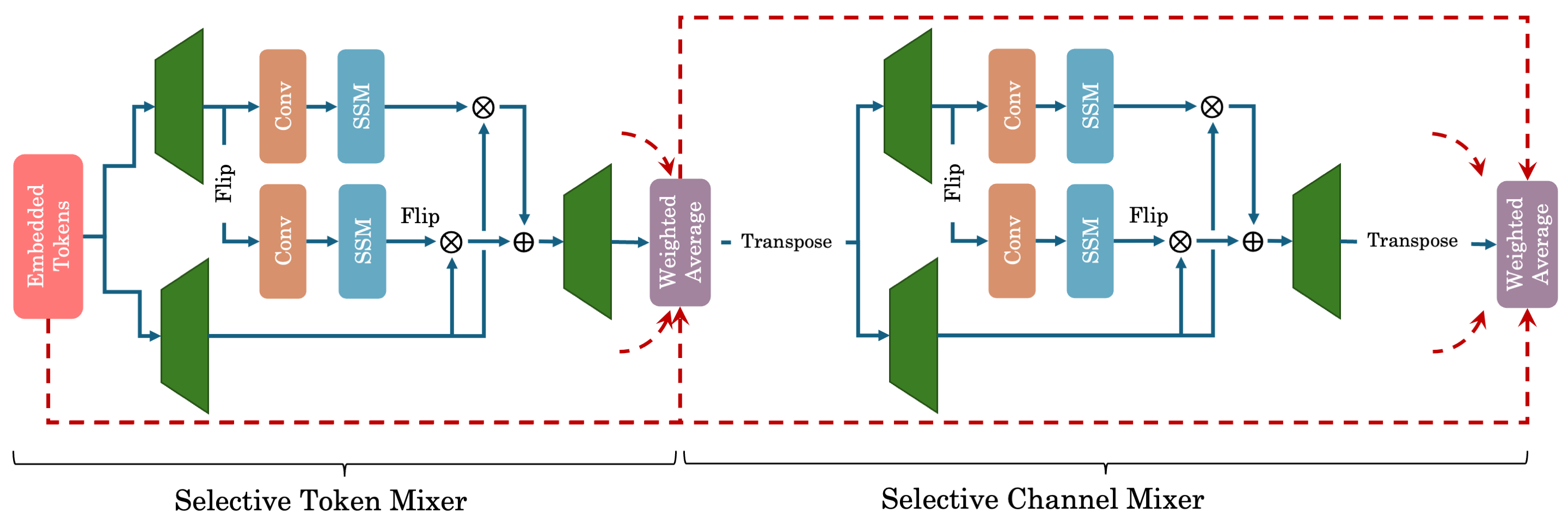
- Introduce Selective Token Mixer and Selective Channel Mixer modules based on data-dependent S6 blocks.
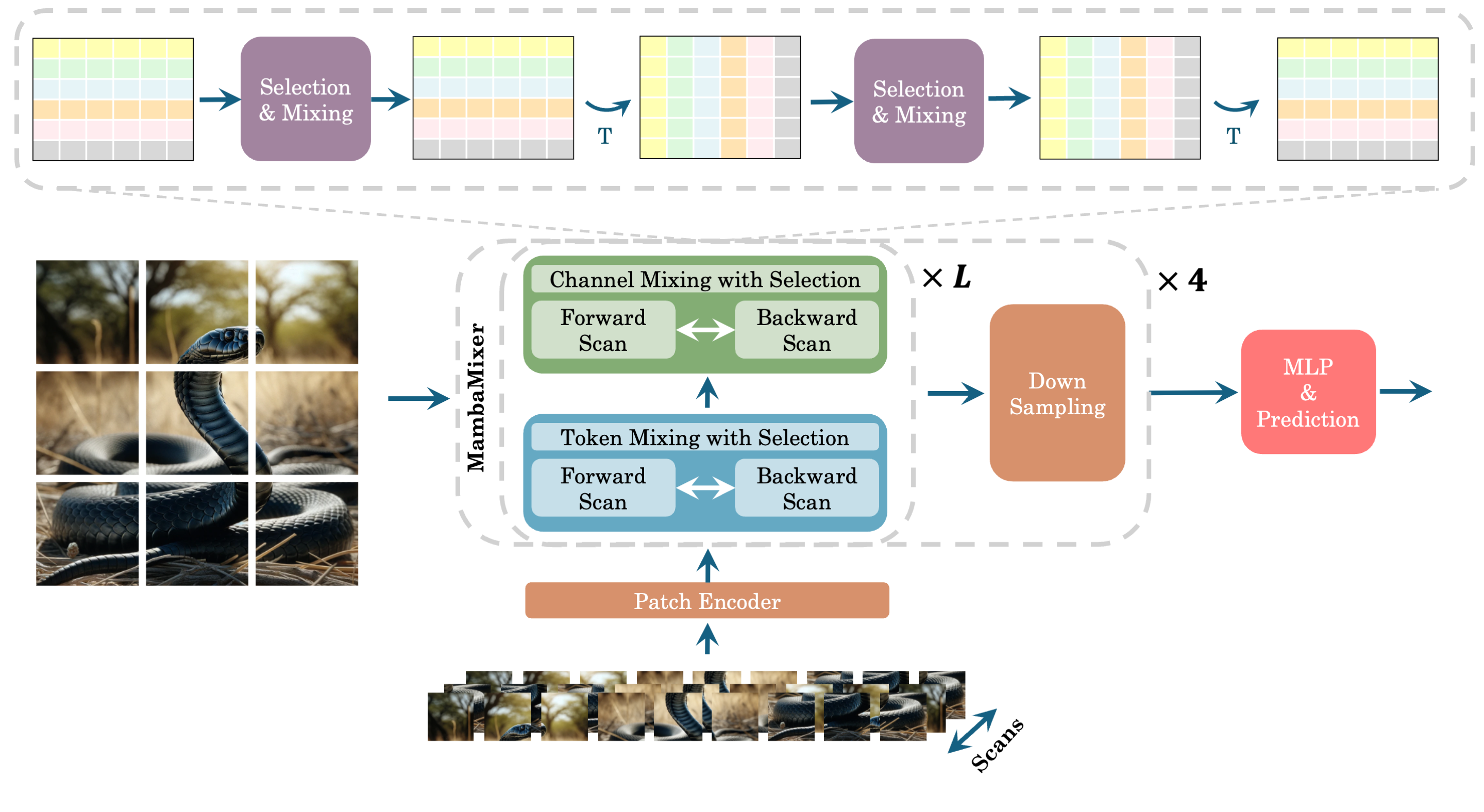
- Extend to multi-dimensional data with bidirectional channel mixing and multi-scan schemes for vision tasks.
- Incorporate a weighted averaging mechanism to connect earlier features across layers (DenseNet/DenseFormer style).
- Apply cross-scan in ViM2 with depth-wise convolutions and patch-based 2D processing for images.
- Apply a unidirectional Selective Token Mixer and bidirectional Selective Channel Mixer for TSM2 with 2D normalization and auxiliary information handling.
- Provide architectural connections showing ViM2 generalizes MLP-Mixer and VMamba as special cases.
Experimental results
Research questions
- RQ1Does dual (token and channel) selective mixing improve modeling of cross-token and cross-channel dependencies over single-dimension selective SSMs?
- RQ2Can MambaMixer-based ViM2 and TSM2 achieve competitive results with state-of-the-art vision and time-series models while maintaining linear time and space complexity?
- RQ3How do the proposed architectures compare to Transformer-based and existing SSM-based models in terms of accuracy and efficiency on vision tasks (ImageNet, object detection, semantic segmentation) and time-series forecasting?
- RQ4What is the impact of the weighted-averaging connection of earlier features on training stability and performance at scale.
Key findings
- ViM2 achieves competitive performance with ViT, MLP-Mixer, and ConvMixer on ImageNet, and outperforms SSM-based vision models.
- TSM2 delivers outstanding performance on diverse time-series datasets while significantly reducing computational cost when compared to state-of-the-art methods.
- Across both modalities, selective mixing across tokens and channels improves information flow and modeling capacity beyond channel- or token-only approaches.
- The architecture maintains linear-time and linear-space complexity with respect to sequence length and number of channels, addressing scalability concerns of traditional attention.
- The model enables direct access to early features via a weighted averaging mechanism, improving training stability for deep MambaMixer-based networks.
Read this paper
Open the full text in the Nubint reader and ask about any passage as you read.
Read this paper on NubintThis review was generated by AI from the original paper. Please check the paper before citing it.