
[Paper Review] Managing Cold-start in The Serverless Cloud with Temporal Convolutional Networks
This paper proposes a novel ensemble policy using Temporal Convolutional Networks (TCN) to predict function instance arrivals 10–15 minutes in advance, enabling proactive infrastructure and function-level resource provisioning to mitigate cold-start in serverless clouds. TCN outperforms other time series models on a real-world Azure Functions dataset, enabling low-coupling, high-cohesion mitigation across both infrastructure and function layers.
Serverless cloud is an innovative cloud service model that frees customers from most cloud management duties. It also offers the same advantages as other cloud models but at much lower costs. As a result, the serverless cloud has been increasingly employed in high-impact areas such as system security, banking, and health care. A big threat to the serverless cloud's performance is cold-start, which is when the time of provisioning the needed cloud resource to serve customers' requests incurs unacceptable costs to the service providers and/or the customers. This paper proposes a novel low-coupling, high-cohesion ensemble policy that addresses the cold-start problem at infrastructure- and function-levels of the serverless cloud stack, while the state of the art policies have a more narrowed focus. This ensemble policy anchors on the prediction of function instance arrivals, 10 to 15 minutes into the future. It is achievable by using the temporal convolutional network (TCN) deep-learning method. Bench-marking results on a real-world dataset from a large-scale serverless cloud provider show that TCN out-performs other popular machine learning algorithms for time series. Going beyond cold-start management, the proposed policy and publicly available codes can be adopted in solving other cloud problems such as optimizing the provisioning of virtual software-defined network assets.
Motivation & Objective
- To address the cold-start problem in serverless clouds, which incurs unacceptable latency due to delayed resource provisioning.
- To identify and operationalize real-world challenges in cold-start management into data and model requirements.
- To develop a holistic, multi-layer solution that operates at both infrastructure and function levels, overcoming narrow-focus approaches in prior work.
- To enable proactive resource provisioning by forecasting function instance arrivals with high temporal accuracy.
- To provide a publicly available, reusable framework for cold-start mitigation and broader cloud optimization tasks.
Proposed method
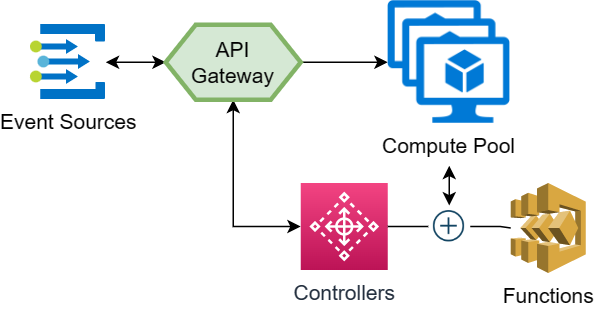
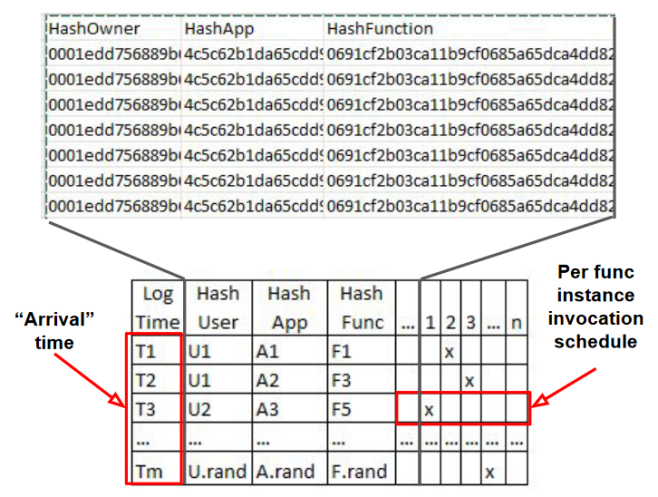
- A two-module deep learning pipeline uses TCN to predict future function instance names and arrival times 10–15 minutes ahead.
- The first module (A) infers infrastructure and worker node demands based on predicted function names and coarse-grain system mappings.
- The second module (B) performs fine-grained code analysis based on predicted arrival times, inferring dependencies and optimizing function execution.
- The ensemble policy combines outputs from both modules, using resource ranking and orchestration schedules to pre-provision optimal worker nodes.
- The system leverages historical data from the Microsoft Azure Functions Trace 2019 dataset to train and validate the TCN model.
- The policy is designed with low coupling and high cohesion, enabling modular integration with existing cloud management systems.
Experimental results
Research questions
- RQ1Can a deep learning model accurately predict function instance arrivals in serverless clouds 10–15 minutes in advance?
- RQ2How does the TCN model compare to other time series forecasting methods in predicting FaaS workload patterns?
- RQ3Can a dual-path ensemble policy effectively mitigate cold-start at both infrastructure and function levels simultaneously?
- RQ4To what extent can proactive provisioning based on predictions reduce cold-start latency in real-world serverless workloads?
- RQ5Can the proposed framework be generalized to other cloud resource optimization problems beyond cold-start?
Key findings
- The TCN model outperforms other popular machine learning algorithms for time series forecasting on the real-world Azure Functions dataset.
- The proposed ensemble policy successfully mitigates cold-start by enabling proactive provisioning of infrastructure and optimized function resources 10–15 minutes in advance.
- The dual-path architecture (A and B) enables coordinated, low-coupling decisions at both infrastructure and function levels, improving system responsiveness.
- The system achieves improved resource utilization and reduced latency by pre-warming critical functions based on predicted arrival times and code dependencies.
- The model’s predictions are robust enough to support practical deployment, with potential for reuse in optimizing virtual software-defined network provisioning.
- The authors release publicly available source code, enabling reproducibility and extension to other cloud optimization problems.
Read this paper
Open the full text in the Nubint reader and ask about any passage as you read.
Read this paper on NubintThis review was generated by AI from the original paper. Please check the paper before citing it.