
[Paper Review] ManyDG: Many-domain Generalization for Healthcare Applications
This paper proposes ManyDG, a novel domain generalization method that treats each patient as a separate domain to address patient-specific covariates in healthcare AI. By using mutual reconstruction and orthogonal projection to disentangle patient-specific features from label-invariant representations, ManyDG achieves state-of-the-art performance, including a 3.7% Jaccard improvement on the MIMIC drug recommendation task, even under low-data and continual learning settings.
The vast amount of health data has been continuously collected for each patient, providing opportunities to support diverse healthcare predictive tasks such as seizure detection and hospitalization prediction. Existing models are mostly trained on other patients data and evaluated on new patients. Many of them might suffer from poor generalizability. One key reason can be overfitting due to the unique information related to patient identities and their data collection environments, referred to as patient covariates in the paper. These patient covariates usually do not contribute to predicting the targets but are often difficult to remove. As a result, they can bias the model training process and impede generalization. In healthcare applications, most existing domain generalization methods assume a small number of domains. In this paper, considering the diversity of patient covariates, we propose a new setting by treating each patient as a separate domain (leading to many domains). We develop a new domain generalization method ManyDG, that can scale to such many-domain problems. Our method identifies the patient domain covariates by mutual reconstruction and removes them via an orthogonal projection step. Extensive experiments show that ManyDG can boost the generalization performance on multiple real-world healthcare tasks (e.g., 3.7% Jaccard improvements on MIMIC drug recommendation) and support realistic but challenging settings such as insufficient data and continuous learning.
Motivation & Objective
- To address poor model generalization in healthcare AI caused by patient-specific covariates such as data collection environments and identities.
- To propose a new many-domain generalization setting where each patient is treated as an individual domain, enabling scalable and realistic generalization.
- To develop a method that explicitly removes patient-specific features while preserving label-invariant representations for improved generalization.
- To evaluate the method under realistic clinical settings, including limited labeled data and continual learning.
Proposed method
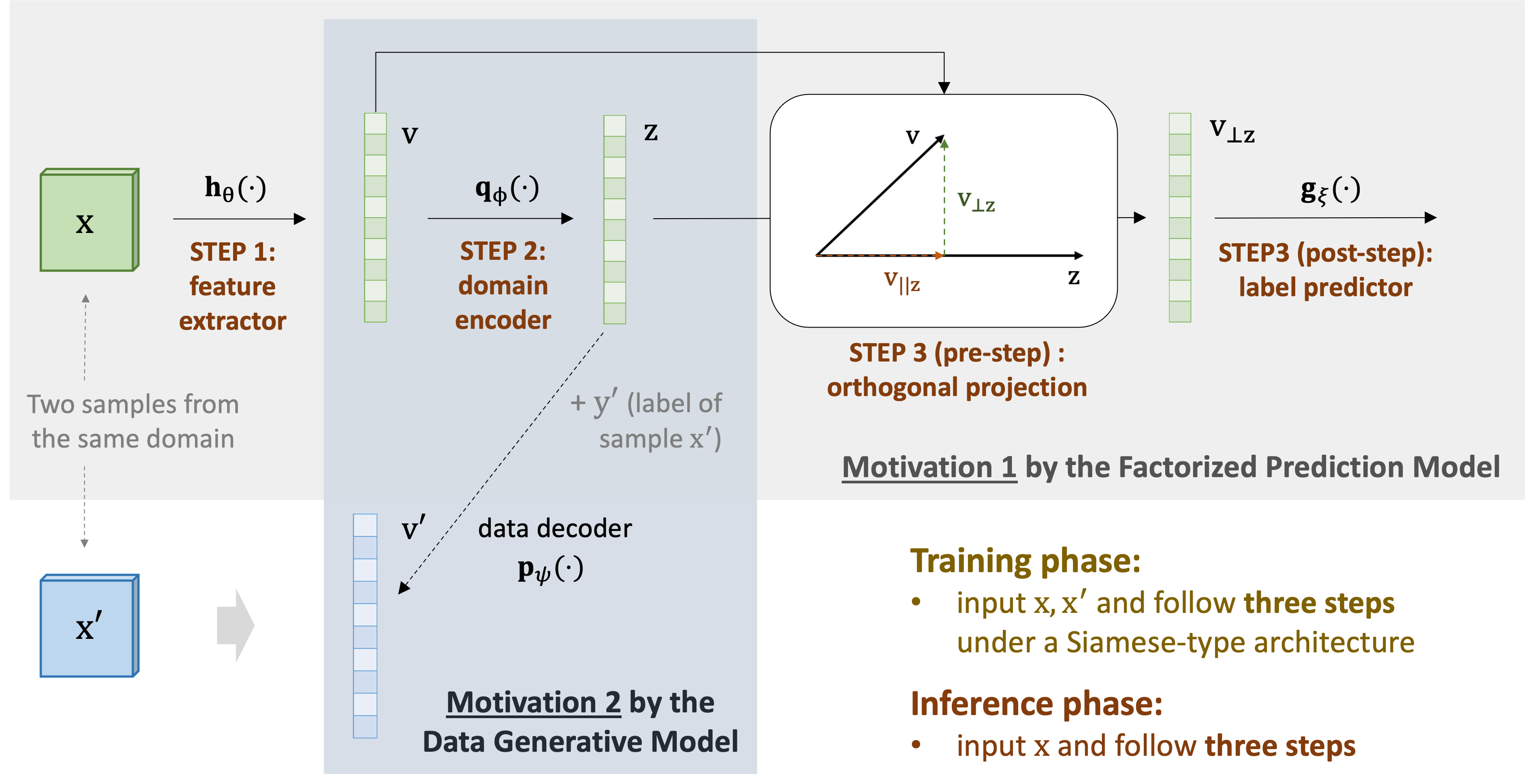
- The method uses a Siamese-type architecture to train on paired samples from the same patient, enabling joint optimization across patient-specific data.
- It employs mutual reconstruction to reconstruct the input feature vector from separate domain (z) and label (u) representations, ensuring consistency across views.
- Orthogonal projection is applied to enforce orthogonality between domain (z) and label (u) representations, promoting disentanglement.
- The model is trained with four loss components: supervised loss on label prediction, reconstruction loss, domain similarity loss (maximizing z similarity within same patient), and orthogonality loss.
- The approach is implemented via a factorized prediction model with separate encoders for domain and label information, enabling end-to-end training.
- The method is evaluated on four real-world healthcare datasets across diverse tasks, including seizure detection, sleep staging, drug recommendation, and readmission prediction.
Experimental results
Research questions
- RQ1Can treating each patient as a separate domain improve model generalization in healthcare applications?
- RQ2How effective is mutual reconstruction and orthogonal projection in disentangling patient-specific covariates from label-invariant representations?
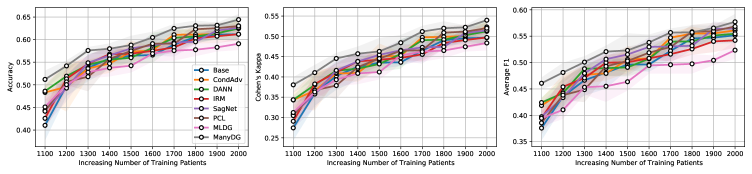
- RQ3Does the proposed method generalize well under low-data and continual learning scenarios common in clinical settings?
- RQ4How does the method compare to existing domain generalization baselines in terms of performance and robustness?
Key findings
- ManyDG achieved a 3.7% improvement in Jaccard score on the MIMIC drug recommendation benchmark compared to the best baseline.
- On the seizure detection task, ManyDG achieved a 0.6754 accuracy (±0.0079), outperforming SimD1 (0.5954) and SimD2 (0.6499).
- In sleep staging, ManyDG reached 0.9055 accuracy (±0.0054), surpassing SimD1 (0.8862) and SimD2 (0.9017).
- On the open EHR drug recommendation task, ManyDG achieved a Jaccard score of 0.5175 (±0.0130), significantly higher than SimD1 (0.4894) and SimD2 (0.4901).
- The method demonstrated consistent improvements across all evaluated tasks, including readmission prediction and sleep staging, under both standard and challenging settings.
- The ablation study showed that SimD2, which uses normalized cosine similarity for reconstruction and domain similarity, outperformed SimD1, which used MSE, due to better-scaled loss objectives.
Read this paper
Open the full text in the Nubint reader and ask about any passage as you read.
Read this paper on NubintThis review was generated by AI from the original paper. Please check the paper before citing it.